The Gift that Keeps on Giving…

“Mum, remember when you thought you might not get to see me grow up? Bet you feel silly now?!”

They say that you shouldn’t wish for your children to grow up, that you should will them to slow down because in the blink of an eye your once tiny baby is all big and independent and doing things you never thought possible.  Well, in a way Peanut that is true.  But as bad as it may sound, there’s a huge part of me wanting you to hurry up! Hurry up and talk, hurry up and walk, hurry up and grow big and strong so that I can be sure to have had the chance to see it all in case it is taken away from me.  I’m scared.  Scared that I won’t get the chance to know you like I should. Scared that Kawasaki Disease has not finished with you just yet.

Today we took you to the hospital for your cardiology follow-up appointment.  You were last seen three months ago, where the cardiologist remarked that the speed of which your coronary arteries have been remodelling is concerning, and they would like to carry out an angiogram to take a closer look.  I knew she was referring to possible stenosis; that the reduction in the internal diameter of your coronaries might not be healthy, and is more likely to be the result of a build up of scar tissue or layered blood clots that have effected  the change.  But I have read that stenosis can take decades to cause any ill effects, and as such I felt it would be prudent to give you more time.  More time to grow, so that less invasive procedures might tell them what they want to know.  Apparently an MRI or CT scan isn’t as effective in giving a true picture in such a young child, and an angiogram is the only option that will show them what is really going on in that little heart of yours.  I asked the opinion of 3 experts, all of whom concurred with my view that there would be no harm in waiting, perhaps even up to a year, and carrying out a less invasive procedure.  I put that question to your cardiologist, but she seemed pretty keen on pushing forward and continued to voice a preference for carrying out an angiogram a year post-diagnosis; June.

I decided to wait until your next appointment to understand more fully why the consultant was so eager to press on.  That appointment was today.

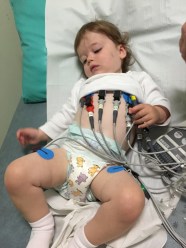
We arrived at the hospital just in time for your appointment, and were sent straight down the corridor for an ECG.  It took the cardiographer 20 minutes to get a reading from your heart because you were wriggling so much! We had to bribe you with ‘sweets’ (little fruit things that we call sweets because they’re as close as we will let you get to confectionary at your young age!) to get you to sit still for long enough! You’re not as easy a patient as you were last year, this time pulling off the electrodes and yanking on the wires, but he got there in the end!  Nothing was said about the result, and I am guessing that means that, as usual, the ECG showed normal heart function.  Next it was time to weigh and measure you (you weigh 8.46kg and are 74cm in height), and then you were called into the examination room.
IMG_5726.jpg

It wasn’t your cardiologist that called us in; it was a registrar.  She introduced herself and asked if we had any concerns since the last appointment.  We had none.  She then asked us to take you over to the bed so she could perform an echocardiogram, and I asked if we were going to see your doctor today.  She said that we would, and that she was just with another patient.  I guess they were helping each other out so they might all finish the day at a reasonable time.

Surprisingly, you laid quite still for the echo.  Okay, so you had to be given a probe of your own because you do like to take matters into your own hands, but she got there (with the help of a bottle of milk!).  She didn’t say much, but as usual I clocked the numbers appearing on the bottom of the screen and was able to catch that your LCA (left coronary artery – the one that has caused the biggest worry on this journey so far) measured 2.8mm.  Was that bigger than the last time? I seem to remember it being closer to 2mm, but what’s a fraction of a mm between friends, eh?  Your consultant then entered the room, and continued the appointment with the registrar present.

She looked at the screen, and remarked that your RCA (right coronary artery) looked almost normal.  She seemed happy with function and blood flow.  It seemed that she was about to suggest a routine follow-up appointment and gave the impression that it would be a longer period next time, but the registrar mentioned that an angiogram was mentioned at the last appointment. Ah yes, remarked the consultant. I reminded her that she was considering the procedure because she was concerned about the extensive remodelling that your arteries have undergone in such a short space of time.  Ah yes, she remarked, and commented that at worst, the diameter had measured 8mm.  I corrected her.  Unless I missed something along the way, the largest measurement was 5.2mm.  Whilst small in comparison to some children affected by this disease, they were more than 5 times normal size and in a baby as young as you were was considered significant and cause for serious concern.

I told the consultant that I had a few questions, and pulled out my notebook (I know! I do like to make notes!)  The first question I asked was why she felt it so important to carry out a risky, invasive procedure now? What benefit could it have? What was her thought process, and what were her concerns?  I had thought that she might concede with a “perhaps we ought to wait” kind of statement.  But instead she told me that she thinks it is highly likely that the remodelling has come about as a result of stenosis – anything other than that would be nothing short of a miracle.  I asked if there wasn’t a chance that the remodelling has come about as a result of the aggressive treatment you received to stop the disease in it’s tracks (you received steroids and a dose of Infliximab when two doses of IVIG proved ineffective).  She agreed that was possible, but didn’t seem convinced.  An MRI/CT would be effective in providing a better picture of aneurysms, but in a child as young as you they would not be as effective in showing stenosis.  I asked what would be gained by doing it now? Stenosis can take decades to develop before the arteries might close enough to prevent blood flow.  And if the angiogram did show evidence of stenosis, how would that change the treatment plan? And then she used words that I had not considered would be used in your lifetime. Stent.  Bypass surgery.

I guess I knew what her concerns were before I asked them.  I mean, she isn’t likely to put you through an unnecessary procedure, is she! I told her that I would prefer to wait, but that if she felt that waiting would put you at risk I would trust her judgement.  She said that she would really like to get a look, and it dawned on me that you are quite the case of interest.  One of the youngest cases to be handled, aggressively treated, showing almost too-good-to-be-true recovery.  Yes, of course they would like to get a look.  I said I appreciated the medical interest in understanding what has been happening with your heart, but that you are not a specimen, you are my baby.  She reluctantly agreed to see you again in three months, and noted that whilst there was a great deal to be learned from you, that she would not consider the procedure for medical knowledge alone.   She agreed to discuss your case with at the next MDT meeting (multi-disciplinary team) with a view to negotiating with me further then.  She has already discussed your case with the surgeon, and they too believe it would be prudent to do an angiogram sooner rather than later.  That said, she still agreed to give us another 3 months (which will end up being more if the waiting list is as long as I expect), on the strict proviso that if we see any evidence of angina we are to contact her.

Let me take a moment to tell you about the symptoms of angina;

  • Chest pain or discomfort (not sure how you will tell me about that!)
  • Pain in your arms, neck, shoulder or back accompanying chest pain (ditto!)
  • Nausea (won’t generally know that one until you actually throw up!)
  • Fatigue (hmm, should I be concerned that you sleep through the night?)
  • Shortness of breath (you don’t get above a fast crawl yet, and I’ve not seen you panting!)
  • Sweating (nope)
  • Dizziness (again, how would I know?)

So apparently the only way I might be able to tell if you are suffering with angina would be if you are playing one minute, and then go quiet, and maybe glaze over for a moment.  This could be interesting :/

It would seem we are not yet out of the woods, my darling.  Just when I thought that there could be a future where KD becomes nothing but a distant memory, here it is threatening to place a dark cloud over the years to come.  The only thing I can hold onto is hope, but that is so hard when I feel like I am fighting a losing battle with this disease.  I have no control over it, none.  It came, it messed you up real bad, and it just won’t leave us alone.  I know there is a chance that they could do the angiogram and discover that you are indeed the miracle I had started to believe in.  But I also fear the worst.  And I know that there are far more complicated procedures happening to very sick babies, with huge success, every single minute of every single day.  But they are not happening to my baby.  And I so want to bury my head in the sand like an ostrich and pretend that this isn’t our life, that this isn’t your life.  Today for the very first time I saw ahead of me just how complicated your life might be, and it has made me incredibly sad.

And because with this disease the hits just seem to keep on coming, I returned home to a voicemail from your GP.  We were given the green light to crack on with catching you up on the routine immunisations, and also later given the go ahead to give you the MMR vaccine.  It was unclear, however, what timing/order the Immunologist felt these should be given in.  You’ve had the 8 and 12 week immunisations now, and I was hoping that we might be able to intersperse them with the MMR, Chicken Pox and Flu vaccines rather than wait any longer than necessary.  This family needs a holiday far, far away from here.

Sadly, the advice was more disappointing than I had anticipated.  The instruction has been to wait until after the final routine vaccinations have been given (around June).  Because you are a unique case, they are not comfortable in progressing to the remaining vaccines until 3 months after that.  So at best, you will get the MMR in September.  No mention has been made of the Chicken Pox or Flu vaccines, but I can only guess they will want to wait longer for those too.  I just wanted us to do some normal stuff, Freya.  Mix with other kids, in places where normal kids go.  Jump on a plane to somewhere warm where we can forget all about this for a time.  I am sick of being restricted by my fear, but I cannot knowingly expose you to illnesses that have the ability to take more from you than KD already has.  I’m talking about Reye’s.  And yes, I know it’s rare, and it hasn’t yet been linked to low doses of aspirin, but it’s a risk I cannot bring myself to take.  What were the odds of you getting KD at 7 weeks old?? Exactly.

I’m sorry, my tone is getting quite unpleasant isn’t it? And I am sorry for burdening you with this worry.  Almost a year ago I asked a God I don’t believe in to prove the doctors wrong.  If he’s listening, this is his chance to show me what he can do.  I can only hope that if you are reading this, it means that you have already proven yourself to be the miracle that we all hope you will be.  I don’t want to live in a world without you in it.
IMG_5728

A Family Affair

Yesterday it was the annual UK National Kawasaki Syndrome Support Group (KSSG) Family Day; an event put on by the founders of the Group to provide the opportunity for families to come together to share the one thing that we all have in common; our lives have been touched (more like whacked) by Kawasaki Disease.

Freya and I, and my eldest daughter Eliza, travelled down to Coventry to attend the event; our first since Freya’s diagnosis.  When the last event took place, Freya was just 22 days old and we were blissfully unaware of what would unfold a few weeks after that.  At that point, we hadn’t even heard of the disease with the bizarre name that, whilst considered rare, is the leading cause of acquired heart disease in children in the developed world.  And why would I have needed to know about it anyway? That kind of stuff didn’t happen to us; it happened to other people.  It happened to the people that were at that family day whilst I sat at home gazing into the eyes of my beautiful, healthy, newborn baby.  Wasn’t I lucky…

Who knew that one day, a little over a year after Freya was born, I would be attending an event with families affected by this little known disease.

Freya was diagnosed on Friday 12th June 2015.  She was 63 days old.  On a Friday 9 weeks prior, Freya was born in our local hospital.  At 7 weeks, she developed symptoms of meningitis and went into septic shock.  13 days later an echocardiogram would secure a diagnosis of atypical Kawasaki Disease, after 2-weeks of drugs, tests and invasive procedures failed to provide any answers.  Once we got the diagnosis for Freya – after the initial “Oh thank God it’s that! Never heard of that so it can’t be that bad!” – we took to the internet, and the mystery of Kawasaki Disease began to unravel, along with an understanding of the severity of the disease and it’s impact on the affected child.  Even when they told us that Freya’s coronary arteries (the ones that supply blood to and from the heart) were severely dilated, I still didn’t appreciate the long term effect that this would have.  I thought it was a side effect of the disease, that they would give her medicine, and that it would all go back to normal in a few days once the meds had their chance to work…

Luckily, this is true for the majority of children.  Approximately 75% of children diagnosed with Kawasaki Disease will manage to escape any coronary involvement (although evidence is suggesting that these children do not escape all potential lasting effects from this disease).  With fast treatment, the risk of prolonged damage to the heart is reduced from 25% of cases to around 6%.  Freya received the treatment, but the damage to her heart continued to worsen.  A second dose of the treatment didn’t stop the inflammation caused by the disease either, and so she was prescribed an infusion of a product called Infliximab made from the antibodies of mice that seemed to do the trick.  Combined with the other treatment – the previously administered IVIG doses, high dose aspirin and intravenous steroids – the disease appeared to be stopped in its tracks, and it was time to focus on maintaining her condition.  The rest has been documented in my blog posts along the way, and to cut a long story short, suffice it to say that Freya’s coronaries have started to remodel to within normal range.  She continues to take aspirin daily for it’s anti-platelet effects, and she will undergo a procedure later (possibly June this year) to ascertain the cause of the remodelling (healthy or otherwise).  But back to the main point of this blog post today…

The Family Day

I don’t know how many families attended, but the room was buzzing with the chatter of the families who did attend from the moment I arrived.  I was greeted by one of the founders of the Group, Sue, who came and gave me a big hug and couldn’t wait to get a cuddle from Freya – they had met some months before and I joked that Sue was like a ‘baby whisperer’ as I hadn’t seen Freya quite so happy to have a cuddle before!

I took my eldest daughter too (my middle child, Finlay, decided that his friend’s laser birthday party was too good an opportunity to miss so he stated at home!)  Looking around the room, I saw faces that were familiar from the profile pictures that you see popping up in the Support Group Facebook pages from time to time.  I’m not going to name individuals because I don’t have their permission to do so, but it was lovely to chat to people who I’ve communicated with on different KSSG Facebook threads, as well as meet new people too.  Some of the families had been to previous family days, for others it was there first time like me.  Talking to the parents around the room, you got a real sense that this is something that sticks with you for a long time.  Diagnosis dates ranged from months ago to years ago.  I spoke to one gentleman who had to face this disease with his child 15 years ago.  That’s before the internet had become as useful and saturated with information as it is now (and that’s saying something, because even now there is a dearth of useful information about the disease).  We all shared our stories, all different but with some similarities.  It felt good not to know that we are not alone.

As well as the informal chatter amongst parents, and the new friendships being formed amongst the children, some useful information was shared in relation to genetic research, and some developments about future projects to change the face of Kawasaki Disease in our country (also not for me to share here, but I am sure things will begin to unfold soon).  The day seemed to whizz by in a flash.

The people who have been supported by the KSSG will have joined the Group at varying stages of their journey with Kawasaki Disease.  Some have been members for years, others recently joined, like me.  And everyone’s circumstances are different; some will have needed a lot of support from the Group, for others just the knowledge that there is someone there if they need them is enough.  Those that have been dealing with KD for a number of years will have seen the group evolve over the last 20 years, will perhaps have seen new developments in the world of KD.  For people like me, joining less than a year ago, much of those developments will already have happened before our time, and so we only know what we know now.  And I’m sure there is so much more available to us now than there has been in previous years, but I think one thing that all of us in the Kawasaki family agree on is that there is still so much more that needs to be done to put Kawasaki Disease on the radar of medical professionals and ordinary people like you and me.  There is most definitely an appetite for change, and there are plenty of people who are willing to support that change too.  I imagine most, if not all of us, left yesterday feeling pretty optimistic about the future of the disease.

One thing that was noted was that looking around the room, you could not tell who was a sufferer and who wasn’t.  Eliza (my eldest) spent a lot of the day chatting with a couple of lads around her age.  I believe both boys have suffered with Kawasaki Disease and deal with the after effects of that illness today, but Eliza didn’t know it.  They didn’t talk about it; they talked about ‘normal’ stuff – music and school and what they like to get up to in their spare time.  Children with multiple giant coronary aneurysms ran around that Rugby Club alongside children that had never had a day’s illness in their lives.  These kids are remarkable.  They face regular medical check-ups, uncertainty about what lies ahead, some have had to stop doing things that they loved to do before all of this happened to them.  And yet you wouldn’t know it to look at them; they’re made of strong stuff.

And Freya? Well, she crawled around happy as a pig in muck all day! And she was clearly inspired by the other children, as today she decided that she would take her first unaided steps and prove that she too was made of the same strong stuff as those other kids who share something in common with our little girl.  Not Kawasaki Disease.  That’s a given.  They share the fact that they are extraordinary, in more ways than one.

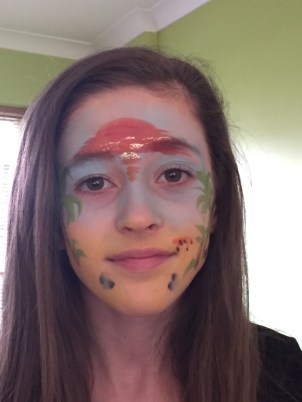
Thank you to the KSSG for putting on the event, and to those that helped them to pull it all together.  I didn’t take many pictures during the day as I was too busy talking (there’s a shock, lol!), so here is one of my daughter Eliza with the face paint that she did not want to take off!

IMG_5240

Memories of another you

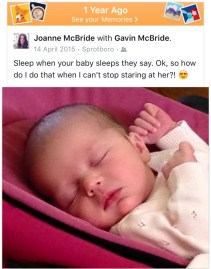
The other day I awoke to a Facebook memory; a picture of you from the same day a year ago.  You were 4 days old, we were home, and you were in your bouncy chair staring at me.  At first I smiled at the memory; that little face full of wonder at a new world that you could barely see through eyes so new.  But then, like a lengthening shadow, sadness crept in.

IMG_5059.JPG

Those days we had with you were so few before Kawasaki Disease pushed its way into our lives and stole you from us.  The you we knew. The you I gave birth to.  The you that wasn’t broken.  I don’t think I will ever learn how to come to terms with what this disease did to you. You were born healthy, and perfect and pure.  For 7 weeks we got to know each other at home, barely going out, because I wanted to be sure I gave myself the chance to drink you in.  We cuddled on the sofa for hours, and I fed you from my breast because I wanted you to have the best start in this world.  I know now how important those moments were, and I am thankful that I cherished you and didn’t feel any pressure to share you with the outside.  It’s like I knew.

But I didn’t know.  I had no idea that things would change for you, for us, overnight.  You were so perfect, so well.  We had no concerns at all about your development or your health.  You were nothing short of perfection, and I was smitten from the moment I looked down at you from my position on that labour bed.

I guess these memories are going to act as triggers for a while.  Seven weeks of memories of the you we had will be replaced by memories of the worst days of my life.  At least I came away from Facebook for a while just before you became sick; that I can be thankful for.  But then, I don’t need Facebook memories to remind me of those days; those days are forever etched on my mind.  I can’t accept the cruelty of it all.  To have struggled so much with the concept of finding myself pregnant again but come through it having battled some old demons and actually looking forward to this new adventure, only to see it come crashing down around my feet was cruel indeed.  We didn’t deserve this.  You didn’t.

I try to tell myself that I should be thankful you are here with us.  Things could have been very different.  In that first week in the hospital I was convinced I would be going home without you, you were so sick.  And when they told us that your little heart was damaged I prepared myself for the worst.  The psychologist told me that what I was experiencing was anticipatory grief; I had been presented with the possibility that you might be taken from us, and my mind had already begun to process that notion.  I could see a certain photograph of you on an easel at the top of a church aisle; that photograph haunts me still, and was the catalyst for my thoughts and feelings on those eyes of yours.  I told myself that if I accepted that this disease would kill you, that I might not take you for granted for the time that you are here.  I guess, even though it’s a little morbid, it’s not a bad way of thinking about it.  I mean, if the worst is that you have a life full of wonder until you are 90 then we won’t have lost anything will we? It’s a good rule to live by, and there are hundreds of cliches I could quote about living life to the full that would fit right in here. We were lucky that your heart began to show signs of improvement, and that we haven’t had to live with that feeling forever – others do.

Using the word ‘lucky’ to describe you makes me flinch, and the bully in my head says “Watch it! You’re not out of the woods yet! Don’t be counting those chickens already…!”

I hate Kawasaki Disease.  I hate it for stealing my memories and turning them into reasons to be sad and full of regret.  I hate that I can’t look at a picture of my tiny baby without feeling sorrow for the short time we had before our lives became filled with fear and drama.  I hate  that I can’t hold another baby without feeling like I’ve missed out on so much.  I held you for seven weeks, and it would be weeks before I could properly hold you again.  I could have held you, but your temperature soared relentlessly for a fortnight and I was scared that I would make you even hotter than you already were.  And I hated the tubes and the wires and the needles; the slightest movement would set the monitors off screaming and the nurses running.  I hated the look in your eyes; you were too young to be afraid.  I wish I knew how you felt when you were lying there in that cot with a vacant stare.

I hate it for making me look at the world through different eyes.  I am wary of the world now.  I know first hand that it has the power to take away everything that you love and I  approach every day with caution, even when I try to find joy.  Sometimes I think I have seen something out of the corner of my eye.  It’s like I see Death waiting in the shadows.  Kawasaki Disease sucks.

75% of children who have this disease will walk away without any heart complications.  They are the lucky ones, but that doesn’t take away the terror of the experience for the child or the parent.  But why did you have to be one of the 25%? Why couldn’t it have just left your tiny heart alone? Could it have been prevented? The doctors ruled out their suspicion that it could be KD on day 9, and yet it was lurking and continued to do it’s damage whilst their backs were turned.  4 days later it became clear that it had been Kawasaki Disease all along. I wonder how the doctors felt when the echo showed them that awful truth…

None of that matters now, I guess.  It’s done isn’t it, and there is nothing we can do to change it.  I have to learn to accept that we live in a world where uncertainty is the only thing that is certain.  Death and taxes.  This world is full of beauty, but it is also home to a lot of hurt.  And as if there wasn’t already enough sadness to deal with in this life, there are people who see fit to cause others pain.  Why do people do that? It is beyond me.

Anyway, enough of this morose talk.  What ever will you think of your mother when you read this stuff?!  It’s hard though Peanut, it really is.  The emotions I have to deal with every time I look at you are a bit too big for me sometimes; sadness, regret, guilt, anger, fear…love.  I just need to get myself back on track with our plans to turn this whole sorry mess into something positive.  You’ve raised a lot of money – £7,000 in just one month of fundraising for one event!  And you’ve even appeared on ITV News (http://www.itv.com/news/calendar/2016-04-13/mothers-plea-for-early-diagnosis-of-rare-kawasaki-disease/).  We will do what we can together to raise awareness of the disease, so that the next time a child presents the symptoms, their parent might just ask the question, “You don’t think it could be Kawasaki Disease do you?”


What a Difference a Day Makes

We did it Freya! We did what we set out to do, and marked your very first milestone with an event to remember.  I hope when you read this, you will forgive me and Daddy for sacrificing your 1st Birthday for Kawasaki Disease Research, and we hope that you will look  back and feel proud of the legacy that we created in your name.  Your first birthday was important to us in more ways than you could ever imagine.  It has been exactly 10 months today since you received a diagnosis of Kawasaki Disease when an echocardiogram (heart scan) showed us the damage to your heart.  Back then I was so afraid for you that I couldn’t see a future that spanned days, let alone months.  Celebrating your 1st birthday never occurred to me – I was focussing on what was happening right there and then and it didn’t look good sweetheart, it really didn’t.  I don’t think I gave up on you, but I did start to allow myself to believe that we might lose you to this disease because of the damage that it did to your heart.

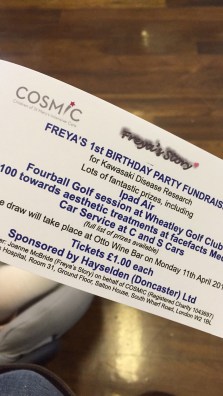
On the 25th January 2016 I sent out an invite to an event on Facebook; Freya’s 1st Birthday Fundraiser for Kawasaki Disease Research.  It would be a birthday party with a twist. First of all, you have very few friends (to protect you from some nasty childhood bugs until you have been immunised against them, we’ve lived in quite a closed circle for the last year).  Instead I had to find you some friends, and so I invited all of my Facebook friends that have children, and a few without.  I intended to have a number of stalls at the party that would provide an opportunity for us to raise some funds for research into the disease, but also needed to make sure that it was a great party for you, and that everyone would enjoy it.  And we wanted to do a raffle too, so I set about contacting local (and not so local) businesses to ask if they would donate a raffle prize to support us.  Some didn’t reply, a few were unable to help, but lots of people were happy to provide some brilliant things for your raffle, and we ended up with a list of 82 amazing prizes with an iPad Air donated by Daddy’s work as the top prize!  I was overwhelmed by the support for the cause, and interest in the raffle was soon peaked.

IMG_4254.JPG

We hit a small stumbling block when a friend informed us that we had to obtain a license in order to sell raffle tickets before the event, but I leapt into action right away and made the application to the Local Authority who (with a little help from the Mayoress’ office) turned the application around quickly and our license was granted.  It delayed the process by about 4 weeks, but the license was received on my birthday, 26th February.  We then had to have special tickets printed, and we were very lucky that Hayselden Volkswagen, Doncaster, stepped up to offer the printing as their donation to our cause.  We received the raffle tickets in the middle of March – we had one month to sell as many as we could, and we needed to sell enough to do justice to the value of the prizes we had received.

IMG_4398

We needed to make sure the party was something for everyone to enjoy, so we engaged a local children’s entertainment business, Bumblezzz, to do balloon modelling, face painting, a magic show and party dances.  The husband and wife entertainers sadly lost a daughter to cancer, so it felt like they were the right people to use for your party; people who could empathise with our situation.

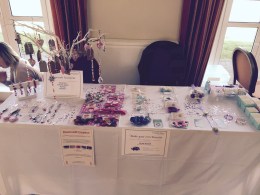
Your nanny offered to run a jewellery stall where children could make a bracelet to take home as a keepsake from your special day.  She also made some things to represent Kawasaki Disease awareness, including little crystal ‘Kawa-angels’ and sun-catchers in orange and red.  Her stall was a huge success and she raised over £120 on the day.

IMG_4970.jpg

People from the local area, and other people that we know, donated lots of things for a tombola.  We even had bottles of champagne, so it was a very posh one! We had so many things that we did one for the children, and one for the adults.  Both tables were absolutely full of things, and almost everything had gone in the first hour of the party!  Your cousins, Tegan and Amber and their friends took charge of the adult tombola, and our friend Louise and her daughter Izzy manned the kiddies one.  In total the tombola tables made over £250, which is amazing!

Some of our friends made cakes to sell at your party.  Jo and Lisa (and their family) made some beautiful cakes and scones.  The stars of the show were Linda and Tracey who made absolutely loads of beautiful things, and made the cake stall look fit for a princess!  They made over £165 selling the things that they donated, and I even got to try a scone with some jam and cream.

The local nursery donated a bear, but he didn’t have a name so the children needed to try and guess it.  He was eventually named “Harley” and raised nearly £40 towards our total.  Our friends Alison and Jo manned the stalls with a little help (well a lot actually) from Jake, who added another £20 to the total with the Guess the Sweets in the Jar competition.  Bonbon Delights donated their Sweet Cart laden with sweets which they sold, making over £20 to add to the total raised at your event too.

Your Granny, Auntie Catherine and Vicky did a sterling job in the kitchen making tea and coffee and soft drinks for everyone, and your Auntie Hayley sold over £230 worth of raffle tickets.  We even had an impromptu visit from an Air Ambulance medic who taught the children to perform CPR using his dummies; that was fantastic!

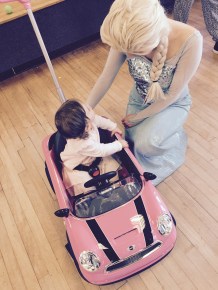
I’m not sure how many people came to your party, but it was very busy!  Nearly 100 people accepted the invite on Facebook, and they brought family and friends and their children too.  Your Granny and Auntie Nicola bought you a car for your present, which you loved zooming around in, and you even got to meet Queen Elsa (Millie’s Magical Parties) who came along for free to support the event.

IMG_4998.jpg

We had an awareness table where I shared a photo story of your journey from the day you were born up to now.  We asked people not to buy you birthday cards, but a lot did anyway and we have a dining room table covered with them!  But we did ask people to write a wish or a message on a paper heart which I will be putting into a scrap book for you with memories of the event.

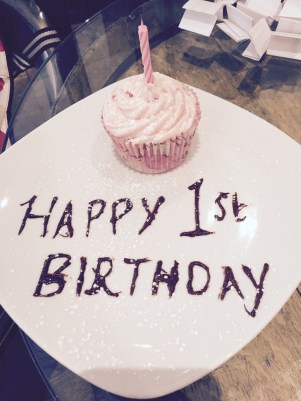
Mummy’s work (Capita) held a bake sale at work where they raised over £185, and the local wine bar, Otto, sold cupcakes on Rare Disease Day, making a massive £120 in one day! They presented us with the cheque on Monday, and you even got a birthday cake from them to mark the occasion.

IMG_5021.jpg

I am overwhelmed by the love and support that we felt on Sunday.  It was one of the most special days I have had with you since you were born, and certainly since everything changed when KD entered our lives.  I cannot think of a better way to turn something so terrible into something good, and the awareness and money we raised at the event will hopefully go a long way to helping the researchers to uncover the mystery of this disease, even if we can’t change anything for you.

All of these things, along with the direct donations made by people who have been touched by your story (not including the huge £75,000 donation received by COSMIC in your honour), add up to a total of over £6500! Because everything we raised is being matched by the Macklin Foundation in America, that is worth £13,000 to the research effort.  And if we can be cheeky enough to add the donation from ‘a cool Italian Dad who lives in Hong Kong, you alone have inspired a total donation worth over £163,000 to research.  I am bursting with pride.  You have achieved more in your little life than most achieve in a lifetime, and I will be eternally in awe of your ability to touch hearts and to give Kawasaki Disease a voice that has been silent long enough.

Together we can move mountains.


I have this noisy baby…

She likes to scream!  And I mean, SCREAM!  A high-pitched, piercing scream that drives right through to your bones.  It makes me wince, and is a source of anxiety for me.  It has me a bit stumped if I’m honest.  Up to now, I’ve been able to communicate verbally and non-verbally with my 11-month old (she knows sign language for ‘milk’, and has made up her own signs for most other things).  When she was a tiny baby, I even worked out the language of her cries, and I could tell the difference between the sound she made when she cried for food to any other cry she made.  But I haven’t quite managed to tune into the scream, perhaps because I am trying too hard to tune out..?

I might be getting close though.  It is somewhere in between frustration and attention-seeking I think.  It happens mostly when she is restricted; car seat, pram, highchair.  Add any of those situations to occasions when she doesn’t have my full, undivided attention, and you can multiply the decibels tenfold.  So, you can imagine how I feel if I’ve driven into town (car seat), walked to a coffee shop (pram) and sat down (highchair) for coffee with a friend (divided attention)!  I am living off my nerves!  That said, I keep telling myself that this is temporary.  She will soon learn to communicate more effectively, and the need to scream will lessen.  And as she starts to settle down in this new and amazing world she has discovered at speed as she commando-crawls across my wooden floors, I will be able to allow her more freedom.  Soon she might be allowed to sit on a normal chair, stand, walk a little, so as not to feel imprisoned by a 3-point harness.  Until then, I have to accept it, and perhaps try and work out how to help her break the habit. That’s the hard part.

Although, saying that, it’s not the hardest part.  Oh no, the hardest part is trying to deal with the noise that my child has decided best fits to articulate her thoughts when surrounded by selfish, insensitive, intolerant human beings who either never had children of their own, had perfect children, or who can’t remember what having small children is like.  Yes, that is the hardest part.

I’d like to address the above described human beings, if I may be so bold.  Perhaps you will need to share this blog post on social media to make sure it reaches the right audience; if you’re reading my blog I am most sure you would not be one of those people.  So here goes…

Dear Intolerant,

I know my daughter’s screaming is loud, and intrusive, and downright irritating.  I feel it too.  Except I feel it in a way that you will never come close to, because she is mine.  I carried her in my body for 9 months, and I went through 3-days of induced labour hell to bring her into this world.  When I beheld that little face staring up at me from the hospital bed (yes, I was on all fours like some kind of wild beast!), I had no idea that she would develop this rather annoying habit.  I could do without it too.  Don’t you think I would prefer to have one of those babies who just sits in their pram without making a sound so that I can engage in good old fashioned chatter with one of my girlfriends over a caramel latte?  Of course I do! Don’t you think that I don’t wish I wasn’t such a prig about dummies (not that my babies have ever been able to take to one when I’ve tried)?    

Do you think I can’t hear it? That every screech doesn’t churn me up so much that inside I too am screaming? Do you know the embarrassment I feel every time that sound leaves her tiny lips, or how I squirm in my seat at the thought that she is spoiling the experience for everyone else?  Well, trust me, I hear it. And I feel it.  And it makes me want to run.  But let me tell you this; seeing the looks on your faces, watching you put your fingers to your ears, seeing your shoulders scrunch up with tension with each shrill squeak, feeling your head snap in our direction and hearing you mutter “Oh for goodness sake!”, or “What a naughty thing!” to your friends not only makes me want to run, but makes me want to run and hide and never come out again.  

When you look at me with irritation, and not compassion.  When you say cruel things about my baby, without understanding.  Those things hurt me to my core.  I can’t expect you to love my little girl like I do, but know how much it hurts to think that others are thinking ill of her because she has learned to vocalise her frustration.  She is an 11-month old baby. She loves to crawl.  She loves to sit surrounded by bright and noisy plastic things that make her smile. She loves the challenge of that piece of furniture that looms like Everest, yet she can conquer it in one pull on those little arms of hers; the pride in her face when she makes it to the summit is something us grown ups have long since forgotten how to show.  She doesn’t particularly like being cooped up in a pram, strapped in because the floor isn’t safe or clean enough for her to roam.  I hear your unuttered thoughts, “Take her to a baby group then, and not our [insert favourite venue]” Oh, how I would love the normalcy of a playgroup right now. Where I could sip a cup of tea with likeminded mums whilst our children play happily in the soft play area.  Except I can’t.  I can’t because my child takes a drug that puts her at risk of serious illness (perhaps even death) if she comes into contact with certain childhood illnesses, so until her immune system is able to accept the relevant vaccines, a play area is the last place you will find us.  

“So, stay at home then, if that’s where she is happy.” Yes! Yes! That’s the answer. You’re quite right of course – she is happiest when at home with her toys and her freedom.  But what about me?  What about my needs?  Most days I do exactly that; stay home and entertain my little girl, or stay close by while she entertains herself.  It’s lonely.  Days go by when the only adult interaction I have had has been via Facebook.  So when that invite for a coffee comes in, with the opportunity to get out in the fresh air and meet another human being and talk, of course I am going to take it.  It is th antidote to my depression.

“Plan your time better! Go out when she naps!” Oh yes, another brilliant suggestion.  Except that I have this clockwork baby, that since spending 6 weeks laid on her back in a hospital cot has slept from 6pm to 8am without a murmur.  The trade off being that she is awake and switched on for pretty much all of the daytime hours.  Once there was a chance that she wouldn’t be here at all, so I’m happy to take the trade.

You see, this baby who looks like butter wouldn’t melt and screams like a fiend, has been through more in her little life than I have had to contend with in my 41 years.  And she has achieved more than most of us will in a lifetime.  She is an inspiration, and she is my little miracle.  And me?  Well, I suffer with anxiety on account of having been through the trauma of seeing my 7-week old baby get sicker and sicker until eventually a broken heart confirmed she had been struck by a rare disease with a penchant for the coronaries.  I haven’t dealt with that yet; these things take time.  But I am dealing with it, and for all you know that coffee I am drinking is the first I’ve had all day because that morning I went to my PTSD counselling straight after dropping the older kids at school.  

I remember the silence of the first few weeks of my daughter’s illness.  It’s a silence that will haunt me forever.  When I feel irritation at that scream, I feel ashamed for disliking a single bit of my little girl.  Sadly, the anxiety is making it difficult for me to see through the scream to the child, to understand what she needs.  But I cannot hide us away from the world.  She is bright as a button.  She has got things worked out that a child her age shouldn’t be able to figure just yet! So of course she is going to scream when I try to stifle her need to move, explore, discover and learn.  

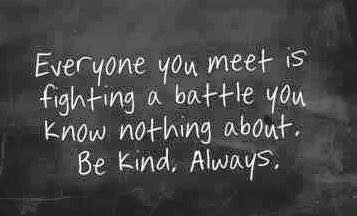
I am not asking you not to feel annoyed; I have no control over that.  I’m just asking that you search deep inside for some compassion.  You have no idea what journey a person has been on.  You have no idea what a person is struggling with right now.  I have no idea what you might be struggling with right now either, which is why I will always look at you with kindness and a smile.  If you knew that I go home and cry after an encounter with someone like you, would you act differently next time…?

1914587_1514766442163082_4861400376192664688_n


Sometimes I talk too much…

Well, I guess if I didn’t there’d be no blog would there! So in some ways my ability to always find something to talk (or write) about, and find plenty of words to say what I want to say is a good thing.  I’ll take that.

But, I have a lot of anxiety about whether I say too much, be that too many words, or just the wrong ones.  When I meet someone, either personally or professionally, I always leave with a sense of embarrassment and shame that I did it again.  I went on too much. Again.  And then I wonder what the person was thinking, both during the engagement and after.  And I wonder whether they will avoid me the next time they see me, lest they attract more of the same.

I’m not sure where the anxiety comes from, or when it began.  I remember some of my family telling me that I was annoying when I was a little kid.  Was that because I talked too much? I’m not sure.  Perhaps I was just generally annoying.  I don’t remember all my school reports, but I do remember one, or at least a bit of one.  “Talks copiously.”  Those were the teacher’s words; words I have never forgotten.  And I’ve been teased about it throughout my career too.  So perhaps the anxiety has grown from years of people making me feel self-conscious about how much I go on, to the point that I am now that aware of myself when I am speaking that the actual act of speaking itself brings on more anxiety. Jeez, I feel anxious just writing about it!

Before a meeting…

I don’t generally feel anxious about going to meet someone.  It could be the first time I’ve met them, a business meeting, a medical appointment, a presentation I have to deliver, anything really, and I approach each with eager anticipation and excitement.  Ok, so maybe there are a few nerves there, but only ‘normal’ ones.  The sort of nerves you might feel (unless of course you are reading this because you too suffer with anxiety, in which case, you’ve probably got a thing or two you could say about it yourself).  Actually, I look forward to meeting people.  I am a sociable person, and I thrive when I am in company.  Perhaps because it is an opportunity for me to talk….

During the meeting…

But whilst I am in the middle of the engagement, no matter who it is with or what the occasion might be, there’s a little part of my brain (perhaps it’s ‘Ant’) that keeps chipping in, “You’re going on a bit”, “You just interrupted them”, “You’ve already said that”, “That was the wrong word, idiot!”  Stuff like that.  So sometimes it’s actually quite exhausting having a conversation with people; because between the real listening, the gap listening, and the speaking, all the time I have this little voice up there telling me to shut up! I remember locking horns with a work colleague (not something that happened often at all, might I add) because they insisted that I never listened to them, always spoke over them and was not interested in anything they had to say.  I think it’s his voice I hear up there, you know.

After the meeting…

Ah, now that depends on what kind of meeting it was or who it was with.  So if it was a business meeting, say, I would agonise afterwards about what the audience thought of my input, my ideas.  If I was chairing the meeting, was I an effective chair? Did I listen to everyone’s views?  Did I encourage everyone to participate? Were they engaged? Were they inspired or just plain bored? What will they say about it when they’ve left the room?  I am a genuine believer that feedback is a gift, and I kind of wish that every meeting could be followed up with some feedback form so I could answer all those questions, quit worrying, and move on!  Don’t get me wrong, it wasn’t like that after every meeting.  I do know where my strengths lie, and am generally quite intuitive about people.  But it happened often, when I allowed self-doubt to creep in.

If it was an appointment, a medical one perhaps, I would leave worrying about what the Doctor thought.  Did they think I was a know-it-all?  Did they think I was stupid? Are they groaning when they see the family name pop up on the screen? Do they think I’m an over-cautious, over-protective, hypochondriac mother? For the record, I don’t think I am.  I know from my time in the hospital with Freya that the Drs gained a lot of respect for me because I showed a deep interest in Freya’s condition and the treatment, medication, etc that went with it.  If they mentioned the immune system one day, I’d have a pretty good grasp on it by the next (thanks Google!).  I still think I annoy the hell out of them with my lists of questions and copies of medical papers that I have gathered during my research! Oh well, keeps them on their toes ;).

And what of a casual meet up for coffee with a friend? Surely that can’t bring any anxiety with it, can it?  That’s a nice meeting.  One without any expectation other than that the coffee and the conversation will flow.  But actually, these kinds of get togethers are the ones that cause me the most anxiety of all.  Perhaps because it’s me I’m putting out there isn’t it? It causes me anxiety because it matters to me that the other person enjoyed my company.  And I want them to ask me again!  I worry if I said too much, if I didn’t say enough in response to their own concerns, did they leave feeling like I didn’t care about what was going on in their world?  Was I boring? Did they leave thinking “All she ever talks about is…”? Did I let them speak? What was it they said about…was I listening? Did they really want to leave an hour ago but were too polite to say?  Will they get home and think of all the other things they could have been doing instead of getting their ear metaphorically chewed off by me?  Sometimes it makes me sad.  And I cry real tears whilst the disapproving voice in my head says, “You did it again, didn’t you McBride..”

Ok, so I’ve probably just committed social suicide! (See how I’m now going to stress about what I’ve just written!) If you were thinking about inviting me for a cuppa, please don’t change your mind through fear of transforming me into a blithering wreck by the end! That isn’t the case most times.  Sometimes it’s extreme worry, and I’ve not quite worked out if there’s any reason or pattern.  I’ll probably always wonder what you think of me, whether I was good enough…

And I think that’s where the answer lies.  The annoying kid, the student who talked too much, the colleague who didn’t listen…throughout my life people have made me ashamed of how much I have to say.  Why does talking too much have such a negative connotation?  When is talking a lot, talking too much? Will I ever learn to embrace this part of my character, in spite of what everyone else wants to make me believe?  Well I am going to try, and to make a start I am going to make a list of all the reasons why my incessant prattle is a good thing…

  1. I might be able to say things others cannot
  2. I am not afraid to say the things others will not
  3. Talking makes conversation easier (or even possible, lol!)
  4. I can talk away my troubles
  5. I can express myself through words – blogging, writing poetry, chatting…
  6. I can make someone feel better
  7. I can make someone laugh
  8. Awareness was never raised with silence
  9. Words inspire people
  10. British Telecom said so (“It’s Good to Talk”)

Alright, so I know I am going to have to do better than that if I want to truly buy into the notion that my copious chatter is a good thing, but it’s a start.  Perhaps one day I might even believe some of it…

IMG_1179
Me, probably post-coffee catch-up, thinking…

75,000 Reasons to be Thankful…

So Peanut, where do I start?  I guess a good place to start would be to thank you.  Thank you for coming into the world, despite all my efforts to ruin that.  I wasn’t sure that you were welcome in my life when I found out that you were coming along.  Some people might say I ought not to share that, but do you know what? I’m not afraid of my honesty, because I know that you will never, ever feel that you were not wanted.  So I wasn’t sure I was going to love you when you were growing inside me, not in those early months.  But towards the end, our bond began to grow, and when you arrived into the world, a tiny, purple, screeching thing, I knew that the past didn’t matter.  What mattered was that you were here, you were alive (yes, I was afraid of that), and that there was no question in my mind that I loved you at that moment, and that I would continue to love you for the rest of my life.

You were so precious, and I held you so tight I was afraid I would crush you.  But I had been on such a journey to get to that point with you that I had to feel you in my arms, really feel you.  Years ago, when your older sister and brother were born, babies seemed to be whisked off, the moment they arrived, for the all important weighing and measuring.  It seems the health service have learned a thing or two about bonding since then.  I remember saying over and over to the midwife, to your Auntie and your Daddy that were all there with me to share the moment when you burst into that delivery room, “Am I hurting her?”, “Am I holding her too tight?”  And they told me to relax, and I held you for the longest time, drinking every bit of you in.  I felt like I had been truly blessed.  Not in the glib clichéd sense, but actually blessed with a gift.  You were a sign.  A sign that proved to me that I was indeed a lucky person, and all the insecurities, fears and negativity I had held onto for so long were allowed to be set free.

In the early weeks, I took heed of all the advice I had been given and ignored with your siblings.  We didn’t go out of the house for weeks.  We spent our days cuddled up in the cosy corner of the sofa and got to know each other.  When you slept, so did I; the housework could wait.  And I didn’t feel any need to rush out to meet people or go places, because I wasn’t ready to share you with the world yet.  You were all mine, and I all yours.  There would be time for all that fun stuff later.  Had I known what would happen 7 weeks later, might I have done things differently?  No, I don’t think I would have.  In fact I am glad I made the choices that I did, because at least I got to have the perfect you all to myself for 7 blissful weeks.  Before…well you already know what happened next.

I am not going to dwell on the following weeks, on your illness, on your diagnosis or the effects that Kawasaki Disease have had on you.  By the time you read this we will have covered all that.  No, this letter is about thanks, so lets get back to the point shall we.

You truly are a remarkable little girl, Freya.  You have endured so much in your little life, and yet you have managed with a grace that shouldn’t even be possible at your age.  You have more courage than I have seen in people more than 20 years your senior.  Your heart, tiny by comparison, has the ability to love with more fervour than any adult I have met in my 41 years on this Earth.  You touched my heart in some magical way the moment you were born, and you have continued to touch the hearts of everyone who has encountered you since.  You have something special within your soul, that shines out like a beacon through those eyes.  Eyes that have both the power to haunt and to heal me.

You have taken everything your short life has thrown at you in your stride, before you are even able to walk a step! Even when you were critically ill and your eyes pleaded with me to help you, your little mouth worked so hard to form a smile.  And later, as you started to get stronger, you smiled for every nurse and every doctor that crossed your path.  And there were a lot!  You even managed to bowl the phlebotomists over when they came to take your blood.  You would cry for a moment, but once they had taken their fill, that smile would spread across your face like a sunbeam and I would see that you had made someone’s day.  Again.

Thank you for inspiring me to write.  Well, it was your Auntie who gave me the journal and the pen, but you were my muse.  I remember opening that book, and wondering where to start, and then I looked over at you in your cot and I knew you were scared and I had to tell you what was going on.  And so the letters began.  I didn’t give it too much thought after that; the letters just came, at the end of every day when you were sleeping.  I would write in the moonlit room, laid on the parent bed by the side of your cot.  Sometimes I would think about how you would learn all about those days, because I knew you wouldn’t remember them.  Often, it was a chance for me to keep a note of the facts as your story unfolded.  Sometimes, on particularly bad days sweetheart, I would wonder if I would ever get to share your story with you, and I wondered if I knew deep down that I could really be writing for myself.  But let’s not dwell on that, eh?

I knew your story was one that I needed to share.  It came from an intense need to make sure that you had not suffered in vain.  To walk away and do nothing would have made me feel like it was unimportant, and it felt too important for me to do that.  In every moment that I wrote through tears in my journal, I felt that there was another parent like me in a hospital room somewhere with their child; sad, scared and alone.  I felt alone.  I scoured the internet,  I contacted Doctors near and far, and I joined social media support groups searching for answers.  The thing is, you can find the basic answers for the typical cases, but your case was an atypical one in many ways.  Any answers I did get were like gold, and whilst I knew that the information I gathered in relation to your case would not be appropriate to generalise, I knew that I couldn’t hold onto them.

And so Freya’s Story began.  I resurrected this blog, and created your tag.  And then I created a Facebook page that would help me to broaden the audience for awareness.  I had a lot of catching up to do – I had written 40,000 words in that journal if I remember correctly! So I began the task of transferring those journal entries onto my blog, whilst updating on your current situation.  There are many other social media pages who are dedicated to raising awareness and keeping people like me informed on latest news and developments in the world of Kawasaki’s.  The various support group pages were great, but sometimes the updates about children who were continuing to experience health issues years after diagnosis would push me into a very dark place.  Sadly, that is the reality of the disease, I know that.  But I wanted to use your page to show people that there is #lifeafterkawasakis.  Of course the disease continues to blight our life.  You have continued complications with your heart that are still unknown.  In a couple of month’s time you will go into hospital for an invasive procedure to try and get some idea of what is going on.  So far, you look like a miracle kid.  But we need to look deeper to be sure.

Freya’s Story is about more than the disease though.  It is about a special little girl, who has the ability to inspire a mum to write; I always knew I had words in me, I was just lacking the inspiration.  It’s about a pair of eyes that have the power to lock with the reader’s through a screen and implore them to read your story.  It’s about flying in the face of adversity, seizing opportunities, loving life and having hope.  It’s a celebration of a little girl who will not allow some nasty bastard illness (sorry for the language but I get a bit angry at KD sometimes) to stand in her way.  You are not the Kawasaki Kid.  You are my marvel, and you surprise me every day.  I hope as you read this, all grown and proud of whatever you have achieved in your life, that you still cannot see the scars that KD left you with.  It is an invisible illness that shows itself for a while, then skulks back off into the shadows where it belongs.

I knew I had done the right thing as soon as the messages started coming in.  Ok, so Freya’s Story hasn’t exactly gone viral – let’s face it, Kawasaki Disease doesn’t have the same amount of clout as Meningitis, say, but it needs putting on the map, and you and I will help to put it there.  And anyway, if even just one parent feels less alone, or one child receives a swift diagnosis or the right treatment after reading our blog, then we achieved what we set out to.  We’ve had parents sending messages of hope, parents asking questions about medication, treatment, immunisations, all kinds of stuff.  I’ve had to be careful with my responses; I don’t have a medical degree (although I do sometimes feel like I have one in KD), so I have mainly signposted parents to useful social media pages, internet links, research papers, support groups and the like.  I have given words of comfort when they’ve been asked of me.  I’ve kept people up to date with how you are doing when they’ve contacted me to ask how you are.   We’ve been credited with helping parents get the treatment that they needed for their child, and helping some people through some lonely times.  I am sure there have been some doctors across the country muttering “Who is this Freya’s mother?!” But I have never claimed to know it all. I only know about you really.  But at least I have been able to provide information that has helped to inform discussion and provide a line of questioning that might previously have been more difficult for a parent to navigate.  Thank you for inspiring me to do that.

You might not thank me for it, but I am sacrificing your 1st Birthday to raise funds for Kawasaki Disease research.  Ever since I made contact with the Professor heading the research after we sent off our swabs for genetic testing, I knew I had to do something.  I had asked the Professor to show me a tangible offering for parents like me to donate to.  Something that would show us how we could contribute to the amazing opportunity that had been granted to Professor Jane Burns in the States.  He cemented the offering in a 2-page document with a link to the COSMIC Kawasaki Disease Research Fund campaign on the Virgin Money Giving site, and I shared it with the Kawasaki community back in November last year.  Once I had a willing recipient, I could concentrate on bringing in some funds – no matter how small our contribution might be, the Professor had assured me it would be worthwhile and gratefully received.  And so the idea of turning your birthday party into a fundraiser was born.  I’ll tell you another time about those details, but for now, I want to thank you for forgiving me for giving up your birthday for Kawasaki Disease.  I have promised that I will not steal any more birthdays from you.

There are so many people to thank for their contribution to your birthday party, and it’s not for another 6 weeks! I will make sure I cover that when I blog about your event.  From local businesses donating prizes to entertainers offering free services, we’ve had a huge amount of support.  The local press have followed your story since we first approached them to help us raise awareness after you came home.  We’ve had cupcakes sold in your honour, and cash donations have started to hit the Virgin Money page.

And then there was this one thing, that started with a Tweet.  

Twitter and I are kind of new friends.  I set up your Twitter account not really knowing what I was going to do with it.  I still don’t really, but I dabble here and there and started to share your blogs when I’d worked out how to!  I mainly use it to hound celebrities in an attempt to increase the reach of your story and shine the spotlight on Kawasaki Disease.  I have had some successes; some of the key KD and Rare Disease organisations follow Freya’s Story.  We’ve had retweets from some celebrity Doctors, like Dr Miriam Stoppard and Dr David Bull.  One of the stars of TOWIE retweeted once, and we’ve had a couple from actresses and directors.  We set out on a bit of a challenge with a Kawadad from the other end of the country, (you know who you are!) but he has had more success than we have, lol!  I have a lot to learn about Twitter it would seem.

But, somewhere, on one sleepless night during their own Kawasaki ordeal, it would seem that the right person stumbled across your story.  They saw that we were raising money for the Kawasaki Research Collaboration between Imperial College London and Rady Children’s Hospital in San Diego.  And that person did a remarkable thing;

“…managed to get…some funding for research. 75 thousand pounds…”

Even though I’ve had that information for a couple of days now, I still struggle to let that sink in.  I think my response was something like “Are you serious? How is that even possible?!” which was met with a reply about the world not being all bad.

I received an e-mail from the charity too, but I still didn’t quite believe it Peanut.  How could we have inspired such a huge donation?   But it is true.  And if the donation can be counted towards the collaboration pot, it will be doubled. Meaning that single investment in research is worth £150,000!!

“…you may want to thank someone who raised awareness about the KD research thru her twitter activity: I found you guys late at night reading the posts from a @freya_story” 

Thank you for giving me a story to tell.  Whilst I would have given anything to have prevented you from going through this, I can take comfort in the fact that because this happened to you, great things might happen.  No amount of raising of awareness or funds will change what happened to our family 8 months ago.  The emotional scars will take a long time, perhaps forever, to heal.  What I hope it will do, what every parent who has experienced this with their child hopes, is that the research being undertaken now will change the future of Kawasaki Disease and the lives that it lays claim to.

I’m going to leave you with these lovely words, received from Ilsen Cafer (Fundraising Co-ordinator for COSMIC – Children of St Mary’s Intensive Care);

…You deserve to be very, very proud.  I can’t imagine how tough a time it must have been for you and your family when Freya was diagnosed, but your special little girl, her story and your courage have helped lots of parents, as well as inspired a donation which will make a difference to the lives of Kawasaki patients around the world.  Never underestimate the impact of your story, you’re doing a fantastic job!” 

“…Please tell Freya in her letter that she is our little COSMIC star and that she should be very proud that aged only 1 she has inspired so much more than most people ever do!”

It seems that I have so many people to thank, and so much to be thankful for, despite this terrible experience that we have all been through at the hands of this disease.  Most of all though, I have to thank you for being you.  You have got us through this.  You.

And then there’s one person whom I would like to be able to thank 75,000 times, and that is one very cool Italian dad who lives in Hong Kong.  Thank you from the bottom of our hearts.

FullSizeRender (1)

The Thing with Rare Diseases…

is that they happen to someone else.  At least that’s what I thought.  What are the odds of my little family being struck by some random illness that nobody has heard of? Well, I’ll tell you. 8:100,000. Those are the odds. 8 in every 100,000 children in the UK are diagnosed with this condition every year. The illness is called Kawasaki Disease. My daughter is Freya.

Today is National Rare Disease Day, so I thought I would focus on that for the subject of my latest blog post. I want to tell you what it means to have a rare disease enter your world.

The thing with a Rare Disease is…

They like playing hard to get.  Some of them are so well-disguised that they masquerade as a number of more common illnesses.  Take Kawasaki Disease.  You take your child to your GP with the symptoms of KD and you’ll most likely be sent home with the word ‘virus’ ringing in your ears. You’ll be told to give four-hourly paracetamol, interspersed with the same regular dose of ibuprofen; antipyretics to keep that troublesome fever down.  Days will pass, but you’ll believe the drugs will eventually do their work once the virus has run its course.  How many days do you let it run its course for? 3 days? Maybe more?  Did you know that there’s a UK medical protocol for dealing witha child  who has presented with a fever for more than 5 days? You’ll tell yourself that the rash that appeared after a couple of days is simply viral.  The eyes look bloodshot; wow this cold really has taken it’s toll on them. And your child is irritable and lethargic all at once, but aren’t all kids when they are poorly? You might even return to the GP, get a course of antibiotics, keep on with those painkillers to take the heat off the discomfort, literally.  Your GP might diagnose Scarlet Fever, or perhaps hand, foot and mouth.  Chances are, your child will not receive a diagnosis of KD until it’s too late. Until the vasculitis that has inflamed every blood vessel in your child’s body has managed to reach their little heart.  Coronary artery dilation and/or coronary artery aneurysms. There’s really only one thing that can cause those in a kid. Kawasaki Disease.

That’s not quite how it happened with us. We were one of the ‘lucky’ ones in that our daughter’s age and the day of the week played a huge part in getting her in the right place at the right time.  At 7 weeks old she was too young for Calpol, and on a Sunday there’s no GP to get it wrong. That said, Kawasaki Disease disguised itself as bacterial meningitis for the first week of Freya’s illness, and then decided to affect her body atypically, making the job of reaching a diagnosis all the more challenging.

It’s quite often a rebel without a cause. Where KD is concerned the cause is yet to be discovered. Without a cause, and with so many children presenting with the illness in a very independent way – not all children get the same symptoms at the same time – there’s no diagnostic test.  The treatment for the disease is effective, but we’re not really sure why.  Knowing the cause of this disease would open the door to swifter diagnosis and better treatment.  With KD it’s a bit of a race against time.  There’s a magical 10-day window within which to treat in order to improve the chances of the heart getting off a bit more lightly. Outside of that, the disease can get too much of a head start. Freya’s heart went from normal to screwed within 5 days.  The disease hid itself well for nearly 2 weeks, until on day 13 (unlucky for some) it went “ta-daa” on an echocardiogram. Nice move KD.

Rare means your doctor probably hasn’t seen it. They may not have even heard of it. So they’re most definitely not looking for it. I’ve spoken with GP’s who have not yet seen a case in their 20 year career. Naturally, doctors will work through the most likely culprits first. They’re not on high alert for some disease that quite frankly sounds ridiculous with its made-up name that conjures images of motorbikes (it’s not actually made up, it is named after Dr Tomasaku Kawasaki, who discovered the disease a few decades ago). But it sounds it. Some rare disorders don’t even have a name. In order to reach a diagnosis for a rare disorder, the medical professionals will have to go through a process of elimination with the more common illnesses that bear the same or similar symptoms. They will test for countless infectious diseases but draw a blank. Do you know, I actually thought they would take my daughter’s blood, put it into a computer and out would come the answer. I had no idea before this, that there were things you couldn’t test for. Silly really. Sometimes the Drs will try certain drugs, only to be baffled by the body’s lack of responsiveness. Our daughter had 4 different IV antibiotics entering her tiny little body, and yet she became more and more sick as the days went on. I couldn’t understand why the Drs weren’t making her better. But our child was diagnosed on day 13 and was treated accordingly. There are people out there with illnesses yet to be named, perhaps even discovered. Those people could wait years for a diagnosis. Two weeks felt like torture. I cannot imagine how that would have felt multiplied into months, let alone years.

If you’ve not heard of it, it can’t be that bad. Right? That’s what I thought. The day before Freya was diagnosed with KD she had a bone marrow aspirate taken in theatre under general anaesthetic. The moment they mentioned bone marrow, I knew they were looking for the ‘C’ word. What they found instead was a whole lot of healthy cells, and she was cleared of that. Relief.  But then the next morning you’re told that they’ve found it! You can’t quite believe it because the last 2 weeks have seemed like an eternity and now the wait is over! They tell you your child has Kawasaki Disease and you actually feel the tension in your shoulders disappear. Aren’t we lucky it’s only Kawasaki Disease. Never heard of that one so it can’t be a bad one. No, the bad stuff everyone has heard of. Leukaemia, meningitis…they’re the baddies aren’t they. No this Kawasaki Disease had to be ok. If it was that bad I’d have heard about it. Wouldn’t I? Except that it is that bad, but you don’t hear about it because your local children’s hospital has probably only seen 4 cases in the last year, and they all looked different.

Rare means there are so many unknowns.  If an illness is rare, it might not have been around for very long.  There might not be many known patients with the disease. Which makes treatment more tricky.  There is no standard UK protocol for the diagnosis and treatment of Kawasaki Disease.  That means you really are at the mercy of the doctors that you are dealing with. Again, I believe we were ‘lucky’.  From the moment a diagnosis was reached they worked tirelessly to aggressively handle this disease. NHS England gave permission for certain drugs to be used on Freya that had not been agreed for use in an infant.  They referred to her case as “a very severe presentation of Kawasaki Disease” remarking that the illness is particularly troublesome in very young babies.

Unknowns are hard to deal with, especially if you’re a bit of a control freak like me. I like to have all my ducks in a row. There’s no chance of that with this. And just as you begin to think things are looking up, KD throws you another curveball.   Long term prognosis is sketchy. But in all fairness, what long term studies have been carried out suggest that Freya might just come through this ok.

Rare is lonely. When you or your child is diagnosed with something pretty obscure you literally feel like the only person in the universe that is going through what you are. Because nobody had heard of KD it felt (still does sometimes) like they didn’t really appreciate the seriousness of it.  Even now, with everything I have shared through Freya’s Story, people ask “So, is she ok now then?”  Never quite quite how to answer that one.  Usually with a “Yes she’s doing really well..” When actually what I want to say is “Yeah, unless you count the fact that’s she now has a heart condition and we don’t know what’s around the corner…”  And it’s not just the general public either. You feel very alone when you’re dealing with Drs that can’t answer your questions because they just don’t know.

That’s where support groups come in. Through the various groups on Facebook I have connected with other parents like me who too have felt scared and lonely. Whilst all of our experiences might have differed slightly, one thing that unites us all is an understanding of the fear when you watch your child begin to slip away from you, and the sheer devastation of hearing that your child has been damaged by this disease. And let’s face it,  the heart is a pretty important organ.

Rare changes you. Since Freya’s illness, I have changed.  I suffer with anxiety, and was recently diagnosed with PTSD. I see a counsellor once every week for cognitive behavioural therapy to help me deal with the trauma of the last year. I find it hard to be around people who don’t understand, or don’t make the effort to. I probably find more comfort in chatting to a fellow ‘Kawamum’ online than I would get from a closest friend.  This experience has left me questioning everything I believed about my role in protecting my child.  I grieve for the healthy baby I gave birth to; the one with the perfect heart. And I am very much aware of our own mortality now. I am scared of dying, and I am scared of loss.

There is an upside. I have met some amazing and lovely people along the way. This experience has taught me that life really is precious and that you should embrace opportunities as they arise. I don’t have the strength for disappointment these days, so I have probably reduced my circle for now, a kind of damage limitation.  I take a lot of joy in meeting people who have been touched by Freya’s Story.   I get messages from strangers that remember when she has a medical appointment, or ask me how I got on at my counselling session. The well wishes and words of encouragement from those people has lifted me from the darkest of moods.

The support from friends and local businesses with prizes for a raffle that we will be drawing on Freya’s 1st birthday has been overwhelming. People are so generous, and I am very grateful to them. I may never come to terms with the fact that this happened to us, to our baby girl. But knowing that Freya has touched the hearts of so many has made this journey a little easier to travel.

So on this Rare Disease Day 2016, I would like to thank everyone out there who is helping to shine a light on Freya by sharing her story and supporting us with our ambition to raise awareness and much needed funding for research. Thank you ☺️

12799260_514903678702345_7766730085390118900_n

You can follow Freya’s Story with updates on her progress and other KD news at http://www.facebook.com/freyasstory

Because life, at best, is bitter-sweet

It has been a little over 8 months since Freya was diagnosed with Kawasaki Disease following her hospital admittance on the 31st May 2015.  She was 7-weeks old.  Infants under 1 year are hit particularly hard by the illness, and are at greater risk of heart involvement.  The magic window for treatment that has the highest odds for reducing the risk of coronary artery dilation and/or aneurysms is considered to be 10 days.  Freya was diagnosed on day 13 when an echocardiogram showed significant dilation to her tiny coronary arteries, and she was transferred by ambulance to a specialist paediatric cardiac high dependency unit (HDU) in another hospital.

Since her diagnosis, Freya has had numerous ECG and echocardiograms performed at follow up appointments. Some of those appointments have shown no change, but two of those appointments showed some remarkable improvement that managed to incite a “Wow!” from her Cardiologist.  In September we were advised that her right coronary artery (RCA) had improved to within normal parameters (around 2mm), leaving just the left coronary artery (LCA) and left anterior descending (LAD) with reduced, but significant, dilation.  The aortic valve had ceased leaking some time before.

I remember at the time asking the cardiologist (who wasn’t our usual one due to a mix up in dates), whether the swift improvement was cause for concern in relation to longer-term issues, such as stenosis (narrowing of the coronary arteries), but he had said that there was no evidence to suggest that was the case.  And so I made my peace (kind of) with the condition of Freya’s heart, and accepted that things were improving and that her prognosis looked good, regardless of how scary it all still was.

Her last appointment in our local hospital was a disaster.  We were kept waiting for nearly 3 hours with no explanation before finally being seen by a consultant who felt under-qualified to deal with Freya’s case.  Nevertheless, she performed an echo, the results of which suggested there had been no change since the previous echo.  No change is good news in these cases – at least things hadn’t got any worse.  Had she told me there was some improvement, however, I would not have believed it, and immediately contacted the original hospital to request that we be moved back under the previous cardiologist.  Sometimes convenience isn’t the best option; I would travel 10 times the distance for Freya to be treated by someone that I trust and respect.

Today found us back in Leeds, back with the Cardiologist that first treated Freya, and has taken pretty good care of her ever since.  She is the same Cardiologist who took me in a room and explained the risks of Freya’s condition back in June; the same Cardiologist who I went to battle with over not giving Freya Warfarin despite the treatment protocols suggesting that was what she should have.  She made a strong case, one strong enough for me to put my trust in her.  It was the hardest decision I have ever had to make, but it appears to have been the right one.  Freya has been thriving since her diagnosis, she appears to show no adverse affects, no night terrors, no evidence of joint pain, none of the things I see mentioned in many social media forums.

So come on then, tell us the news….

Ok, so today Freya had an ECG and an echo.  As usual, the ECG showed that heart function is all good.  During the echo, the Doctor remarked that Freya’s heart function was “Beautiful!”  She measured the arteries at their widest points and remarked that she could see two aneurysms on the RCA.  I was surprised by this, as previously we had been advised that the RCA had normalised, and I wondered aloud whether as the artery had remodeled, could any ‘true’ aneurysms now be more noticeable (Freya’s arteries were significantly dilated all the way along, without the typical balloon shape aneurysm you expect to see when you use the ‘a’ word).  The doctor went in to look again, and could not get the same image, or any image to show the aneurysms she believed she had seen.  Perhaps it was a bad angle?  Maybe Freya wriggled too much for her to get the same view?  I’m not sure, but the Doctor concluded that all three coronary arteries (the RCA, LCA and LAD) appeared to have remodeled to within normal parameters!  Wow! That’s cause for celebration!

During the acute stage of the illness, we were advised not to expect to see any improvement at all until Freya was at least one year old.  To have seen her arteries reduce to near-normal levels in just 8 months is remarkable!  She truly is a miracle.  Or maybe this is just the case with tiny babies?  Sure, they are hit hard by the illness and more of their little hearts suffer, but their organs are still developing and perhaps they just compensate for the damage and work harder to repair it?  Who knows? Research is still very much in it’s infancy (thus my passion for fundraising for this cause).

We sat down, and I asked my husband to dress Freya whilst I asked the questions I had prepared before I went in.  These are the questions I wanted to get answers for:-

  • What do you consider to be the current risks?
  • What are the exploratory steps we can expect for Freya?
  • When would those next steps take place, i.e. at what age?
  • What is the view on Reye’s Syndrome, and what are the suggestions in relation to aspirin during the Chicken Pox vaccination period?

Before I had the chance to ask my questions, the Doctor started to answer the first.  She exclaimed that the improvement was indeed remarkable, but that the speed at which Freya’s arteries had remodeled was unexpected and gave her cause for concern.  She knew that I understand that an echo can only see approximately 3mm of the length of the coronaries, and explained that she was concerned about what was happening beyond what she could see.  She aired the same concern that I had raised back in the Summer when I told another Cardiologist that I was worried that the swift remodeling could result in higher risk of stenosis.  Sometimes I wonder if I am bloody psychic!  She said that she would be happier if she could take a closer look at Freya’s heart to satisfy herself that the whole picture was as good as what she could see.

So, what’s the good news?

Ok, so the good news is that Freya’s heart has shown remarkable improvement, basically remodeling itself to where it should be, or would have been under normal circumstances.  If the next steps prove that the bigger picture is the same, the Cardiologist feels she would be comfortable to stop the aspirin.  That means that Freya would continue to be monitored into adulthood, that further tests (exercise stress testing, MRI, etc) would continue to take place during that period of monitoring, but that she would be treatment free.  Fantastic! That would be almost ‘normal’.  Wouldn’t it?  Wouldn’t that just be normal?

Yeah, so that’s sweet isn’t it?  What’s there to feel bitter about?

Alright, alright, I know what you are thinking!  For months I’ve suffered mentally over the prognosis for Freya and the fear that comes with having a child with a heart condition.  I should be unconditionally happy, right?  It’s just that the way they want to find out what is going on with the bigger picture is to carry out an angiogram.

“An angiogram is a test that’s used to find out more about your heart. It can help to show if blood vessels called coronary arteries, which supply blood to your heart, are narrowed or blocked. If they are, it can show where and how severely they are affected. It can also see how well your heart is pumping blood.”  http://www.bupa.co.uk/health-information/directory/a/angiogram

Whilst a CT or MRI are preferable in a child as young as Freya because they are non-invasive procedures, an angiogram is considered (by our Doctor) superior to a cardiac CT or MRI scan in that it provides a clearer image where the arteries concerned are very small, like in a young child.  The procedure involves inserting a catheter (a thin tube) into an artery in the groin or wrist and guiding the catheter to the coronary arteries where dye is inserted and a number of x-ray images are then taken.  Freya would need to be sedated, likely to go under general anaesthetic.  Not only is it invasive, but it is a procedure where the risks are greater the younger the child.

It is considered pretty standard practice to carry out an angiogram, or other exploratory test, a year after diagnosis with KD.  However, an angiogram is not performed in very young children without careful consideration.  We were told that the catheter that is used is kind of a one size fits all; they will use the same sized tube to enter Freya’s tiny arteries that they would use on an adult.  We were also advised that young babies’ arteries are quite sticky, and have been known to grasp onto the catheter,  causing the artery to spasm.  This can cause a heart attack.  The Cardiologist said that the hospital will be reluctant to carry out the procedure on Freya at such a young age (she will be 14 months old when she is a year post-diagnosis), but said that she feels that Freya is a special case and that it is important that this step be taken.  She says she will convince them to do the procedure.  I replied, “Thank you…I think.  I mean, on the one hand you are keen to move things forward and a clear result could end with us stopping the aspirin.  But you are expediting a potentially risky procedure and I am not sure how I feel about that.”

But I do trust her.  I think.  Didn’t stop me from e-mailing the world’s leading Kawasaki Disease expert for her opinion though…

And that’s where I am right now.  I’ve written this down to provide an update, but mainly to try and work out how I feel about it all.  I’m not sure, I feel quite numb.  So I am just going to dump all the crappy thoughts that are running through my head right now, and hopefully the answers will come to me over the coming days or weeks.  Excuse the rantings of a confused mind…

  • Here we go again, as soon as I let my guard down and ignore my instincts, someone goes and throws a curveball!
  • I knew this was going to happen!
  • I knew that there was a chance that the fast improvement was too good to be true.
  • What if I lose her after all?
  • What if I can’t bear to watch her go under general anaesthetic again? It was like watching her die on that table.
  • What if she doesn’t wake up from the anaesthetic?
  • What if she has a heart attack?
  • What if she dies?
  • What if she dies because of the procedure and they tell me everything was ok anyway?
  • What if there are signs of stenosis? They can’t operate on her this young anyway.
  • What if there are no signs of stenosis, but it happens when they’re not looking and she dies?
  • What if we say no to the procedure? How much potential danger would we be putting her  in?

I think that’s about all I can figure out from the fog right now.  Somewhere in there, though, there is a tiny voice of hope.  ‘Ant’ is doing her best to drown her out, but I hear her.  She sounds how I imagine Freya to sound in a year or so.  I see those eyes through the fog too.  They are looking at me, huge and wide, and they are saying “I’m going to be ok, Mummy.”  This kid is miraculous.  She is made of something stronger than you and I were made of.  Maybe, just maybe, she is going to prove them all wrong.  Maybe, (and I don’t consider myself religious so this just came as a huge surprise to me, hitting me like a juggernaut and reducing me to sobs), just maybe, someone heard my prayer….

IMG_5289

A Recipe for Disaster

So it seems I am suffering with post-traumatic stress disorder with a nice deep filling of depression, topped with a scattering of anxiety sprinkles.  If I were a cake, I’d be a fruitcake.

I was thinking this morning, after I left my second Cognitive Behavioural Therapy session, about what mental illness looks like.  What does someone suffering with mental illness look like?   I guess they look haggard and worn, frayed around the edges.  Scruffy, definitely; they wouldn’t have washed in weeks.  Tired, with dark purple circles under those sad eyes.  Hair scraped back in a ponytail in an attempt to disguise the oil slick it has become from days of neglect.  Shoulders drooping, head hanging down, slow lumbering gait where others confidently tread.  Yes, I reckon that’s about right.  Except it’s rare that you would get a real close look at one, because they’ll be under a duvet, or rocking in a corner; the lesser spotted hermit

Sometimes, mental illness looks like this…

IMG_3441

“Nooo!” I hear you exclaim.  “She can’t be depressed! Look at her, she’s smiling.  And I know she isn’t depressed, because she lives in that nice house with those three gorgeous kids.  Anyhow, I saw her in the Wine Bar last week and she looked like she was having a great time!”

Don’t get me wrong, there are plenty of people suffering with a mental illness who meet the description above.  I’ve been there myself, duvet pulled up over my head, praying for it to be bedtime again.  But this time, it’s not like that.  Mostly I look like the woman in the picture.  Sometimes that face has to be painted on, that smile fixed in place with staples invisible to the naked eye.  Other times it’s real, and I feel real joy.  Sometimes, behind closed doors, when nobody is watching, I lay curled up in the corner of the sofa and cry.  I could cry right up to 3pm, then paint that face on and pass pleasantries with you in the school playground at pick up time.  Being a great actress comes with the territory.

I don’t want you to think that I am fake.  I’m possibly one of the least fake people you will meet.  It might be an effort to put on that smile sometimes, but I am generally a very sociable person and if I didn’t feel like smiling before we started talking, it’s very likely that I will be genuinely smiling by the time we part company.  I’m like that; people lift me.

And suffering with depression, either long-term or temporary, doesn’t mean that I am miserable all of the time.  In some ways, whilst this illness can be debilitating, I think I am one of the lucky ones.  I am very tuned in to my thoughts and emotions.  When I suffered with post-natal depression after my first daughter was born (nearly 12 years ago now), it was different.  I was severely depressed.  I believed that my husband’s family wanted to get me sectioned so they could have my daughter all to themselves.  I considered leaving, and telling nobody where I was going; figured I’d go live in some little hut by a lake in the Outer Hebrides or somewhere.  I thought everyone would be better off without me, and I would be better off without them.  On my worst days, I did not recognise myself in photographs.   And on worse days than that, I actually contemplated how much easier life would be if my daughter could just be gone

I’ve always been a sensitive, thoughtful soul.  I guess I was predisposed to this kind of malady.  In my teens, my old bedroom at home was painted black and I wrote a lot of poetry.  I’ve never found it hard to cry.  I think I’ve cried an ocean in my years on this Earth.  I don’t believe I had ever been depressed before my experience with PND.  A bit of low self-esteem maybe, but not depressed.  But PND altered me; it’s like a part of me was broken that could never be repaired, and was the catalyst for years of on-and-off suffering with various mental health issues.  The last 12 years have been on the whole great, though peppered with periods of counselling, cognitive therapy and anti-depressants.  The last time I was prescribed anti-depressants was when I was pregnant with my youngest daughter.  The only thing that stopped me taking them was the risk of congenital heart defects for my baby; those of you that follow Freya’s Story will appreciate the irony in that.

Mental illness covers a whole spectrum of serious disorders in a person’s behaviour or thinking, with over 200 different conditions to choose from. Now, that was a bad choice of words; this isn’t something anyone chooses.  But you get my drift.  And although many people will suffer, with or without a diagnosis, with the same conditions all over the globe, the degree to which they suffer will vary with every individual. What I am going through this time is very different to anything I have suffered with before.  Firstly, the post-traumatic element is new; I hadn’t faced any real trauma before my daughter was diagnosed with a life-threatening illness last year, so that’s a first for me.  The treatment I am receiving is specifically designed to expel the flashbacks and help my brain to process the memories that have got a little lodged on their way to my long-term memory.  The depression isn’t new, however it has been nicely disguised, hiding in the shadows of the PTSD, waiting for the right moment to strike.  It felt now was a good time.  And then there’s the anxiety, and oh boy ain’t that a treasure!

So, just how much fun is it to live with me these days?  I guess you could ask my husband or my kids, but like I said, I’m pretty in tune with my thoughts, emotions and behaviour to give you a pretty honest view of that.

I’ve talked about PTSD before.  I’ve shared some of the flashbacks and intrusive memories that I have suffered since my daughter was diagnosed with Kawasaki Disease last June.  I’ve told you that sometimes, when I look at Freya for long enough, her face morphs into the sad, scared, sick little baby that pleaded with me with her eyes from a hospital cot.  I was embarrassed by the diagnosis.  You associate it with war veterans.  But, it does happen to people who have suffered a critical illness, or in my case watched a child suffer.  There’s a big difference between a flashback and a bad memory.  We all have bad memories from time to time; a smell that reminds us of our first love, a song that can recall memories of a lost loved one, events that remind you of the time you were badly beaten up at school by that one girl in your GCSE year (https://bluemama.co.uk/2014/12/01/one-girl-one-day/).  Bad memories I can deal with.  They are long-term memories, and as such when recalled the emotion doesn’t hit you with the same intensity that it did at the time.

A flashback puts you right back in the original situation, and all the components of that memory – the emotions, the sounds, the smells, the physical surroundings – are replicated with all the intensity of the event itself.  Apparently when these happen, I have to tell my inner child, the victim, that it is ok for them to remember, but that I will help them through it.  I know, right?!  But joking aside, the tips I have been given have worked, and I haven’t had what I would call a ‘real’ flashback for a little while now.  Removing the spare cot from our room was a stellar move and my brain no longer keeps me up until the wee hours to avoid going to bed.  Cognitive Behavioural Therapy that specifically focusses on trauma, exercises ‘mindfulness’ to overcome that trauma by training your brain to accept the thought, but to prevent it from lingering by focussing your attention on how the thoughts made you feel, rather than the memory itself.  I’m sure I’ve just understated the treatment completely, but that’s it in layman’s terms.  And it actually seems to be working.  We haven’t yet worked through the key reason for my condition (Freya’s illness), instead we are working through three other life events which evoke a particularly poignant memory (good or bad).  The idea being that you practice the techniques on some more dormant memories, so that by the time you reach the biggie, you’re ready for a fight.  Today we practised the technique on the memory of the death of my grandfather.  I’ve been told not to reflect on that outside of the sessions, so I shall leave that there.

The depression is different again, and kind of fills in the spaces between the PTSD symptoms.  It’s a general feeling of low mood, varying in intensity depending on the day, the hour, the situation.  I can’t describe it any better than it being like a dark cloud permanently looming above my head, casting a shadow over me.  The good thing about clouds, is that sometimes they shift a little in the breeze.  A strong wind can brush them off completely for a time.  And the sun sometimes manages to break through and cast a beacon of light upon my path.  In some ways, I have learned to control the weather.  In the PND years, I couldn’t have done that.  But as I have said, I am more self-aware now.  I know that even if all I want to do it bury my head under that duvet, I have to choose another way.  Having kids kind of forces my hand.  With my firstborn, I didn’t have to be anywhere, so it was far too easy to stay in my pyjamas all day and wallow in sorrow.  I know some victims of mental illness find themselves in that place, regardless of their personal circumstances.  Luckily, this hasn’t taken all of me, and I do function on a pretty normal level most of the time.

How does depression affect me?  Well, I go a bit into myself sometimes.  I think a lot.  I cry a lot, not always for any reason.  I question my capabilities as a mother, as a wife, as a person generally.  I lose sight of my self-worth.  I retreat from people when I feel hard done to, and the depression makes sure that the further I retreat, the higher the wall becomes.  I have automatic negative thoughts (‘Ant’ – you might have met her in previous blogs.  She looks a little bit like me, but a lot like that girl that beat me up in my GCSE year.  Pretty girl, likes to stick the boot in now and again).  My thoughts tend towards the catastrophic.  And I get a bit hung up on signs.  Numbers, magpies, white feathers, a necklace breaking; all signs of impending doom for me or my relationships.  On a good day, it doesn’t affect me at all.  No more than a grey cloud hovering above, threatening rain, but not quite managing to defeat the sunshine.  I’m stronger than I think I am.

For a more insightful description of how depression feels, I don’t think there is anyone that has done it better than The Black Dog Institute when they put out this video on You Tube (https://www.youtube.com/watch?v=XiCrniLQGY).

And lastly there’s that little treasure, anxiety.  That’s a whole new ball game.  Aside from the nasty flashbacks, I have found the anxiety the most debilitating and damaging of all.  The Mind website provides a pretty comprehensive list of the symptoms of anxiety, so I thought sharing that was as good as any list I could provide (http://www.mind.org.uk/information-support/types-of-mental-health-problems/anxiety-and-panic-attacks/anxiety-symptoms/#.VsTInsexrjI)

Physical sensations: Psychological sensations:
  • nausea (feeling sick)
  • tense muscles and headaches
  • pins and needles
  • feeling light headed or dizzy
  • faster breathing
  • sweating or hot flushes
  • a fast, thumping or irregular heart beat
  • raised blood pressure
  • difficulty sleeping
  • needing the toilet more frequently, or less frequently
  • churning in the pit of your stomach
  • experiencing panic attacks
  • feeling tense, nervous and on edge
  • having a sense of dread, or fearing the worst
  • feeling like the world is speeding up or slowing down
  • feeling like other people can see you’re anxious and are looking at you
  • feeling your mind is really busy with thoughts
  • dwelling on negative experiences, or thinking over a situation again and again (this is called rumination)
  • feeling restless and not being able to concentrate
  • feeling numb

That’s how I feel a lot of the time.  Add to that the fact that I have developed a hypersensitivity to certain sounds, which make me want to explode (want to? You do Jo!) and I’m pretty much a coiled spring of anxious tension from dawn ’til dusk.  You can imagine how fun it must be for my husband these days!

But.  And it’s a big but. It’s not all bad.  I am that girl in the photograph.  I do smile, and quite often that smile manages to reach all the way up to my eyes.  I want to do things, see people, have fun.  I like to escape the confines of my daily life sometimes.  I want to be happy.  I don’t want to cry, or shout, or feel inadequate.    I want my family to love me, not to worry about me or look at me with judgement when I fly off the handle for what seems like no reason at all to them.  I have things I want to achieve, places I want to go.  For now, I am giving the counselling route a try.  If things don’t get any easier anytime soon, I will consider medication.

No journey with mental illness is easy.  Some might be easier than others, and I am open to treatment and very self-aware.  I know that right now I have feelings that could result in life-altering decisions.  I also know that those feelings might not be real, and until the fog lifts I will hold those thoughts.  Thoughts are not facts.

To anyone who has ever suffered, or is suffering still, I hope you find your own way to mend.  There is help, but it can often be hard to ask for it, sometimes even harder to find.  I talk candidly about myself and my experiences now.  I haven’t always.  When I started this blog I was too afraid to make it public for fear of judgement.  But this last year has taught me some lessons about not holding back, so now my heart is firmly on my sleeve for all to see.  Judge, don’t judge.  It’s not important to me anymore.  And if I ever offend with a too glib portrayal of mental illness, please know that a) I only describe what mental illness means to me, how it has affected me, and b) that humour has often been my way of handling the most negative of situations.

One in four people will suffer with a form of mental illness in any given year.  Take a look round you, at your family, your friends.  If it’s not you, it could be one of them.  Be kind, always, because you never know what personal struggles other people may be facing, even when they seem to be wearing a smile.

image1

Follow me on Facebook at www.facebook.com/bluemamablog and if you are interested in learning more about Freya’s Story and Kawasaki Disease, you can visit www.facebook.com/freyasstory 🙂