To Immunise or not to Immunise…

…That is the Kawaquestion!

If you’ve been following Freya’s Story through my blog or on Facebook (www.facebook.com.freyasstory), then you’ll know that one of the hurdles I have been trying to get over since her diagnosis and treatment for Kawasaki Disease is the question of when to immunise.  When is the important question here – it is not a question of ‘if’ for me.  Freya is my 3rd child; I had the older two vaccinated in line with the standard UK immunisation schedules without hesitation.  They both had the (then controversial) MMR vaccination that was vilified for years, for those claims to be later contradicted by the very doctor who made them.  I am not an antivaxer (yes, that is a word that is banded around various mum networks).  I can’t say I’m a provaxer either to be fair; in all things medical I am a conformist.  I trust the NHS and the doctors to have made the right decisions.  Well I used to anyway.

Now before I go on to share all the information I have in relation to this subject, there are a couple of things you should know.  First of all, the information I have received is contradictory to say the least.  I’ve even had different information from the same doctor, just on a different day.  And therein lies one of the biggest issues, and the key reason why we should be campaigning for standard protocols for treatment and care of Kawasaki patients.  But that’s a whole other blog.  Secondly, I take no responsibility for the decisions you may make in relation to this issue.  I am not a medical professional; I am just a mum that wants to do the right thing for her child.  I could not protect my baby from Kawasaki Disease; I have to be able to protect her from the other nasties, if I can.  I will share the information I have and where I’ve found it.  You also need to understand that Freya’s case is an individual one.  We certainly haven’t found a doctor in the UK who has received a patient as young as Freya where Kawasaki’s is concerned.  Generally children are older (commonly between 6 months and 5 years) and have therefore already begun their immunisation journey.  Infants diagnosed with this disease have often already had at least the first tranche of jabs (leading some to believe the vaccine to have been the trigger that KD needed to start it’s evil – a theory that I don’t discount, in fact I find it a very interesting theory with some validity and would not be surprised if it is confirmed as one of the triggers in the not too distant future).  Indeed, some of the vaccines state an increased risk of Kawasaki Disease in the patient information – information we often don’t read before we give consent for the needle to go in.  Again, I do not want to be a scaremonger, and it is absolutely not my intention to send cats amongst pigeons.  I’ve already said I am a provaxer.  I am pro-choice in all things – but I believe in those choices being informed if you are someone like me who needs to know it all (and often thinks she does, lol!).  

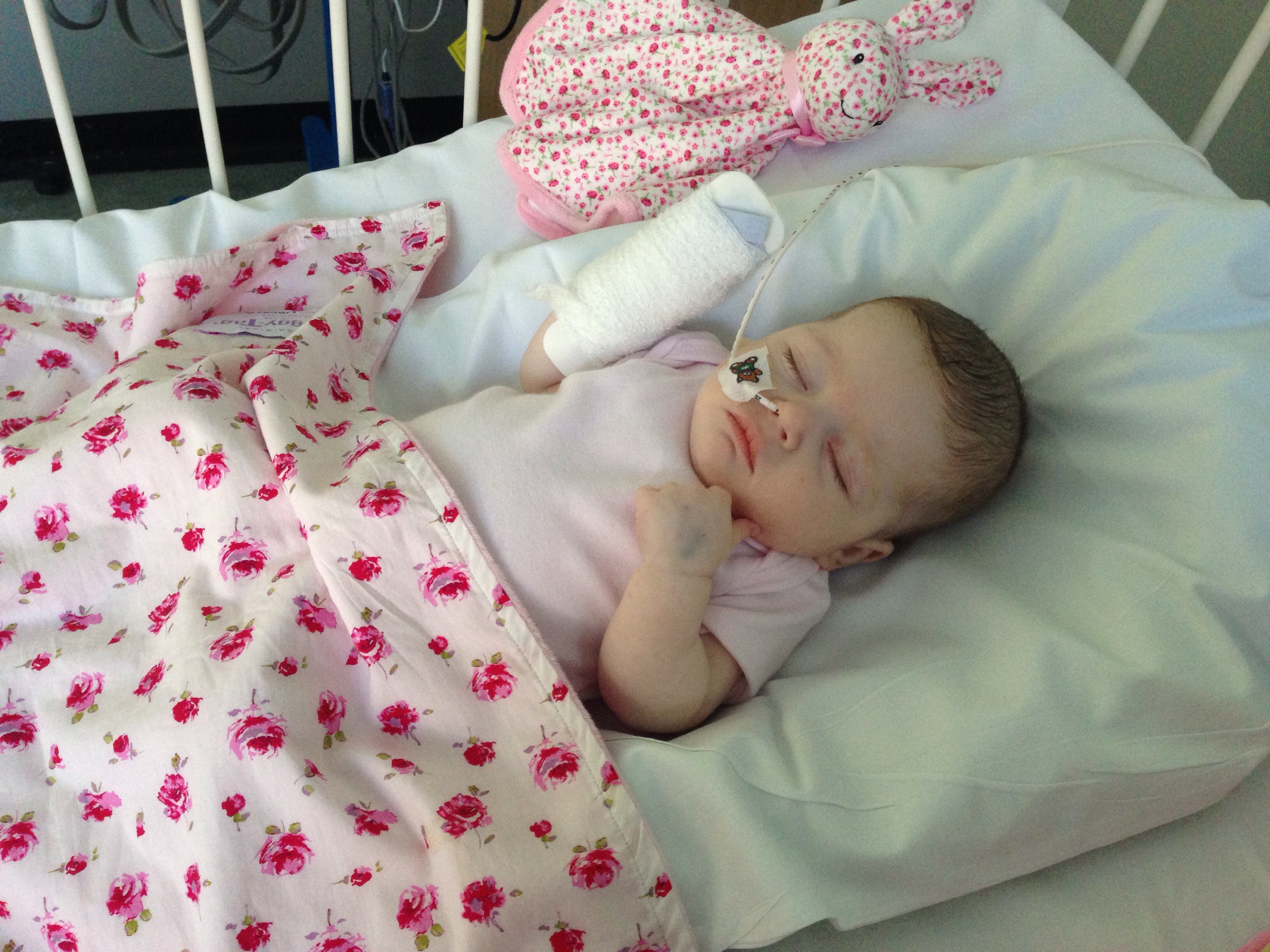
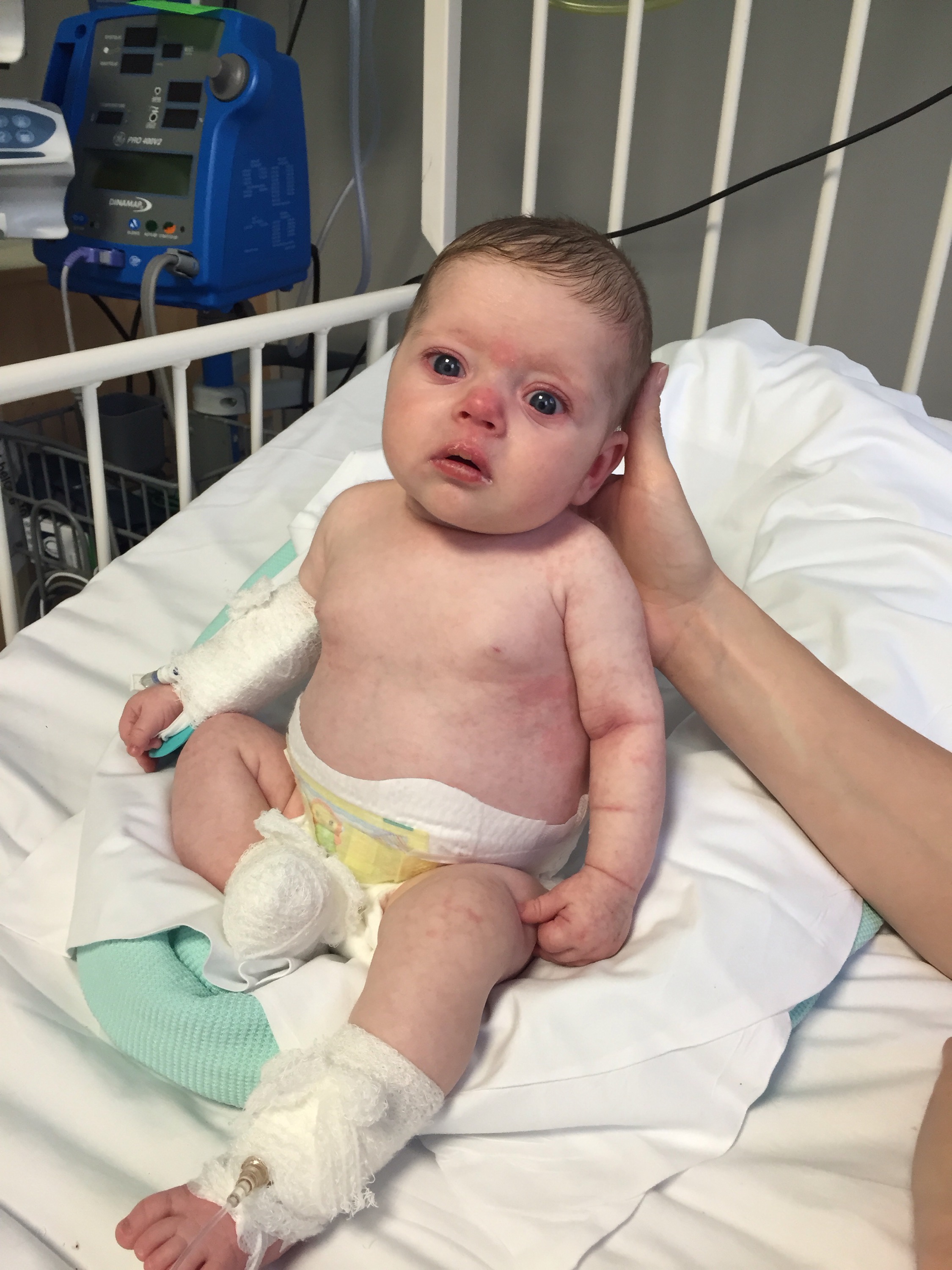
Freya was 7 weeks old when she became sick.  She was hospitalised on the very first day that she showed a single symptom (fever) and spent a number of days on a paediatric HDU, several weeks in a Children’s Hospital, and a week on a Cardiac HDU.  We hadn’t yet seen a health visitor, and the appointment for her first set of immunisations (8 weeks) has just come through.  I guess due to her condition, and later the treatment she received, it wasn’t possible to start the process of vaccinating with Freya whilst she was in the hospital.  She was 7 weeks old when she went in, and 13 weeks when she came out, so she was already behind schedule.  She received a blood transfusion, intravenous immunoglobulin (a blood product) and intravenous and oral steroids.  All of these have an impact on the immune system, rendering vaccination difficult for a certain period of time.  And I can’t be more specific than that, because that is one of the biggest areas of contradiction I have come across when researching this subject, and the reason why now, at nearly 10 months old, Freya has not had a single vaccination.

Some might wonder why that is an issue.  Plenty of parents (those antivaxers) make the decision not to immunise their children against some or even all of the diseases that the immunisation schedules seek to protect them from.  There are children who are unable to receive the immunisations because of poor, weakened or non-existent immunity.  We vaccinate the many to protect the few; herd immunity.  I could trust that everyone else has been protected, so Freya will be ok among the herd.  But, what if…  And then there is chicken pox – we don’t routinely vaccinate for that here in the UK (they do in the States).  If you Google “chicken pox and aspirin” you will find one big reason why aspirin and kids don’t mix; Reye’s Syndrome, a rare but potentially fatal illness linked to the fever associated with Chicken Pox and Influenza in children taking aspirin.  Ok, so the link has been found where high doses of aspirin are taken, and not yet with the low anti-platelet doses that a KD kid is prescribed, but nonetheless it’s a nasty illness and one I don’t want to take any chances with.  Freya has been through enough.

So what happens if you have a child who has not been immunised, and you are concerned about them coming into contact with what others would consider pretty innocuous illnesses?  Let me tell you what happens with us.  Freya has not been to a baby group; not baby massage, or baby music, or baby yoga.  Hell, she hasn’t even been to a playgroup, and when my older two get invited to a kids party, Freya stays at home.  Don’t get me wrong; we have not become social recluses.  Instead I apply my common sense to the activities we will undertake.  I know there might be someone in the coffee shop who has the flu.  Why is that kid in the shopping centre not at school? Could they have chicken pox?  I can’t hide us away from the whole world, but I can reduce the risk of her coming into contact with these nasty germs and bugs.  I call it damage limitation. She has one or two little friends that she sees from time to time, but only when they are well.  And don’t forget she has an older brother and sister who are exposed to all manner of things at school every day – we don’t make them wear a mask!  It is a source of sadness for me though.  Freya is such a happy, sociable child, and I worry about the effect this lack of exposure to her peers might have on her development.  I want her to laugh and play with other children, to learn how to share, to grow bonds and discover new things.  Instead there is a lot of singing and dancing going on in this house, which isn’t a bad thing (unless you’ve heard my singing!!). And with a bit of luck we can catch up with those immunisations soon and provide what we believe to be a little protective bubble around our child before it is too late for her to start over.  The knock-on effect of KD will be huge – when I return to work, she will have to go to some form of childcare.  She will be over a year old, and will never have been with anyone else other than her close family.  That’s going to be a tough one for both of us to handle…

Let me go back to the beginning of Freya’s immunisation journey.  While we were in the hospital with Freya we were advised that she shouldn’t have the immunisations, first because of her condition, and secondly because of the medication.  A lady used to pop her head in our cubicle door every other day with an immunisation leaflet and I repeated often that we had been advised Freya would have to be left to catch up.  I was promised an individualised immunisation schedule to leave the hospital with; it never materialised.  I made a number of calls to the hospital to enquire about when I could start the process, and to the Health Visiting team to ask them to stop the weekly postal reminders telling me what I already knew; Freya had not received her first immunisations.  Eventually I got the call from the hospital that advised I could give her any killed (inactive) vaccinations immediately (she was discharged one month after treatment for KD), but that I should wait 3 months post steroid treatment for any live ones.

I did a bit of research, because I was convinced there should also be a timescale for receiving vaccinations after a blood transfusion.  All avenues confirmed that vaccinations should not be given until 6 months after a transfusion.  Not to mention the varying timescales quoted for giving vaccinations after IVIG!  But all my hospital ever referred to was the steroid treatment, I guess because that is an immuno-suppressant.  But what of the other things? Had they forgotten what she had been given? I felt uneasy with the advice, so I sat on it for a while.

At a follow-up appointment with Rheumatology, I asked about whether Freya should be vaccinated against Chicken Pox (Varicella).  The doctor said that in the UK we only vaccinate children who are at high risk of contracting the disease.  I said that whilst Freya wasn’t at higher risk of contracting chicken pox, the potential consequences of her contracting the disease whilst taking aspirin could be catastrophic.  He agreed to take the issue away, and on the 19th August 2015 I received a letter confirming that they believed it was “reasonable for Freya to receive vaccination against Chicken Pox, both in relation to the issue regarding ongoing treatment with aspirin and the small degree of risk of developing [RS] and also the small risks that Freya may require treatment with immunosuppression therapy in the future…”.   Freya had been weaned off steroid therapy a lot more quickly than originally planned when the gastrointestinal bleeding started. From memory, it was the 8th July 2015 when she took her last oral prednisolone; that meant she could have the live vaccines, including CP, anytime after the 8th October 2015; “…it is important that Freya does not receive this until at least 3 months following…the last day Freya received the steroid treatment…”.  I still felt uneasy, and decided to wait until our next follow-up appointment to discuss.  It was at that appointment that I shared all the research that I had done, and got a referral to Immunology.  I had to wait until yesterday for that appointment.

I wonder if now might be a good time to share what I have learned, from the internet (reliable sources, like the NHS and the American Heart Association) and from medical professionals from London to California…
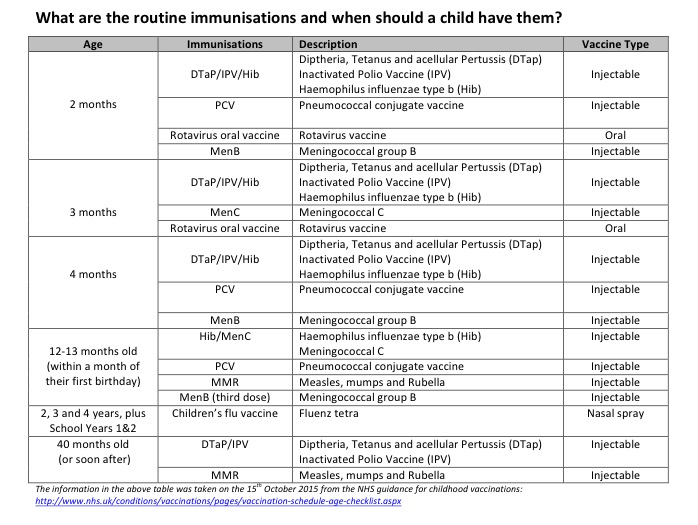
image1

From the list above, all vaccines are inactive with the exception of the following live vaccines – Rotavirus, MMR, Children’s Flu vaccine (note that for the children’s flu vaccine, the nasal spray is live, however there is an injectable inactive flu virus available).
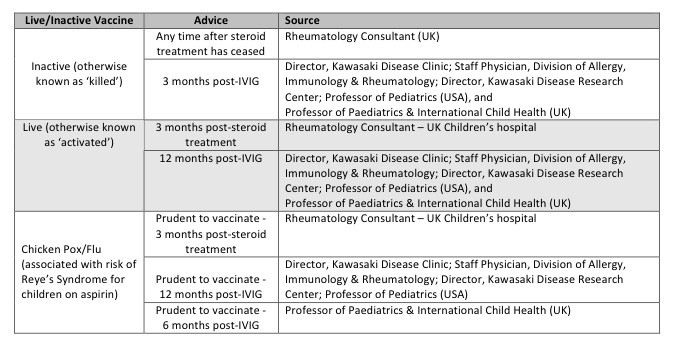
image2.PNG

These are just a few examples of the responses I received from medical professionals, and I can say that my internet research has thrown up much the same; anything from 3 months to 12 months.  Helpful, right!  My gut feeling was telling me I should err on the side of caution, and follow the advice of the US doctor who is considered the leading Kawasaki Specialist in the World – she calls herself a ‘Kawasakiologist’ and I believe she deserves the title.  Our GP agreed that Freya qualified for the injectable (inactive) flu vaccine.  My decision was made.  Well, kind of.  I had decided I wanted to get Freya caught up on the inactive vaccines immediately, then discuss the issue of the live ones with our Immunologist.  Chances were, by the time we got any decisions we would be nearing that 12 month mark anyway, so it was a win-win.  But our ever cautious GP decided that if we were speaking to an Immunologist anyway, there was no harm in waiting for that meeting before we started the immunisation process, and he felt happier to wait for clear direction from her.  So, again we would have to wait.

So yesterday we had that appointment with the Immunologist.  I was all geared up to go in and cover all my questions, but unfortunately an hour’s wait with a baby that has decided that a high pitched squeal is the best means of communication made the whole process a little trickier than I had anticipated!  The doctor was the Infectious Diseases Consultant who treated Freya when she arrived at the Children’s Hospital on day 8 of her illness.  That was nice, as I had the opportunity to thank her for her compassion, support and tireless determination to get to the root of Freya’s condition (especially as I was quite a difficult ‘customer’ who asked lots and lots of questions, and even accused them of breaking Freya’s heart at one point!)  She seemed genuinely pleased to see Freya looking so well.  She received the news that we had seen some improvement in her coronaries since the acute stage of the illness with a broad smile, and she was happy that Freya has not had anything more than one little cough and cold since her hospitalisation.  I expected her to call me a muppet for being a cautious and over-protective mother, but instead she said she felt I was doing the right things, which was reassuring.

I came away from the appointment with a solution, individualised for Freya.  I still don’t have a definitive answer about the timescales related to immunising after IVIG.  But then why would I?  The fact that I can quote at least 5 different timescales from medical papers and journals across the world tells me a lot of them are guessing. I’ve read that medics aren’t completely sure why IVIG even works in the case of KD – they are still trying to understand what causes the illness in the first place, so I guess it would be near impossible to understand why the treatment works. It just does (in most cases).  The Immunologist told me that they deal with children who have compromised immunity as a result of a bone marrow transplant, for example.  Those children are given immunisations  in line with the hospital guidelines and they do not wait 12 months.  That said, she agreed that they had learned more than they previously knew about KD from Freya.  Presenting at just 7 weeks old, and having had no previous immunisations, she is a bit of an unusual case.  So they have agreed to follow a similar process to that of a bone marrow transplant patient.

What are they going to do?

They have taken blood samples from Freya in order to test her body’s immunity status.  They will be testing Freya’s immunoglobulin levels, and lymphocytes (T-cells).  Depending on those results (and I am sorry, I didn’t ask what result they would be expecting or what a low or high result might indicate, or whether there was a chance they might just be reading ‘borrowed’ antibodies as a result of the circulating IVIG – I will ask that when we discuss results), they will start the routine inactive vaccines and the injectible (inactive) flu vaccine.  After a period of time following those (I think she said 6 weeks), Freya’s immunoglobulins will be tested again to check her immune response to those vaccines.  Assuming they get the right result (whatever that might be), they will then progress to live vaccines, including chicken pox.  If we get moving quickly, Freya may even make it in time to have the MMR vaccination at precisely the right time.  I have some decisions to make about Rotavirus (which I believe is time-specific so she may already be considered too late) and Meningitis B, as both have stated increased risks of contracting Kawasaki Disease in the patient information.  I know it is incredibly rare for KD to reoccur, but show me one parent of a kid with a rare condition who finds that word reassuring.

Yes, I am still confused as to what the right answer is about timescales for vaccinations post treatment Kawasaki Disease.  But, I think I have a great solution for me, for Freya.  Rather than guess based on the varied guidelines out there, we are going to take a look at Freya as an individual.  Actually take a look inside and see what is going on, and make the decisions based on what she tells us.  The Immunologist has always said that Freya showed them the path to a diagnosis, and that they learned so much from her.  Seems she is going to teach them something new.  And as much as I probably do their heads in with my questions and powerpoint presentations, I do know that they respect me for it and that they are luckily not too arrogant as to discount this mum’s research and opinions.  She actually said it was helpful and told Freya that she is as well as she is because of her “amazing mum”. I don’t know about that, but in a sea of negativity and low moments, I’ll take that right now.

Whatever I learn from this experience, I will share.  Every Kawasaki case is different, no matter how similar some of the stories might seem.  No wonder it is a tricky one to spot, diagnose, treat and understand.  I hope in my lifetime they find the cause so I can finally understand why this happened to us, to my little Peanut.

Our Rheumatologist said that the subject of immunisations in these cases is “contentious” and currently being debated.  Another said that “guidance is not clear as there are no trials/studies to guide us for this exact situation…” and “…is a balance involving unknowns…”  He gave his opinion and advice, stating that “…there are other equally ‘correct’ versions too!”  No shit!

I’ll leave you with a few of the comments that I received from KD specialists here and in the US, which might help to dispel a few myths relating to IVIG and immunity.
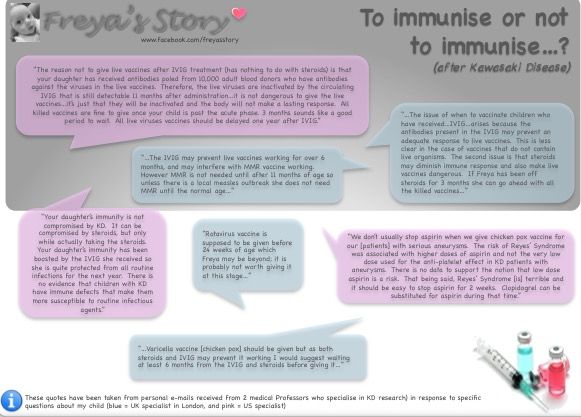
FullSizeRender

And in case you can’t read that, I have pasted below:

“The reason not to give live vaccines after IVIG treatment (has nothing to do with steroids) is that your daughter has received antibodies poled from 10,000 adult blood donors who have antibodies against the viruses in the live vaccines. Therefore, the live viruses are inactivated by the circulating IVIG that is still detectable 11 months after administration…it is not dangerous to give the live vaccines…it’s just that they will be inactivated and the body will not make a lasting response. All killed vaccines are fine to give once your child is past the acute phase. 3 months sounds like a good period to wait. All live viruses vaccines should be delayed one year after IVIG.”

“We don’t usually stop aspirin when we give chicken pox vaccine for our [patients] with serious aneurysms. The risk of Reyes’ Syndrome was associated with higher doses of aspirin and not the very low dose used for the anti-platelet effect in KD patients with aneurysms. There is no data to support the notion that low dose aspirin is a risk. That being said, Reyes’ Syndrome [is] terrible and it should be easy to stop aspirin for 2 weeks. Clopidogrel can be substituted for aspirin during that time.”

“Your daughter’s immunity is not compromised by KD. It can be compromised by steroids, but only while actually taking the steroids. Your daughter’s immunity has been boosted by the IVIG she received so she is quite protected from all routine infections for the next year. There is no evidence that children with KD have immune defects that make them more susceptible to routine infectious agents.”

“…The issue of when to vaccinate children who have received…IVIG…arises because the antibodies present in the IVIG may prevent an adequate response to live vaccines. This is less clear in the case of vaccines that do not contain live organisms. The second issue is that steroids may diminish immune response and also make live vaccines dangerous. If Freya has been off steroids for 3 months she can go ahead with all the killed vaccines…”

“…The IVIG may prevent live vaccines working for over 6 months, and may interfere with MMR vaccine working. However MMR is not needed until after 11 months of age so unless there is a local measles outbreak she does not need MMR until the normal age…”

“Rotavirus vaccine is supposed to be given before 24 weeks of age which Freya may be beyond; it is probably not worth giving it at this stage…”

“…Varicella vaccine [chicken pox] should be given but as both steroids and IVIG may prevent it working I would suggest waiting at least 6 months from the IVIG and steroids before giving it…”


Freya’s Story (9)

Monday 15th June 2015, 08:25am

“I am sorry to say that I woke up feeling a bit hopeless this morning.  I woke at around 5am and decided, foolishly, to dedicate some time to carrying out more research on your condition.  I had been so focussed on the results of the blood tests in relation to the infection itself, that I completely overlooked the complications surrounding your little heart.  You see, whilst the treatment has been fantastic in fighting off the disease, it cannot reverse the damage that has already been done to your heart. Continue reading

Freya’s Story (8)

I don’t remember much about the day we got a diagnosis for Freya’s condition (“D-Day”).  Perhaps I was numb with all the information I had to take in?  I remember my friend was visiting.  I remember going for the echocardiogram.  The consultant who carried out the echo was kind of eccentric, and Freya loved him.  She cooed at him and laid there smiling while he did his work.  It was him that told me he had been asked specifically to look for Kawasaki related issues with Freya’s heart.  He mentioned Kawasaki Disease, and was profusely apologetic when he realised that was the first time I had heard that word mentioned.  I immediately googled it on my i-phone, attempting to surreptitiously arm myself with information as he continued to scan Freya’s heart.  I wasn’t able to read much, as the consultant was talking to me about what he was doing, so I resigned myself to waiting until I got back to our cubicle.  He finished the scan and said that his report would be available in an hour or so. Continue reading

Freya’s Story (7)

On the morning of Friday 12th June (Day 13 on this journey), Freya threw us another curveball.  I awoke to a strange noise and found her gasping for breath.  She looked like she was drowning.  Her nasal passages were blocked, but she kept closing her mouth and when she couldn’t catch a breath she wouldn’t open her mouth and was gasping for air.  She had to have a saline nebuliser that morning, and again I felt like we had taken a few steps backwards.  She had an x-ray in her room that morning; her 4th chest x-ray so far.

At 8am that morning I wrote:

“This isn’t fair, none of it is.  I’ve had enough little one, had enough of seeing you poorly, of watching you go through test after test and for what? They are not making you better!”

I didn’t write any more after that morning because the events that unfolded that day didn’t allow me the time, and I didn’t have the heart to put pen to paper.  I was lost.

Saturday 13th June 2015, 08:45am

“Well, what a day we had yesterday.  A day that whilst filled with angst and emotional turmoil, may have just marked the beginning of your recovery in earnest.  They’ve found it!  After days of tests and numerous medical professionals scratching their heads, they reached a diagnosis.  You have a rare autoimmune condition called Kawasaki’s Disease.  It was a relief to finally get there, but as the information poured in and the extent of the illness became clearer we realised this wasn’t going to be an easy ride.  I had hoped with all my heart that they would find an infection that could be treated with antibiotics.  That they would up the dose, and we would go home.  Unfortunately that wasn’t to be.

Remember I told you on Thursday that the Rheumatology Consultant had been to see you?  I told you that he had asked for more tests, including another ‘echo’ heart scan.  Well you had that scan yesterday morning…The scan identified dilated arteries in your heart, and that my sweetheart was the final piece of the puzzle.  The Consultant came to see me and told me that you needed immediate treatment.  You were to be given two doses of Immunoglobulin.  Basically, it is a collection of antibodies from lots of different people’s blood – an army of special forces designed to go into your body and wipe the nasties out, along with your silly blood cells that decided to embark on a bit of friendly fire. Our immune system is an amazing thing.  Our blood cells are always on the look out for things that shouldn’t be there, so when a virus turns up uninvited, your body sends the white blood cells in to send it packing.  In your case though, it would appear that something…triggered an autoimmune reaction, and instead of attacking the virus, your white blood cells started attacking the healthy cells in your body.

The symptoms you presented as a result of this internal battle (prolonged fever, rash, dry lips) are collectively known as Kawasaki’s Disease.  It is a very rare condition, affecting only 8 in 100,000 people. And although it is more common in children under 5 years old, there have been few babies as little as you with this condition.  The Doctors have had lot of conversations with specialists in Newcastle and Great Ormond Street Hospital in London to decide your treatment.  So it is 2 doses of Immunoglobulin…aspirin to protect your heart, and steroids to suppress your immune system while all this is going on.

I broke down yesterday and with each new detail I was given I began to unravel a little at a time.  So much to take in, and so much pressure.  No treatment is without risks and we found ourselves making decisions about drugs with possible side effects, or non-treatment with potential long-term effects.  The steroids may affect your normal development.  I guess if you are reading this now we will know if that was the case or not.  I was scared about that, but the doctors strongly advised the treatment so we had to trust them to get you better.  We won’t know yet if there has been any permanent damage to your internal organs, particularly your heart.  Daily ‘echo’ heart scans over the next few days, weeks, months, will show us that.  I hope we can mend your broken heart and I am so sorry that I couldn’t protect you from this my darling.

I would be lying to you if I didn’t admit that I looked for all sorts of reasons to blame myself.  Did I not look after myself enough during pregnancy? I should have taken more vitamins, I should have breast-fed you for longer.  Today, I have to accept that this was no-one else’s fault…This just happened…I’m going to have to try really hard not to wrap you up in cotton wool for the rest of your life, and I don’t doubt there will be a few wasted trips to A&E over the course of the coming months and years.

I am struggling to come to terms with this whole thing if I am honest.  To think that 13 days ago I took you to the doctor with nothing but a high temperature…

That evening I remember trying to settle Freya when a woman entered our room, announcing that she was the surgical consultant on duty.  She needed me to give consent to a PICC line for Freya.  Basically, they were concerned about the longevity of the cannulas in Freya’s body and wanted to provide longer-term access.  I was anxious about my daughter having to be subjected to further surgical procedures that would require a general anaesthetic.  I will never forget how matter-of-fact the doctor was as she received my signature from my left hand, as my right hand was busy soothing my screaming child.

A few hours later, 2 doctors came to our room to say that they needed to take a blood sample as an earlier sample had shown something concerning that they wanted to check.  The female doctor asked me if it was ok to take blood from a vein in Freya’s left arm.   It was midnight and I had not long since managed to finally settle my baby to sleep.   The pressure of the day got to me, and I screamed at the doctor, “What are you asking me for?  If you want to take it from there, take it!! You’ve done nothing but take her blood every day, so take it! Take it all!”  The poor doctors didn’t know what hit them, and they slowly backed out of our room.  The nurse began to move Freya and I started to worry that because of my emotional outburst they were taking her away from me.  The nurse told me that the doctors wanted to take Freya’s blood in the Treatment Room.  I really thought they were going to take her away and have me committed under the Mental Health Act until the nurse asked me if I wanted to go with them.  I wanted to stay in our room and cry.  Instead, I brushed myself off and went to the Treatment Room and held my child whilst they took more blood.

Freya underwent an echocardiogram daily over the weekend, and each day showed that there had been no change, for better or worse.  I felt like I understood the illness, and how it was affecting Freya’s body, but I had seriously underestimated Kawasaki’s Disease.

Freya’s Story (6)

I’ve not written for a couple of days as I’ve been busy with my family, keeping a promise I made to myself and to Freya to make our time here count.  It was my son’s 6th birthday on Friday, so this weekend he has taken the limelight, and Freya had to take a backseat for a few days.  I’m not sure she liked being back there much, but no matter what she has been through or what she has to come she is going to have to learn to share the people in her life sometimes.

I left you on the 10th June, where I had returned home from the hospital for some rest.  Rest that I didn’t get as I knew Freya had a big day to come.

Thursday 11th June 2015, 13:31pm

“…I didn’t sleep very well last night.  I guess I was kidding myself that I would rest well at home when I knew what was coming today.  I set off from home at 7:30am to make sure I was at the hospital in time.  Daddy looked shattered bless him!  He had slept in his clothes so he looked all crumpled!  You had a temperature again, so you’d just had some paracetamol…You were pretty grumpy because you weren’t allowed to have any milk after 2am.  I was so pleased to see you.  When I am away from you it feels like I have a little hole in my heart and I find it hard to breathe…As soon as I have you back in my arms I feel whole again.

At 10 o’clock the nurses came to take us to theatre.  You had to wear a little surgical gown – it was tiny, but still too big for you…When we reached the theatre wing the staff gave Daddy a buzzer [to let us know when you were awake], and I went with you into the theatre.  There were lots of people there.  They laid you on the operating table.  You looked so tiny.  I wondered how many lives {might have been] saved on that table.  I sat with you when they injected the anaesthetic.  It was one of the worst experiences I have ever had, watching you fight the anaesthetic until seconds later it took you off to sleep.   Your eyes didn’t close fully.  I cried.  I had to leave then, so I kissed your forehead and went with Daddy…and sat in the park opposite the hospital.  I can’t tell you how long that hour seemed to take.  Eventually the buzzer went off and they took us to get you.  You were fine; you had woken up…”

At around 4pm the haematologist came to deliver some good news.  Freya’s bone marrow aspirate showed no immediate cause for concern.  Freya’s cells appeared healthy and there was no sign of the ‘C’ word.  Again this was considered a sign that we were dealing with an infection caused by a virus and that Freya’s red blood cell production had been temporarily halted by the illness.

“…The Rheumatology consultant has also been to see you, and although he has asked for some more tests (heart scan tomorrow), he also feels that this is more likely to be an infection…Today has gone a long way toward helping mend my broken heart.”   

I wrote one last entry that night before going to sleep:

“Do you know little princess, I think you were sent to me to teach me a few things about how to live this life.  Looking back to the challenges I went through when I discovered that you were coming into this world, I can’t help but think that you are a little miracle.  Perhaps the soul that was looking for a body had been watching over me and saw how troubled I was, saw that much of this wonderful life was passing me by whilst I focussed on the very worst that could happen.  So it chose you, and me.  I’ve learned that you can’t always have a plan.  That sometimes there is joy in the unexpected, and…contentment from just letting life take it’s own course and not the one you meticulously carve out.  Life isn’t always about the big bang moments; sometimes it is the smallest events…that leave the most lasting impression on you.  Things happen for a reason, I truly believe that.  That’s the first lesson you taught me – let go, forgive, forget, see the beauty and freedom in a life without a pre-determined course.

I’ve got a feeling that this experience right now may well be the second lesson you have for me.  Twelve days into a hospital stay and you have some of the best of our medical profession stumped!  Haematologists, Rheumatologists, Immunologists – none of them can find an answer.  Because maybe there isn’t one.  I have a hunch that you are going to get well very soon, and we will be leaving this hospital without any diagnosis.  And it won’t matter, because you will be well and the family will be complete again.  I will have you home, and my heart will be mended because maybe it is okay for there not to always be an answer or a reason.”

Reading those last journal paragraphs for the first time since I wrote on those pages in the hospital, I feel like I’ve been punched in the chest, and tears that I had managed to stem flow freely again.   I thought our journey was nearing its end; I was full of hope.  I believed that as the bone marrow aspiration was the final test and there was nowhere else to look, all avenues had been exhausted and she was getting better.  I had no idea what was about to unfold the following day, or that the days ahead would be darker than anything we had endured so far.

Freya’s Story (5)

Moving to the specialist hospital came with its challenges.  It was a logistical nightmare for a number of reasons and put me an hour away from my children.  But it was the right place for us.  Initially Freya was under the care of an Immunology Consultant who worked with her team and the laboratories to try and find whatever this infection was, and where it was hiding.  By the time we left our local hospital, Freya has just one cannula in; the one in her head had been removed.  She still had the feeding tube, but she was much more accessible for cuddles with all the tubes and wires gone.  She drank a full bottle on the first evening, and I went to bed feeling that she was turning a corner.  The Children’s Hospital would now do their best to diagnose the illness, but said that there was a chance she could just get better and we might never know what made her so poorly.  She was a bit of an enigma to the medical staff.


It did feel like there was a real investigation under way.  Freya went for an echocardiogram on the Monday morning (Day 9) which showed nothing but a slight murmur, considered normal at her young age.  Her temperatures were settling down and she was feeding almost normally.  I truly believed she was getting better and we would be discharged without a diagnosis.  Some of her medication was changed.  I think they stopped the Gentamicin and replaced it with Meropenem.   They also added Acyclovir which is used to treat the herpes virus.  Her haemaglobin was low and the decision was made for her to have a blood transfusion.  I remember feeling shocked by that as it seemed such a drastic measure, particularly when I thought she was on the mend.  An MRI scan was planned to check Freya’s brain for any collections of infection that might be lurking there.  That’s where Group B Strep would be most likely to hide.

Freya received a blood transfusion on Tuesday 9th June.

Tuesday 9th June 2015, 12:52

“You now have someone else’s blood entering your body.  Seems the blood I gave you wasn’t quite up to the job…I just found out that your blood group is B Negative.  Mine is B Positive (which is ironic really as I can be such a neghead at times!). But the good news is (if I remember my maths lessons correctly) that a positive plus a negative equals a positive.  Which is grand, because that is exactly what we are together.” 

On Wednesday 10th June (Day 11) it seemed like we had taken 3 steps forward but 2 steps back.  The temperatures that I thought were a thing of the past returned, and Freya stopped feeding.


That was also the day of the MRI scan.  When the doctor told me that Freya would have to be sedated I fell apart.  I have this fear of general anaesthetic, always worrying that you might not wake up from one, so to be told my child would have to be put to sleep was hard to take.  I cried. A lot. I was relieved when in the morning the doctor said that they would try without sedation.  I had to feed Freya before we went down, and I had to swaddle her as tightly as I could in a blanket to keep her comfy and still.  I went in with her, and I was told that they would try Freya for a few minutes but if she wasn’t still they would have to pause and sedate her.   They gave me a set of ear defenders and I sat down next to the machine and cried silent tears as I watched her tiny swaddled body enter the tube.  She shouldn’t have to go through this at her age.

  
I’ve heard that MRI’s sound like an aircraft, and yes that is true of the background noise.  What I wasn’t prepared for was the periodic sirens and hammering sounds that were deafening to me even with my ears covered.  Freya slept through 25 minutes in there without moving a muscle.  I took it as a sign of how good and strong she was.  Her consultant was concerned that she was too sick to be affected.

Wednesday 10th June 2015, 12:55

“The good news is that the scan didn’t show any abnormalities…  They were looking for collections of pus that would indicate an infection in your brain.  You have a big day tomorrow.  The doctors want to take a sample of your bone marrow.  That means that you will have to be put to sleep with a general anaesthetic and they will take you to theatre  for surgery… I won’t lie to you sweetheart, I am scared.  I know that one of the things they look for in bone marrow is cancer. I am sure that isn’t the case…but they are concerned that you don’t seem to be recovering very well and there could be an underlying condition that is hindering you from getting better.  And I am so frightened that you won’t wake up from the general anaesthetic.  Silly I know,  but I can’t help being scared because you are so precious to me.  Part of me doesn’t know if I can be there…when you go to sleep, but a bigger part of me knows we are in this together.  See you in the morning.”

That night I went home to rest.  It was a stupid idea.  By the time I got home I was a nervous wreck.  I hadn’t made any arrangements for the children in the morning, but if I did the school run I could be too late for Freya’s procedure.  Luckily, my mother-in-law and sister-in-law already had it covered.  I had a large glass of wine, and went to bed where I worried more than I slept.

Freya’s Story (4)

Nothing much seemed to happen in the first week of Freya’s illness whilst we were under the care of our local hospital.  They were very much focussed on treating the suspected cause, and although they had no evidence at that point they continued to treat for sepsis and bacterial meningitis.  Freya was too unwell to undergo a lumbar puncture, so they continued to take blood to monitor the levels of infection in her body and waited for something to grow in the cultures in the lab.  Nothing grew.

On Day 4 (3rd June), the decision was made to use Freya’s head for the next cannula site.  I mentioned before that the doctors were quite sheepish about shaving her head, but one thing about me is that whilst I am incredibly emotional and sensitive, I am also very level headed when it comes to the necessary, and providing more stable IV access was exactly that.  It was on this day that the new antibiotic (Gentamicin) was added into the cocktail.  It is my understanding that it is a more potent broad spectrum antibiotic, but I never really did any research into the medication.  In fact in that first week I did no real research at all, only using the internet to search medical terms I was unfamiliar with, or to prepare myself for what a lumbar puncture involved for example.  My research skills came into play once we had a diagnosis, which would not come for another 9 days.


Having a cannula in Freya’s head wasn’t nice.  It felt a lot harder to handle her, although she seemed to be in pain whenever I tried to pick her up so we weren’t handling her much at that point anyway.  It was trickier trying to lay her back down, because the cup that was stuck over the cannula site to protect it kept falling backwards and I’d end up digging it into her head as I laid her down.  I think it was the same day that we took her for an ultrasound of her head, chest and tummy.  I wheeled the pram down to the ultrasound unit and the nurse wheeled the IV trolley.  As I pushed the pram over the threshold of the scan room, I got too far away from the nurse and the cannula tube in Freya’s head was tugged, making her cry out in pain.  I broke down in tears.  Here was my baby in enough pain and discomfort already, and I go and hurt her through my carelessness.  I was embarrassed and upset, but the nurse was great about it (this wouldn’t be the first situation like it, but I’ll save that one for later!) Everything looked ok on the ultrasounds – another dead end.

The days pretty much passed like that, uneventful, Freya not getting any better, blood tests showing nothing but elevated white blood cell count (and other things that I never understood) but never any diagnosis.  I stayed with Freya for the most part, going home on Day 7 to get some rest at home, and spend some time with our other two children.  On Day 6 (5th June), Freya had her lumbar puncture – I’ve already told you that was also inconclusive.  The night I went home was the night that my husband had a conversation with the doctor who spelled out to him how sick Freya was.  The next morning, my children had their first visit to the hospital.  My daughter had been away on a school residential, and my son was missing the iPad more than us, so we had managed to keep the situation away from them.  We told them that Freya had a cold, but that she was too young for us to give her medicine and it had to be given at the hospital.  The first week was a novelty to them, so they bought that story.  It was that afternoon that we were transferred to the specialist children’s hospital and Freya had her first trip in an ambulance.

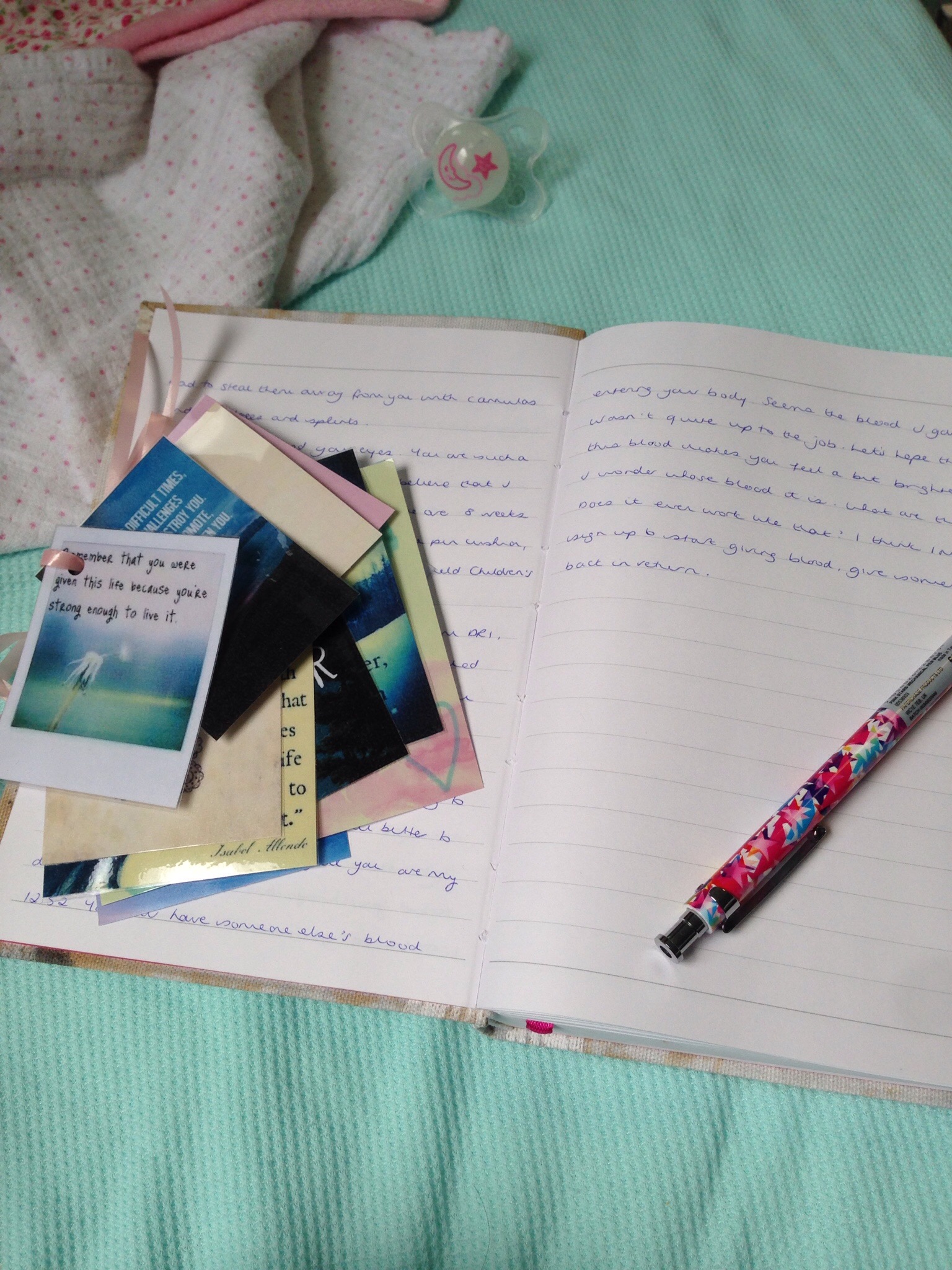
That evening, my best friend (who also happens to be my sister-in-law) brought me a journal and a pen, and a little collection of inspirational quotes tied together with a pink ribbon.  She knows that I find it therapeutic to write and knew that I was finding it difficult to blog from the hospital.  That night, once Freya was settled and sleeping, I wrote my first entry.

Monday 8th June 2015, 23:05pm

“I am sat on my bed next to your cot, listening to your snuffly breath and watching your little tummy pump up and down, helping you to breathe.  Your tiny body is working so hard, fighting the infection and battling to bring that temperature down.  I cannot imagine how you feel.  Are you in pain? Are you frightened? What do you make of all this poking and prodding? At tubes going in and tubes coming out?  Do you feel the cool liquid pumping through your veins as the antibiotics are delivered to support you in your fight?  Does it scare you when the machines start to beep?  What do you make of all these new faces? Of doctors and nurses and everything in between?  If I try to put myself in your situation, I cannot fathom the thoughts that would be in that little head of yours.  As an adult I would be scared, lonely, in pain.  How much that are you feeling, little one?  

When the nurses come to take your blood and you stare right into my eyes do you know that it isn’t me that is causing you the pain?  Do you know that I would take it all away from you in a heartbeat; that every physical thing you have to endure causes a fissure in my heart that feels like it will cause it to break in two?  Do you know that I am there by your side for every procedure because I feel that if I am there with you sharing the experience, I can feel some of your pain.  Do you know how my heart breaks every time I hear you cry, or see your scared eyes pleading with me to make it go away? I would trade places with you in a heartbeat.

I pray that you will get well, and that you never, ever have to go through anything like this ever again.”

That night Freya took her first full feed from a bottle.  Things were looking up and I sent a postcard to the local hospital to tell them so.

Freya’s Story (3)

I wonder if I will ever not be afraid to wake up.  I sleep well, perfectly well in fact.  Freya fell into a 4-hourly feeding routine in line with the nurses timetables for observations and started sleeping through the night towards the end of our stay.  She would even stay asleep for her observations, hardly flinching when the blood pressure cuff tightened around her chubby little legs.  She’d take her oral medicines without a murmur, sucking away on the syringe and settling straight back to sleep.  Now we are home, she is sleeping from around 7pm to 7am, and the move to her cot didn’t phase her (although I guess a big cot has become more familiar to her than a moses basket since her hospitalisation).  She sleeps so still and quiet that i cannot help but fear the worst, and I keep my eyes squeezed tightly shut until I hear a murmur or a breath.  Sometimes I have to physically touch her to encourage some kind of movement to reassure myself that she is ok; that she is still here.

It isn’t an unusual fear in the early months of a baby’s life though is it?  I remember checking my other two were breathing constantly whenever they were sleeping, especially when they started taking their naps upstairs.  We have a baby monitor, but she is so quiet that it doesn’t provide much reassurance.  For the first six months at least, most mothers  will harbour a fear of cot-death, and secretly (sometimes publicly) celebrate the milestone being reached without their baby coming to any harm.  This for us has been a very real fear, with the chances of the worst happening increasing as a result of her illness and its effect on her body.

When I hear her first sound or see her first movement after a period of sleep, I breathe a sigh of relief and thank a God that I don’t believe in for keeping her safe for one more day.  I count my blessings that she is still here with us, and think of all the moments when things might have been different.  Imagine not taking her to the hospital on Day 1!  Imagine not even making the call in the first place!  I was worried that I was over-reacting, worried that I would be putting strain on an already struggling Accident & Emergency function, worried I would be judged as a hypochondriac; one of those mothers.  My mother-in-law, who was once a nurse, told me not to take any chances and to trust my gut.  She said it didn’t matter what anyone else thought, it was better to get her checked out and it be nothing, than not to check and risk her becoming more poorly.  How right she was.

I often think about all the times people have said to us “she’s in the right place”.  Firstly, she wasn’t in the right place.  The right place was home with her family doing normal things.  Secondly you might assume that if you are in the right place, the right things would always happen.  That wasn’t always the case, and I was often glad that I am blessed with some intelligence, an inquisitive nature, and unfaltering tenacity.

I am by no means critical of the medical profession in it’s entirety.  On the whole, the medical staff from cleaners to consultants and everything in between were amazing.  There were however, a few occasions where it paid to be nosey, to take an interest, and to keep notes (mental or otherwise).  The first of these occasions happened on either Day 2 or 3 of Freya’s illness.  I can’t remember which day, but I can remember that we were still in the HDU so it had to be the Monday or Tuesday night.  As Freya’s nurse was administering her IV medication, she commented that the cannula had tissued.  In layman’s terms, it was no longer in the vein and therefore any fluid was entering the tissue surrounding the vein rather than being delivered into the bloodstream.  It had to be checked and/or removed, and a new one would have to be inserted before she could receive any further medication.  There was a cannula in the other wrist, but it was in such a tenuous position that it was not successful for the IV medication delivered through the pump.  The nurse did a thorough handover as it was at the end of her shift, and I felt as happy as I could be with the arrangements that had been made to keep Freya safe and aid her recovery.  That evening we were looked after by a bank nurse.  I asked on a few occasions when her next antibiotic dose was due, and reminded her that she needed a cannula inserting in advance of that.  Because she was difficult to cannulate, the nurse eventually called the on-duty doctor to come and insert a new cannula so her drugs could be given.

The ‘doctor’ arrived, and I use inverted commas because there was no name badge visible and she didn’t introduce herself so to me she could have been anyone.  Add to that her physical appearance (which I will not describe for fear of offending anyone), and the rancid smell, and I really had to wonder who they had sent to my daughter’s aid.  She took a look at her patient and commented at how many cannula sites she could see (I mentioned in my last blog how quickly they kept failing), and she said that she wasn’t prepared to insert another as it was unfair on Freya.  I asked how they planned to give her the antibiotics without any access, and she replied quite nonchalantly “Perhaps she doesn’t need the antibiotics.”  I felt like I had been smacked in the face.  A few hours before, a senior nurse had given me a clear explanation of what to expect, what care they were giving and why they were giving it.  I felt confident that Freya was in good hands and that she would recover soon.  In one moment, and one blasé statement, that ‘doctor’ knocked any confidence I had out of me.  I immediately jumped to Freya’s defence and the fatigue and stress forced a rather angry response.  I remember very loudly saying something along the lines of “Do not walk in here with that blasé attitude and tell me that my daughter does not need the medication that this morning I was told would save her life.”  Immediately she said she would put a cannula in, and again I stopped her; “Hold on just a second!  When you came in you felt it was not right to cannulate her and now because I question you, you flippantly say you will do it.  Why say it is wrong, then back down so easily when I challenge you?”  She spoke in a very thick accent, so it was hard enough to understand her that day, without trying to remember today, but I got the impression that she felt that I was afraid that a cannula would hurt Freya, and the nurses tried to usher me away for a cup of tea because apparently my reaction was down to tiredness. I retorted with “Trust me, I am not tired. No amount of tiredness would change the fact that right now I have no confidence in the care you are providing, and I am not leaving my daughter alone with her!”   In the end, they tested the cannula that had failed, believed it to be working ok and ‘pushed’ the drug through manually at the instruction of the ‘doctor’.  Once she had left i made it clear that if that ‘doctor’ (who was not actually from our local hospital) ever came near us again, I would wheel Freya in her cot right out of the front doors!  I never saw her again.

Luckily incidents like that one were rare, but there were times when I was thankful that I had paid so much attention to Freya’s care-plan.  There were a number of occasions throughout the course of our ‘incarceration’ when I was required to remind the nurses that Freya was due some medication. Sometimes I would be met with a casual “I was waiting for her next feed”, but that never washed with me as I had all the milk in our cubicle, the nurses didn’t know when Freya was feeding, and on one occasion when I received that response I had only fed Freya an hour before.  Had it have been an antibiotic that wouldn’t have been critical, I might not have been so cross, but when it is the drug that is responsible for reducing the risk of further complications with her heart it was a different matter.

Another time, Freya was due to receive some essential medication (once we had moved to the specialist hospital and a diagnosis had been reached).  It had to be delivered as one dose, but over 2 days due to Freya being so tiny.  Because we were being transferred to a 2nd specialist hospital the following morning, it was important that the medication was delivered at 4am, being a drug that took at least 4 hours to ‘infuse’ through the IV pump. At 5:30am I woke up and noticed that there was no IV going in.  When I asked the nurse, she replied that it was one dose, and Freya had received that the night before.  I corrected her, telling her that the dose had to be split and that it needed to be started at 4am so it was delivered before the ambulance arrived to transport us.  I overheard the phone call from the nurses station, working out how to rectify the situation.  The drug was given, and our transfer was delayed.

I guess that was a bit of a long-winded way of saying that when you put your life in the hands of medical professionals in a hospital, you do indeed believe that you are in the right place.  Over the 6 weeks that Freya was in hospital care, we encountered numerous medical staff.  Freya spent her 6 weeks in 3 different hospitals so we were also able to draw comparisons between staff and the physical environment.  I would say that 99% of the time we were in hospital, Freya was cared for incredibly by some amazing staff who proved through their actions why they were in the profession.  There were a tiny number of nurses that I felt less warmth from, or felt that they were desensitised, lazy even.  I will not allow my view of the NHS as a whole be shadowed by the behaviour of a few less capable nurses.  But I will say never assume that they all know best.  Do your research, but be discerning about where you get your information from.  Ask questions, make notes, and ask again and again until you understand.  With an illness like Kawasaki Disease, it is possible that many disciplines will become involved.  Freya receives follow up care from Immunology, Rheumatology, Cardiology, Gastroenterology and a Dietician.   They are not always joined up, sometimes making decisions that contradicted the care being provided.  At the beginning of this journey I was reluctant to ask questions for fear of offending the doctors, I bottled my concerns up because I didn’t want them to think I was over-reacting.  Freya could not fight her own corner.  I soon learned that if she was to stand a chance, she needed her mother strong and bold, and beside her every step of the way.

Freya’s Story (2)

I was just stood over my daughter’s cot watching her sleep peacefully in her ‘big bed’.  Last night we built the cot in our room, as we accepted that she has outgrown her moses’ basket.  It seems hard to believe that we have reached this milestone already, having been robbed of a number of weeks of our tiny baby, cooped up in a hospital cubicle when we should have been at home.  Standing watching her from the end of her cot I was struck by the thought that 8 weeks ago today, at around the same time, I was stood at the foot of a hospital cot in a high dependency unit, watching doctors work to save my daughter’s life.  I remember being stood there, watching on without making a sound, my hands gripping the high metal bars at the foot of the cot with silent tears rolling down my cheeks.  I recall feeling numb; it was surreal and I struggled to digest what was happening.  I had called my husband and told him that he needed to come straight away.  I could search a dictionary and never find the words to describe the fear I felt at that moment.  It was a fear I had never known, and one I never wanted to feel again.  Unfortunately, because of the lasting effects that the illness has had on Freya’s body, that fear will remain with us for many years to come.

I ought to feel elated by the contrast of this morning, and I guess there was a small part of me that smiled inside at the idea that we are home, and had I not made the decision that I did all those weeks ago, what happened on that morning would have been happening at home, and her situation will have been very different.  But I can’t help but look at her with sadness sometimes.  Watching her sleeping soundly she looks like any other baby; she bears no scars to betray the journey she has been on.  If I could see inside her though, I would see that she is broken.

We spent 8 days in our local hospital.  All that time Freya battled with soaring temperatures that could not be controlled despite the cocktail of drugs that she was receiving intravenously.  She spent the entire week wearing nothing but a nappy, lying in the cot quiet and still.  She had daily blood tests while the doctors tested for whatever it was they were looking for.  One of the things that they measure from your blood is something called CRP.  It is an indication of inflammation or infection.  On the day we took Freya into hospital, the CRP count was around 37.  By mid-week this had soared to over 300.  There was something happening inside her body, but no-one could tell us what.  The doctors referred to Freya as ‘septic’, and continued to affirm that they were treating her condition as meningitis and would expect to see some improvement after a few days on the antibiotics.  The only real way to confirm bacterial meningitis is through a lumbar puncture, but Freya was too sick for them to attempt the procedure.

Around mid-week, the doctors decided to add a 3rd antibiotic, Gentamicin.  On the Thursday, her temperatures started to settle down, spiking a number of times throughout the day as opposed to constant fevers.  She was tachycardic, meaning that she had an abnormally high heart rate.  She was connected to a monitor that showed her heart rate and oxygen saturation levels (‘sats’) that beeped every time she went over the thresholds set.  Because her heart rate was so high – over 200 bpm – they had to set the monitor higher than normal or it would have been alarming constantly.  The doctors believed she had turned a corner, the CRP levels had come down a small amount, and they felt she was well enough to undergo a lumbar puncture.  By this point, Freya’s symptoms included prolonged fever, a light rash over her body, and dry cracked lips.  Her hands also looked very strange, and I remember remarking to the doctors that her hands looked like those of a dead person.  They were grey and the skin looked paper thin.  They put it down to the cannulas that were inserted in each wrist.

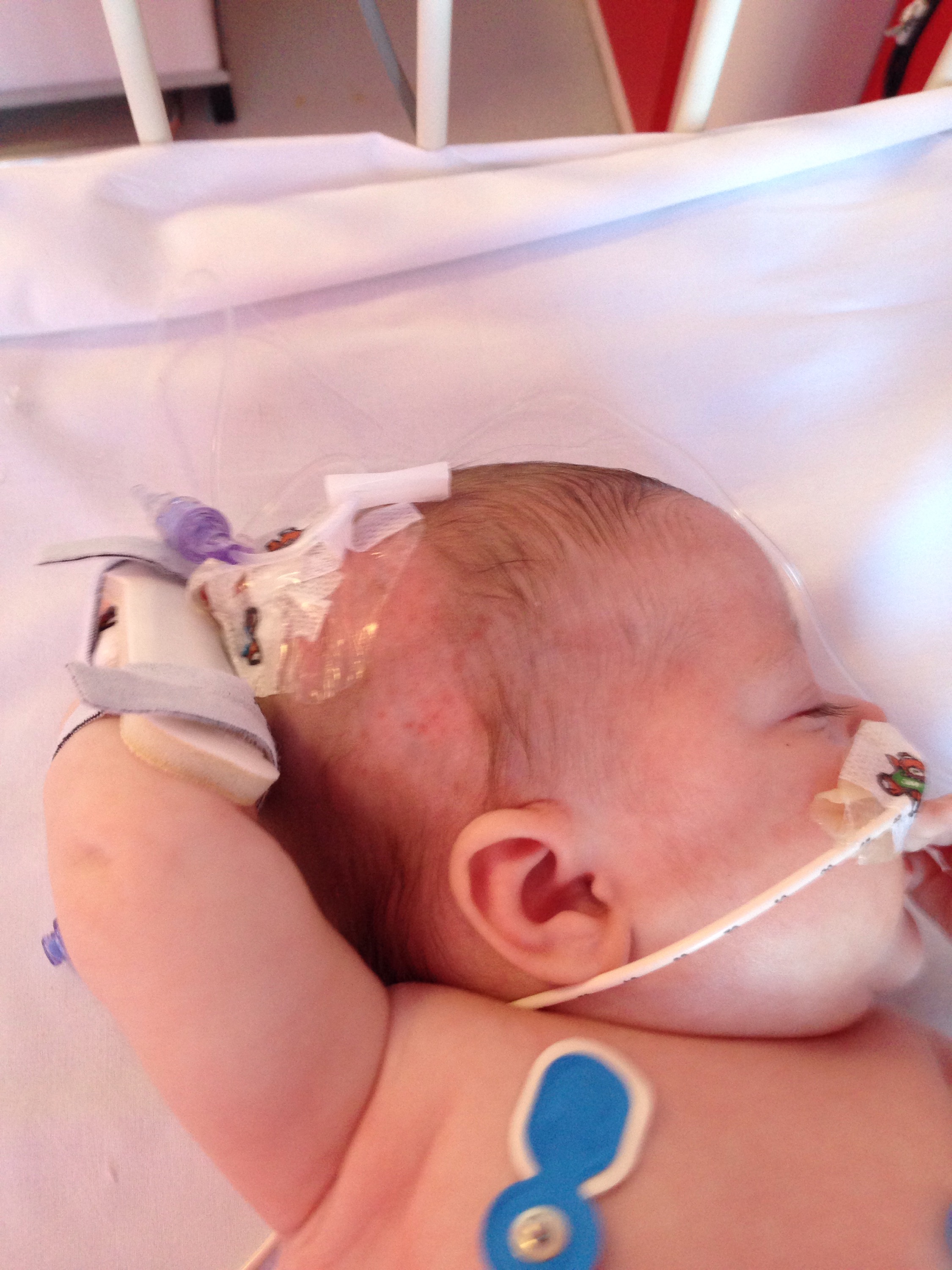
During the course of the week, a number of cannulas were inserted to provide access for the intravenous (IV) drugs.  Because their veins are so tiny, babies can prove difficult to cannulate, and they often stop working much quicker than they would in an adult for example.  Due to the position of the cannulas and the fact that it is pretty impossible for a baby to keep parts of their body still, with all those jerky arm movements, the cannulas in Freya’s wrists were failing daily, and the decision was made to insert a cannula in her head.  The doctors had to shave her hair on one side.  They were so cautious about doing that, because apparently some parents have been known to kick off about their child’s head being shaved.  Seriously? Hair grows back, why on earth would you want to hinder your child’s recovery because they might look a bit strange for a while.  To protect the cannula from Freya’s wandering hands, the nurses placed a plastic cup over it, and taped it to her head.  She did look a sight! I have the photographic evidence to show her just how daft she looked!

The lumbar puncture was performed on the Friday, which was our 6th day in the hospital.  This was the only procedure that I wasn’t present for.  The nurses felt that it was better for me to wait for Freya to return and provide the comfort of cuddles.  It is apparently not a pleasant procedure, and the body has to be bent into such a tight ball that to watch your baby go through it can be quite distressing.  I paced the corridors, wincing when I heard  my baby girl’s cries from behind the doors of the treatment room.  She recovered from it pretty quickly, babies are so incredibly adaptable.  I remember the nurse passing her to me, and telling me that I had to keep her flat for a period of time. An hour? I can’t recall how long.  What I do recall is my complete meltdown at the pressure and responsibility of having to keep my baby still for that period time, and I panicked that I could cause Freya some damage if I were to get it wrong.  The nurses were brilliant and reassured me that it would be ok.  The results from the lumbar puncture were inconclusive.  The white blood cell count was slightly elevated, but there was no confirmation of meningitis.  There was a suggestion that because Freya had already had 6 days of high dose antibiotics, the initial condition may have been treated and no longer be apparent in her spinal fluid, although they would still have expected to find some trace of it.

Throughout this first week in hospital, I couldn’t make out how I felt.  It is strange because you almost become used to seeing them in that poorly state so it becomes a new normal.  Remember we hadn’t had much time with her before she became ill, so we quickly forgot what Freya’s normal looked like.  I received mixed messages every day, and wasn’t sure whether I should be scared for Freya, or whether her condition was under control.  At one point a nurse came to tell us that they had found rhinovirus in the test of her nasal secretions.  She had a cold!  Was it possible that it could be just that?!  I knew that it was not right that she should be continuing to have a temperature after a week, particularly when she was receiving fluid, 3 different IV antibiotics, and regular paracetamol and ibuprofen.  She was too exhausted to feed from a bottle, and had a tube inserted through her nose into her stomach for feeding.  She was still being tube fed after a week in hospital which was another sign that she wasn’t recovering.  I was so emotional, that every conversation I had with a doctor had me in tears, and I worried that I was only hearing the negative.  Prone to automatic negative thoughts, I put that down to me being a ‘neghead’ and tried to bat those thoughts away.  It was the Saturday (Day 7) that I relayed one of the conversations with a Registrar to my husband that he decided he needed to hear the news first hand.  I had told him that the doctor had said that whilst rhinovirus is a common virus that causes cold-like symptoms in an adult, for a baby as young as Freya it was a pretty nasty virus to have, and there was a chance that was the situation with Freya.  However, a consultant later that day said “rhinovirus doesn’t do this to a baby.”  The registrar kept saying that Freya was very sick, and I felt that the doctors looked overly concerned whenever they examined her.  My husband arranged to meet with the doctor to discuss it.  I told him I needed to understand how sick Freya was.  I needed to know if there was a chance that she might not get better at all, if she could die.

My husband asked the doctor to tell us on a scale of 1-10 how sick Freya was.  The doctor replied that with 1 being healthy, and 11 being dead, Freya was a 10 on the day she was taken to the HDU.  She felt that, Freya was now more like a 7 out of 10, and that she was still very sick though clinically more stable than she had been earlier in the week.  My husband asked why they were not considering moving Freya to the specialist children’s hospital in a neighbouring town, and she replied that she felt Freya was receiving the appropriate care and that her condition was slowly improving.  The following morning, a consultant came to see us.  He said that it was unacceptable that we should have a baby as sick as Freya for as long as 8 days without any diagnosis or prognosis for recovery.  He said that if it was his child he would not be happy that we were still none-the-wiser about her condition, and that he would want everything possible to be done to ensure our daughter’s recovery.  He told us that he had requested a bed for Freya at the Children’s Hospital and an ambulance was on its way to take us there.

Freya’s Story (1)

Exactly a year ago today, my husband and I made the decision to create another child for our family – ok so it wasn’t quite a decision as a ‘happening’, and it was more unconscious than conscious given the amount of wine I had consumed that afternoon! If you’ve read the posts that gave birth to this blog, you will have some understanding of the journey that I went on through my pregnancy, and you will have shared some of my thoughts and fears along the way.  You will also know then, the joy I felt when my daughter was born.  I was besotted; I am besotted.

I’ve been absent from my blog for a while.  I will forgive my followers for assuming that I just got busy with the new addition, and that having 3 children and a home to look after left me very little time for writing.  I wish it were that simple.  But we have been on an ‘adventure’, Freya and I.  It’s an adventure that began on Sunday 31st May 2015 when Freya was just 7 weeks old.  It’s an adventure that I would like to share with you.  I hope that through the telling of Freya’s story we are able to raise awareness of a barely known disease, and if our insight and updates can help others to understand this illness, or provide support to those who are living with this devastating condition, then I will have achieved more than I could hope for with my words.

I was unable to blog from the hospital with limited or no internet access, so I kept a hand-written journal.  To tell the story, I need to go back in time to when this all began, so I ask that you indulge me as I share the experiences of the last couple of months, as well as keeping you up to date with where we are today.

How it all began

On Sunday 31st May 2015 my daughter awoke at around 5am for her first feed of the day.  I had stopped breastfeeding about a week before so she was bottle-fed with formula.  She was very snuffly, her nose was all blocked up and she was struggling to feed as a result.  She took about an ounce of the 4 ounce bottle and fell asleep in my arms.  Assuming she was just tired still and not ready for the milk, and that she had most likely tired herself out trying to feed with a blocked up nose, I thought nothing of it and returned her to her moses basket.  She slept until around 9am, again I prepared her formula, and again she managed to drink around an ounce before falling asleep.

After a few hours, I decided I couldn’t leave her sleeping any longer and I needed to try and get her to take a bigger feed.  When I approached her in her bouncy chair where she was sleeping, I noticed that her lips looked dry and she had a lot of spit around her mouth.  Again I assumed this was because her nose was so blocked up that she was having to breathe through her mouth.  When I touched her to pick her up, I noticed that she felt very warm, so I took her temperature with a digital ear thermometer.  Her temperature was 38.3 degrees; she had a fever.  I went to the medicine cabinet to find some Calpol (paracetamol) but the box said ‘from 2 months’, and with Freya being one week short of that milestone I wasn’t sure whether I should give it to her not.  Being a bit of a worrier and a goody-two-shoes, I decided to call the out of hours doctor’s service.  By this time, Freya was still sleeping soundly, though I had noticed that her tummy was heaving up and down a lot whilst she was breathing which was unusual.  The doctor advised us to take her to the hospital Accident & Emergency unit as a precaution as it is unusual for such a young baby to have a fever.

After the initial examination, the doctors decided to admit Freya to the Children’s Ward for overnight observation.  I mentioned that I was Group B Strep positive in my pregnancy; I had this niggling worry that she could be starting to present symptoms of late onset GBS infection.  The doctors decided to give her intravenous Amoxycillin as a precaution and we settled into our room for the night.  I sat in the reclining chair holding Freya as the IV antibiotics were delivered to her tiny veins.  When the IV had finished, I laid with her in my arms until she finally fell asleep.  Not wanting to risk losing my hold on her if I fell asleep, I transferred her to the hospital cot and returned to my chair.  There was all too familiar smell coming from her nappy, but I decided to leave her to sleep rather than disturb her again. I say I decided to leave her, but after about 2 minutes back in my chair the guilt of leaving her in a dirty nappy took over and I got up to change her.  As I lifted her vest, I noticed what looked like a rash on her torso in the dim light.  I wasn’t sure though as it was quite dark, so I decided to put the light on.  A bit dazed by the light I found it hard to decide whether my eyes were playing tricks on me or not.  It was around 5am, and was beginning to get light outside so I opened the curtains to take a closer look at Freya.  Her torso was covered in a rash of tiny red spots.  I’d read somewhere about meningitis and that the rash was one of the last symptoms that would appear, and also that it would be the type of rash that wouldn’t go away if you pressed it against a glass.  I didn’t have a glass so I ran my finger across her skin.  The rash seemed to go away.  I called the nurse and asked her to take a look.  She was unsure whether it was concerning or not, so she called the on-duty doctor. He came within ten minutes.  By that time, the rash had spread across Freya’s arms and down her legs.

What happened next is a bit of a blur, as it all seemed to happen so fast.  I will never forget the feeling as I watched the doctor and listened to his directions to the nurse.  They called a more senior doctor.  As soon as he entered the room I felt the atmosphere change.  The feeling was oppressive, like an elephant was sitting on my chest.  Their calm orders, and deliberate movements betrayed no panic, but there was something about the air that just felt wrong.  I watched on as they wheeled her to a high dependency unit (HDU) and started to give her fluid, more antibiotics, take blood samples.  She looked like she was sleeping.  I didn’t know then that she had gone into septic shock, and her little body was starting to shut down.  I learned later that what they were doing in the HDU is called fluid resuscitation and that Freya was very sick indeed.

It was too early to say what was wrong with Freya, but the symptoms suggested bacterial meningitis was the cause, and so the medical staff elected to treat her for that with two antibiotics (Amoxicillin and Cefotaxime), intravenous fluid, and regular paracetamol and ibuprofen to reduce the fevers.  Looking back to that day, I remember feeling scared, but also feeling very proud that I had moved quickly enough to get her to hospital before the illness had really taken its hold.  Everyone told me she was “in the right place”.  I didn’t know that the “right place” would end up being our home for the next 6 weeks, and that Freya would eventually leave the hospital forever changed.