The Reality of Kawasaki Disease

When the phone rang at around 9:30pm last night and my mother-in-law was on the end of the line telling me to tune into ITV because an episode of Doc Martin was showing a case of Kawasaki Disease, my stomach did a little somersault.  A prime-time TV programme mentioning KD? I could hardly believe it. I switched over a little too late so set the programme to record on ITV+1.  As more and more comments and messages came into the various Kawasaki support group pages on Social Media sites, including Freya’s Story, the adrenalin was pumping.  You could almost feel a collective buzz as parents of children who have suffered at the hands of Kawasaki’s from all over the UK tuned in to witness KD getting a voice.

I couldn’t help but feel a sense of pride in being part of this campaign for raised awareness.  I cannot claim credit for the inclusion in this TV programme, or the coverage in The Daily Mirror last week, but I would like to think that somewhere along the way there will be a link with Freya’s Story and the small bit I have done to help raise Kawasaki’s profile.  I can claim credit of over 300 signatures on the Kawasaki Support Group UK petition (change.org/kawasaki), and I know that a lot of the 500+ people who now follow Freya’s Story on Facebook and Twitter will not have heard about Kawasaki Disease before;

“This evenings episode of Doc Martin includes a case of Kawasaki disease, wouldn’t have known what it was without this page and good coverage to help raise awareness.” (Posted by Facebook user on http://www.facebook.co/freyasstory)

“I saw the Mirror, I have read nearly all of Freya’s story, I have cried for you and smiled at the lovely pictures. It’s amazing though what you have done, I knew you were strong and raising the awareness is fantastic.” (Friend, and follower of Freya’s Story on Facebook)

But I’m not doing this for praise or thanks.  I’m doing it because I don’t want another parent to have to go through what we did, what so many parents have, because of a lack of knowledge and understanding of this disease.

So, what did I really think of last night’s episode of ITV’s Doc Martin?  Initially, I was excited and amazed that Kawasaki Disease had even managed to make in into the public eye in such a dramatic way.  One of the nation’s most prolific TV channels mentioning something much of the country has never even heard about! Fantastic!  And then I watched it.

What were the positives?  Well, you get to understand the symptoms of the disease.  The little girl has a temperature, a red tongue and a rash on her body.  They allude to the fact that she may have peeling skin on her hands when a little boy remonstrates about having to hold the sick child’s hand on a school outing.  The child eventually collapses, and the show’s ‘hero’ appears.  After one look at the child, he makes a rather pompous statement, which went something like “this child hasn’t been eating sweets, she has Kawasaki Disease”.  And just like that, after seconds of seeing the child, he makes his diagnosis and drives the child at high-speed (she may die within 30 minutes apparently) to get her the treatment she needs to avoid the risks of a coronary artery aneurysm.  Amazingly the medication is waiting for them on arrival at the hospital and the child receives the treatment.  In terms of the programme, this whole thing took 3 minutes.  Remarkable.

So why the long face? It didn’t take long for the celebratory feelings to wear off once I let what I had just watched sink in.  Part of me still wants to believe that no matter how the issue was covered, any coverage is good for raising awareness of a disease that most haven’t heard about.  But (you could see that but coming couldn’t you!) it was scripted in such a glib and blasé manner that I wouldn’t be surprised if the message was lost on most viewers.  I suspect many won’t even remember the name of it today, let alone the symptoms.  And if they did remember it, I do not believe that anyone who hasn’t experienced KD first hand will have one iota of an idea about how serious, or how scary this disease is.

I know that the ITV would argue that Doc Martin is a medical comedy drama series; it does not profess to deliver messages in a serious manner (that can be left for the likes of Panorama and Casualty who gave KD some airtime about 20 years ago, in the mid-90’s).  We can be grateful that such a rare disease has even made it on the ITV radar, I guess.  But when you’ve watched your child battle with this disease, you can’t help but be left with a sour taste in your mouth after watching the episode.  In fairness to the programme, however, I am not a regular viewer so am unfamiliar with the usual format and scripting, and I know that they are likely to come under attack from victims of all manner of illnesses that they cover; they’re never going to please everyone.

If you watched the programme, and you think that Kawasaki Disease is a funny sounding illness, maybe even fictitious, then please know that it is very real, and is the leading cause of acquired heart disease in children.  If you think that it is easy to diagnose on first look at a few symptoms, please know that is not the case and often the symptoms come and go, disappearing just when you needed them to be seen.  In fact in many cases, not all the symptoms are present.  If you agree with Doc Martin’s assessment of the child’s parent being negligent by not noticing the signs, then please know that most medical professionals in our country have never heard of Kawasaki Disease, and many mis-diagnose the illness, sometimes with catastrophic results.  If you think that the treatment is readily available, please know that intravenous immunoglobulin is in short supply, and it is expensive.  It’s a product derived from human blood; we’ve probably all seen the marketing campaigns from various blood donation schemes recently – there is not a bottomless pit full of blood that we can all tap into at any time.  And if you think that all cases of Kawasaki Disease have a happy ending, you’ve just got to be a part of the support groups on social media sites to know that isn’t the case.  There are children currently fighting for their lives, and many that have lost their fight altogether.

I am disappointed in the programme, not only for its flippant handling of the illness, and think they could have done more to make it clear that this is a sinister disease that needs some real focus.  Many programmes include messages in the credits to support people who may have been a victim to the contents of an episode.  I think the ITV could have at the very least put up a public message about Kawasaki Disease, making it clear that this is very real, and even just supplying a link to NHS Choices for further information.

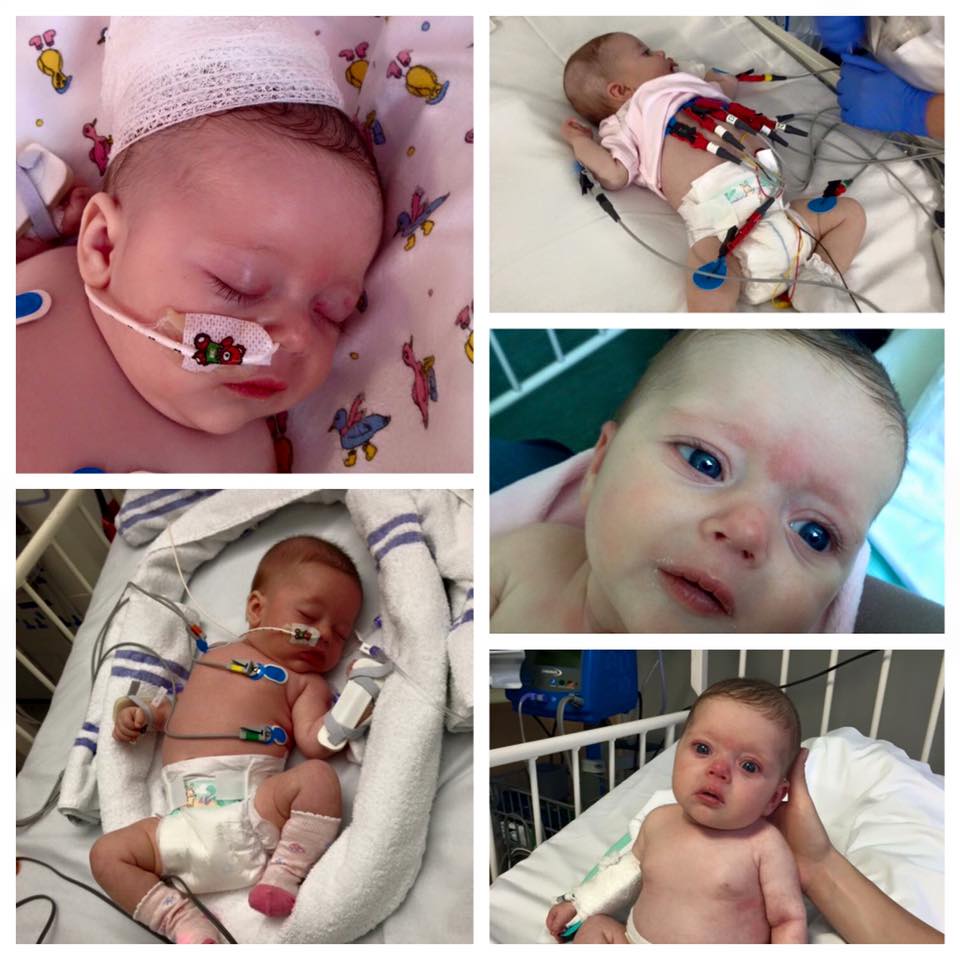
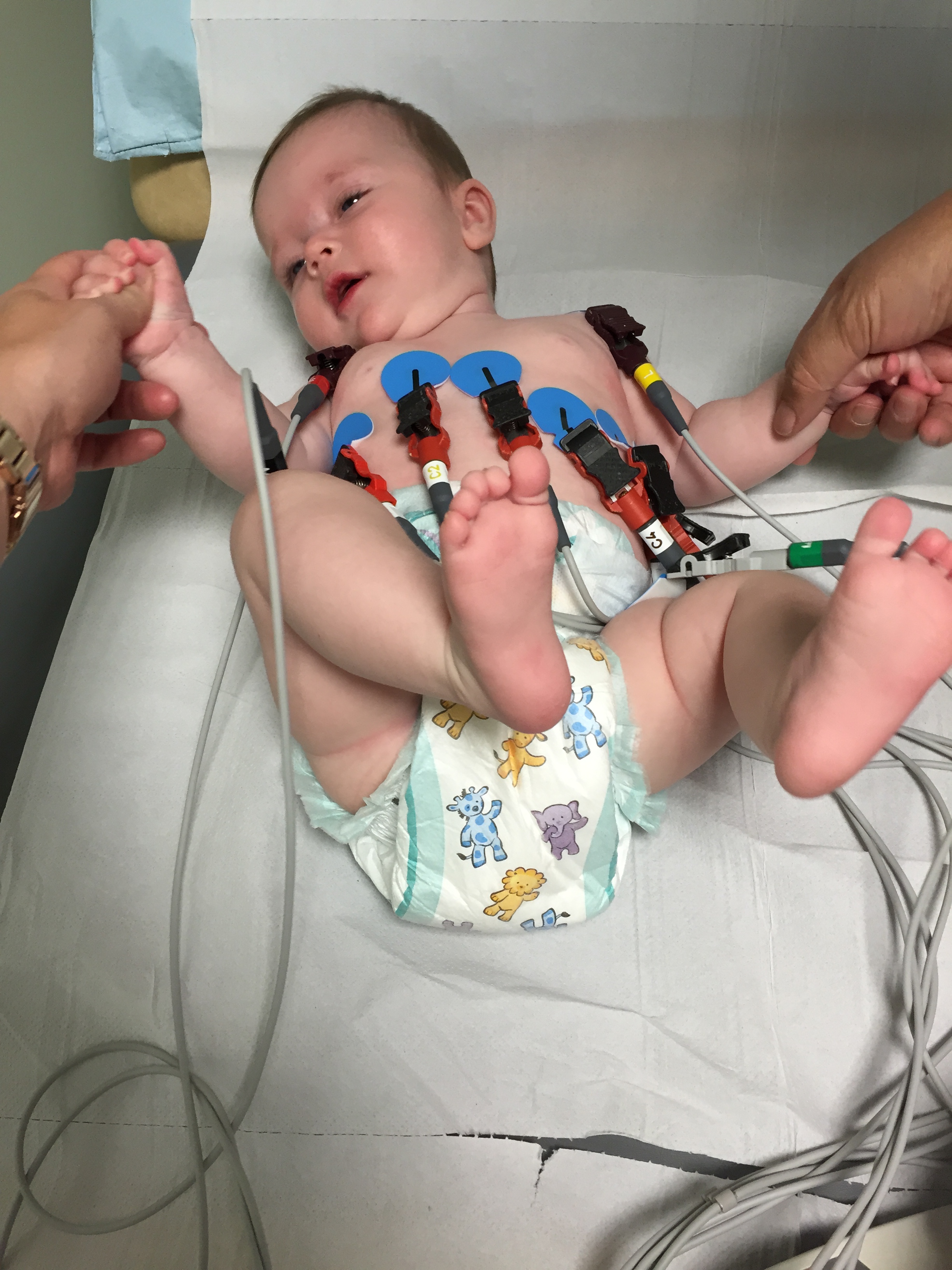
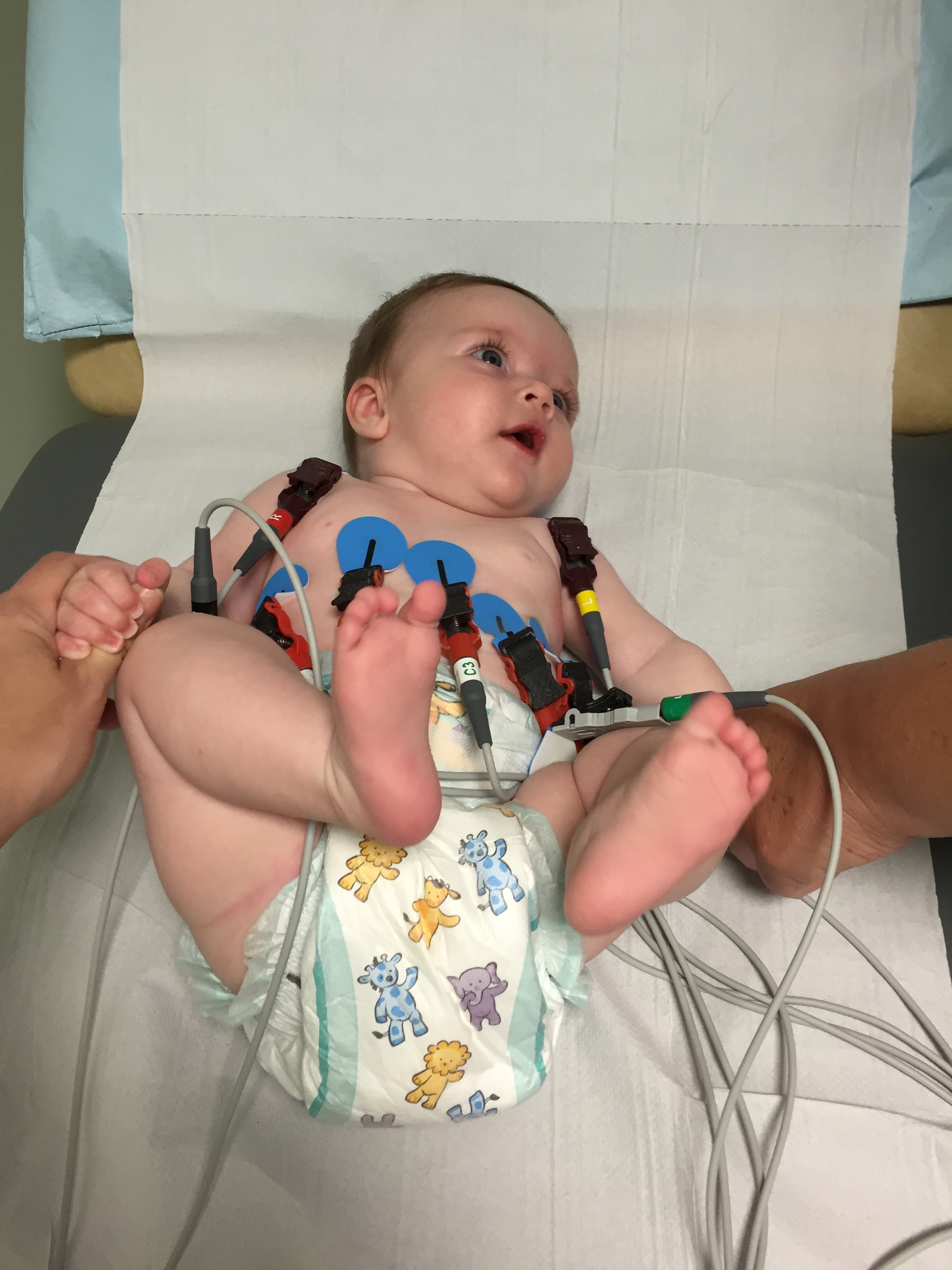
In order to reach a diagnosis, I had to watch a 7-week old Freya battle constant temperatures above 39 degrees for over 2 weeks.  Her heart rate was dangerously high.  She was resuscitated in a high dependency unit after her body started to shut down.  She had cannulae in every site possible in her tiny body, delivering a cocktail of various potent antibiotics, ibuprofen and paracetamol, and she was being fed through a tube.   She had blood taken every day for a period of 6 weeks, sometimes twice a day.  She had an MRI scan, ultrasounds, x-rays, ECG’s and echocardiograms.  She had 2 lumbar punctures, one under general anaesthetic which they performed at the same time as performing a bone marrow aspiration to test for Leukaemia.  She received a blood transfusion when her haemoglobin levels dropped dangerously low.  And she has received intravenous immunoglobulin – a product that is derived from thousands of blood donors – as well as a drug that shuts off the protein that is instrumental in the body’s fight against cancerous cells.  She is not even 6 months old yet.

Sounds shocking to read it all like that, doesn’t it? See all the tests that she underwent, just to try and work out what this illness was.  Kawasaki Disease threatened to take her life.  If the Rheumatology Consultant that came so see her on Day 12 of her illness had not suggested performing another echo “just as a precaution” the damage to her heart would have remained undetected, and her coronary arteries would have continued to dilate further and further until perhaps they wouldn’t have been able to stretch any more.  That means rupture.  Rupture means sudden, unavoidable, unpreventable death.

Now think about what you just read about Freya, and imagine now that her case is not the worst by far.  Yes she had a severe presentation of the disease, and her life was in very grave danger.  But as I type there are parents fighting against doctors won’t entertain a KD diagnosis, parents whose precious children have been in hospital for weeks struggling to fight off the disease, parents who still co-sleep with their children for fear of losing them, and worst of all there are parents sitting at home wondering how they will ever recover from the death of their child.

I cry every day.  I cry when I hold Freya in my arms and am overwhelmed with how much I love her.  I cry because I can’t shake the images in my head of how close we came to losing her.  I cry when I see other people happy, without a care in the world and no appreciation of just how lucky they are.  I cry because I am still heartbroken that this happened to my baby girl, before we had even had a chance to get to know her properly as Freya, just Freya.  I cry because I am so scared about the future.  I cry because I daren’t take Freya to baby groups for fear of her contracting chicken pox or the flu (as they can develop into another rare and potentially fatal disease, Reyes’ Syndrome) and I cry from guilt that she is missing out on a massive part of her development as a result.  When I visit the children’s ward at the local hospital where this all started, I have panic attacks.  Even this week, when I thought I’d be ok and felt no anxiety approaching the hospital, I was suddenly struck by uncontrollable sobs, and I couldn’t breathe.  I cry because I am grieving for the loss of my child’s health – she was perfect when she was born; Kawasaki stole that from me far too soon.  I cry because I feel the pain of every parent who is going through this, or something similar.  And I cry with frustration that more isn’t being done to improve the advice and support that is currently being offered by the medical profession.  Chances are I cry a lot because I sleep for less than 4 hours a night; not because I have a young baby – she sleeps through the night – but because I am permanently researching the illness or related issues, or communicating with parents and doctors on the other side of the world.  I cry because I am devastated, because I am sad, because I am frightened, because I am exhausted, because I am frustrated.  I cry because I cannot forget the journey we have been on, and am haunted by the playback of the last few months, which is constantly on repeat.
Sunny with a chance of rain

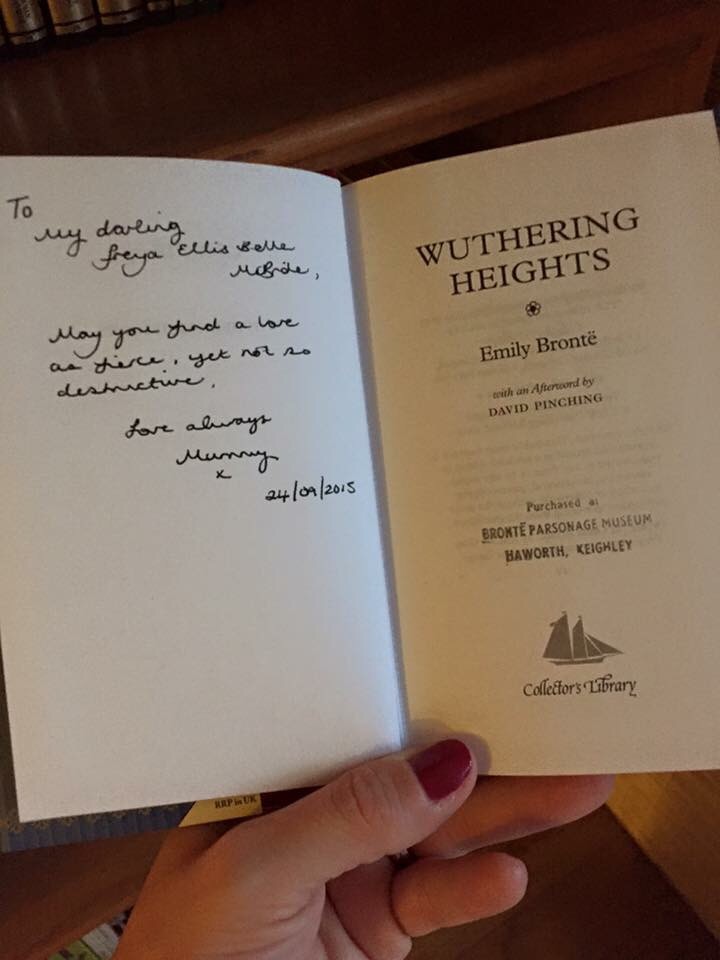
Today I took my daughter to Haworth, home of the Brontë sisters. I have always been a fan of classic literature, with Austen and the Brontë’s being right up there with my favourite writers. In fact all of my children are named because of my love of literature; Eliza (as in Bennett, Pride and Prejudice),  Finlay Austen (as in Jane) and now Freya Ellis Belle (for those of you that don’t know, Emily Brontë, author of one of the worlds most renowned classics Wuthering Heights, wrote under the name of Ellis Bell for a time).  Of course I was indulging myself with this trip, but I thought that while I am on a quest to make special memories with Freya, memories that will wipe out the ones I have so far, what better place to start than in the place that my inspiration called her home. It was going to be a wonderful day out, and Freya would surprisingly love it too; she was going to share my love of literature as a result of this early exposure. Oh how we kid ourselves!

In reality, the day didn’t start very well.  Having taken a look at the Brontë Parsonage Museum website last night I became aware that the quaint old village of Haworth wasn’t really built for my ultra-modern pram (or anything with wheels for that matter).  The streets are cobbled, and the house itself has a steep staircase that renders it impossible to manoeuvre with any kind of vehicle. I needed a baby carrier and would have to try and get one before I set off on our road trip.

After I dropped my son off at school this morning, I drove to our local Mothercare.  There were about 8 different types of baby carrier on the shelf and I set about making an informed and practical decision (otherwise known as picking the nicest colour). My eye was drawn to a sling type carrier in a fetching lilac.  Having asked if I could try them on, I removed it from the box and tried it on. Hmm. I have no idea how a baby is meant to be carried in one of those things. I even took Freya out of the pram for a dummy run but daren’t let go of her once I had her in it. The member of staff didn’t seem to know much about how it should fit so I decided to give it a miss. Bored of being in her pram, and now particularly peed off that I’d taken her out and put her back in again, Freya started whinging. And then crying. And then screaming.  I knew she was not in need of anything – she had not long had breakfast, and had a clean nappy on – so I continued to look at the other brands and styles on the shelf.

Now, I’ve never been very good with noise, particularly when I’m feeling a little anxious. And the more noise Freya made, the more anxious I became. I took another carrier out of the box but it looked like you would need a degree in engineering to work out how to get it on. I struggled for a bit, but the more I tried to read the instructions, the more Freya cried and my anxiety grew. I had such high hopes for our day and these minutes in Mothercare were minutes I couldn’t afford to lose with a 90 minute drive ahead of us. By the time a member of staff came to assist, I was in tears on the floor of the shop with open boxes around me, trying to make sense of the instructions.  The lady was really sweet, and did her best to help me into the one I had chosen. Freya was still screeching.  I was so embarrassed by my little meltdown that I just said I’d take it. I asked her to box it back up and take it to the counter while I took Freya to the baby room to change her and feed her. Cue stupid moment number 2 when I had to come out 2 minutes later having realised that I had left all our paraphernalia in the car not expecting to be in the shop for as long as I was.

Drama aside though, I don’t know how you are supposed to safely put a baby in a baby carrier by yourself, and I’m glad I didn’t just pick one up and walk out of the shop without trying it out first.

By 10:30 we were finally on our way, and although a little shaken by my emotional outburst in the baby shop, I began to look forward again to our little trip. I’d picked a nice day for it and the sun shining as we left.  As we got closer to Haworth though, the heavens opened, and I couldn’t help but smile at how fitting the weather was as I drove over the Yorkshire Moors, picturing Cathy and Heathcliff running for the shelter of a tree.

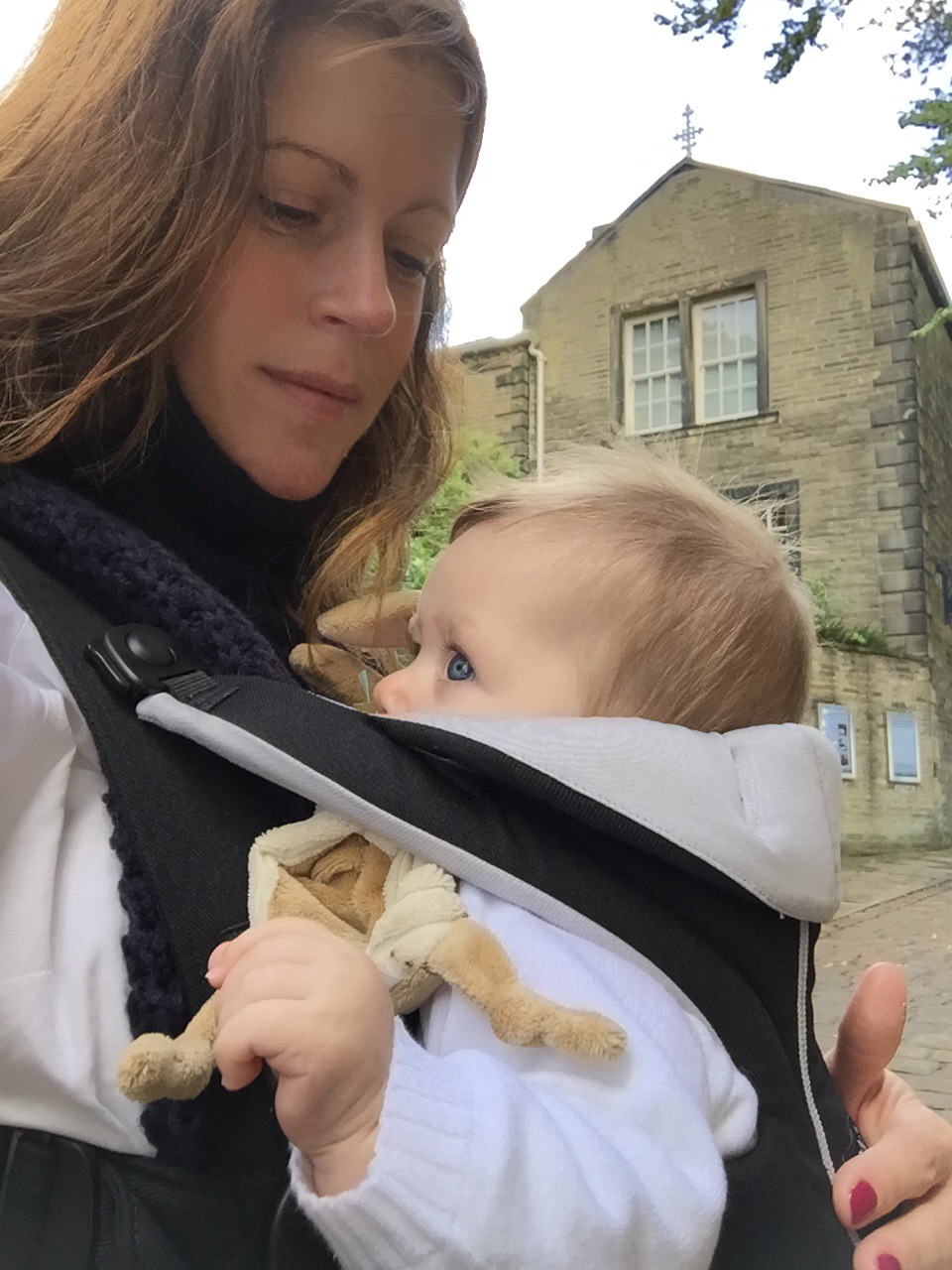
The sat nav kindly sent me around the block a couple of times before I found the car park, but I found it and I got easily parked. I decided to get the pram out of the boot as I had an idea that the village wasn’t far and I’d get the chance to scope it out with the pram and come back to the car if I needed to. The Tourist Information office advised me to ditch the pram, even offering to let me leave it in their shop. I took it back to the car, got Freya into the carrier with surprising ease and walked back into the village.

I’ve been feeling quite tearful and overwhelmed by things these days, and today was no exception. I had tears in my eyes as I walked through the village, chatting to Freya held close against my chest. We arrived at the Parsonage Museum (which has its own car park, doh!)  and went inside. The man on the door was lovely and chatted to us before we had a chance to move on. He thought that it was lovely that we had named Freya after Emily, and that I had taken her there specifically to make some memories.  I walked slowly and thoughtfully around the house, taking everything in. I was particularly taken by the artefacts, especially the portable writing desks belonging to Charlotte and Emily with all their trinkets. Makes you feel closer to them somehow, which is strange because they died so long ago. One of the curators came over to speak to Freya and remarked that she was about the same age that Anne Brontë was when the family moved to Haworth, and said how nice it was to hear a baby in the house.  She pointed to a room across the hall, labelled ‘Charlotte’s Room’ and said that Anne would have probably had that room when she was brought there and that it might be a nice place for me to look with Freya. It was in fact the room in which Charlotte Brontë passed away, and I felt an incredible sense of sadness as I stood looking at a painting of her above the fireplace. I stood there for while, Freya stared too. And as I rocked from side to side taking the picture in, Freya drifted off to sleep.

IMG_0826I finished off the tour, and bought a few things in the gift shop including a copy of Wuthering  Heights which I planned to write an inscription in for Freya. I don’t know why my heart felt so heavy as we left. Moments like these with Freya are more special to me than any other moments in my life. I know that might sound bad because I have a husband and two other children; they are special to me too. But time with them tends to be moments of madness, of getting ready for school, of bedtime routines. I have become quite accustomed to just being with Freya. We are like two halves of a whole who are only truly content when we are linked together in some tender moment. She stares, so intently sometimes that I wonder if she can see into my soul. And I’m reminded of an earlier post, “cleansing the soul” that I wrote before all this, before KD.

I am hoping that the dark cloud that follows us whenever we are trying to make new memories is something temporary, a symbol reminding me of the trauma we have been through together. Perhaps when I’ve started to get some support with how I’m feeling that grey cloud will start to dissipate and we will be allowed to have sunny days without the threat of rain.

A quest for peace

Today I accepted that I might need some support to move on from this thing. I don’t mean forget, I mean how could I ever forget what we’ve been through? And I would never want to shut KD out of my life completely, because I feel like I can be of use somehow in raising awareness of this elusive disease.  But I do need to work out how to process it all.

I have spent the last 3 months or so immersed in the world of Kawasaki Disease; at least the world that I can access through medical journals and the Internet, tirelessly reading, learning and challenging. And that’s all great, but it only serves to distract me from the fact that I am still a mother, and I’m a mother with a fracture in my heart.

I am surviving on very little sleep. I stay up until the early hours of the morning, sometimes researching, other times just thinking. And thinking. And thinking.  I stare at photographs of Freya and I feel grief, and then I feel guilt because she’s still here isn’t she. I’m not sure how long it takes for sleep to take me when I finally do go to bed, it feels like I am laid awake all night. I hear every sound that Freya makes, from the familiar sound of her breathing or when she does that little grunt under her breath, to all the unfamiliar sounds that strike fear into my very soul; what was that? Did something happen??  And then there’s the silence, when I lie awake holding my breath, waiting for her to make a sound, any sound, to reassure me that she’s still ok. For those seconds I lie frozen, wanting to reach across and touch her to be sure, but too afraid. It’s irrational I know. The risks she faced at the beginning of this journey are no longer a source of constant worry. I know every new mum experiences degrees  of worry about losing their child. I don’t have the monopoly on those fears. But I feel sick with anxiety from the thought of losing her.  Thoughts are not facts, Joanne.

I think on the whole I have handled this thing pretty well. In all honesty I’m surprised I haven’t cracked up completely. I think there must be a strength inside all of us that we never find out until we are faced with something big.  But you can’t be strong always. I thought that by writing my blog I would exorcise a few ghosts, but it doesn’t seem to be working as I had expected.  Maybe because the blog doesn’t answer me, so my words are left hanging in the air like a dense fog.

Most days I’m good. I’m not a neurotic parent, watching over Freya 24/7.  I don’t put her up in her room for naps like I did with my other children, allowing her to fall asleep on her playmat when she’s tired herself out. To be fair, though, she’s so content she can be playing one minute and sleeping the next. But I do take her up to bed in the evening, and she sleeps in her cot in our room from 6pm until 7am the following morning, later if I let her.  Of course either me or my husband tiptoe upstairs at regular intervals throughout the evening, but that’s normal. I get on with the housework, or I hang up the rubber gloves and play; depends how clingy Freya is feeling at the time. We get out and about, I enjoy little trips out with her.  We went to York on the train the other day to see my niece who has just started at University there. I am my most content when I’m mooching about, pushing my little Peanut in her pram. But every now and again, more frequently these days, I am aware of a dark shadow following me around and I am transported back in time to those weeks in the hospital. Every day I relive a part of our journey and the tears fall silently down my cheeks, sometimes completely unprompted, other times triggered by a tender moment with Freya, a conversation, something on TV.  Tonight I watched a programme where a 3-month old baby was put to sleep for surgery, and the tears appeared within a nano-second. It’s still so raw.

I thought I could handle it alone. Of course I was going to be feeling like I do after this ordeal. But I thought that every appointment that brought good news would take the pain away. But it doesn’t and I so want to celebrate Freya’s triumphs over Kawasaki Disease.  I need to package the last few months up into an easily accessible box and store it away in the corner of my mind where the unpleasant boyfriends and school bullies live. But right now I’m on a ride that I can’t get off. I have to find some peace with KD; need to accept that no amount of hating this disease and the uncertainty and lack of concrete information that goes with it is going to change the fact that it bulldozed its way into our perfect little life and left its mark on my precious girl.

Kawasaki and I are not friends, nor will we ever be. All I can hope is that over the coming weeks, with whatever avenue I choose to help me get out of this kawahell, I can focus more and more on a bright future than on the dark and dismal past of the last few months. Here’s to a day when I might look at Freya without being haunted by memories I wish I could forget.

A productive day and a Superbaby

So today has been a Kawasaki day; I’ve spent most of it either conducting research, replying to e-mails or producing information slides.  Not quite what you can call getting back to normal.  But needs must, and if I didn’t spend as much time reading and learning as I do, then I would be at the mercy of our medical profession who are great, but can’t seem to agree on the right treatment or after-care for this disease.  It makes me so angry that I don’t feel I can rely on the information I get because at every turn there is something that will contradict the last piece of advice you were given.  Just when you feel like you are getting somewhere, another nugget will drop in your lap and you’re right back to square one.

So, what did I achieve today?  Well I’ve been battling for a while over how to catch Freya up with the immunisation schedule.  Because she was only 7 weeks old when she went into hospital and has since received treatment that affects the immune system, she has not had any of the 8, 12 or 16 week vaccinations.  About a month after Freya was discharged from the Children’s Hospital, we were advised that she could be given any of the killed vaccines, but no live ones.  I was not given any indication of what was live and what was killed, so had to turn to the internet yet again.  I called our Health Visitor to ask for clarity and they confirmed that all of the routine 8, 12 and 16 week vaccinations are killed (or inactive) with the exception of Rotavirus which is live.  The flu spray is also a live vaccine, but this isn’t routinely offered to young babies; the flu vaccination is inactive however, should Freya be required to have it.

I still felt uncomfortable for some reason.  I guess when you’ve been through an experience like this and realise that the medical professionals don’t always know everything they need to, you are a bit less likely to take the first bit of advice you get.  So I debated and procrastinated until Freya’s next Rheumatology follow-up appointment.  I raised the subject again and our consultant said she was fine to get caught up with all of them, as all the standard vaccines are inactive.  I corrected the doctor and advised him that Rotavirus is now included and is indeed a live vaccine.  You might gasp in horror that a doctor didn’t know this simple piece of information, but what I have learned from our experience in the hospital is that when you specialise in a certain area you really can only be expected to retain the knowledge for that specialism.  Outside of that there are other specialists for different disciplines, and if that fails…well, there’s always Google!

The decision was reached that Freya could have any inactive vaccines immediately, but that we needed to wait for 3 months post-steroid treatment before giving her any live vaccines due to her immune response being suppressed.  I asked about whether Freya should have the chicken pox vaccine because of the risk of a pretty nasty (and potentially fatal) illness called Reyes’ Syndrome which has been known to occur when a child taking aspirin contracts chicken pox (and influenza, I’ve found out today).  The response was that the chicken pox vaccine is only given to children considered at high risk of catching chicken pox.  I replied that whilst Freya might not be high risk for catching chicken pox, she was at risk of developing Reyes’ Syndrome as a result of being on aspirin.   Right now I can protect her from chicken pox to a certain extent, but next year if she has to go into childcare how do I protect her then?  The doctor agreed to take the question away and come back to me with a response.  That response came by way of a letter, confirming that following consultation with Immunology it was agreed that it would be prudent for Freya to have the chicken pox vaccine, it should not be given sooner than 3 months post-KD treatment and we could go ahead and book her in with our GP.  I also e-mailed one of the consultants that looked after Freya in Leeds, who responded to say that there had been little research in this area and as such I should make a judgement call.  Still I felt uneasy.

Since then I have had many conversations with the Health Visitor, and spent countless hours online reading everything I could about immune response and immunisations.  Some of what I read scared me; for instance, a child on aspirin should not have the chicken pox vaccine due to the risk of Reyes’ Syndrome.  Good job I didn’t take Freya right on down to the Dr’s surgery to inject a little dose of the pox into her.  In fairness, I had already decided that I would catch up the inactive vaccines, but leave the live ones until next year when the need for them would be more pertinent.  I had even made the appointment, but after receiving the “make a judgement call” e-mail, I decided to do just that and cancelled the appointment.  One thing I have learned about this KD journey is to trust your gut instincts.  Mine were pretty spot on all through this illness, and even when I tried to convince myself I was wrong, I was over-reacting, my gut won out.  I just couldn’t shake an uneasiness that would creep up on me every time I thought about vaccinations.  I needed to do more research.

As well as research, I’ve kind of gone on a one-woman crusade for Kawasaki Research this last week or so!  I’ve bombarded people on Facebook with please to sign the support group petition.  I’ve just spent a couple of hours reproducing one of the support group’s guide for parents as they didn’t have a soft copy to share.  One morning I woke up feeling so cross that I couldn’t get the answers I needed and angry that parents are basically having to fend for themselves, that I penned an e-mail to our local MP (Ed Miliband) and contacted the local press!  I received a holding letter from the House of Commons this morning, and the local newspaper would like to run a story on Freya to help me raise awareness.

As a last-ditch attempt to get some clarity on Freya’s immunisations, I e-mailed 2 Kawasaki experts; one in the UK and one over in San Diego, California, and yesterday I received the answers that I needed.  Although I have yet to discuss their responses with our doctors, the new information which states we should wait longer before giving Freya any vaccinations at all.  I’m not going to include all the details here as I’ve posted the slides I have pulled together on http://www.facebook.com/freyasstory.  I feel like a weight has been lifted and that I now fully understand the reasons why the immunisation question is complicated.

It’s a bitter-sweet journey with Kawasaki Disease, perhaps with any childhood illness.  I’ve said before that one of the hardest things about KD is the lack of consistent information, and with there being no UK protocol for standard diagnosis and treatment the advice you get differs depending on who you speak to on what day of the week.  That’s why the petition is so important (sorry, can’t help a plug when I get the opportunity!)  Just as you feel that things are getting back on an even keel, something else comes up and bites you in the arse and you’re back in the dark place you thought you’d escaped long since.  And then I remember that Freya is only 5 months old, and it was just 8 weeks or so ago that we returned home after her ordeal.

Today was a day like that, down one minute and up the next.  One of the reasons was the communication between me and the specialist in America.  And she isn’t just any specialist – she’s known as a world leader in Kawasaki Research, having dedicated the best part of the last 20 years or so to trying to find the cause of this disease.  We were to-ing and fro-ing with different questions, facts about Freya’s medication, etc when we got onto the subject of coronary artery aneurysms and anti-coagulation therapy when I mentioned that it would appear that Freya didn’t have a typical balloon-shaped aneurysm, but that her arteries were significantly dilated throughout the whole artery (well, the bit they can see from an echo anyway).  I knew that had meant things were pretty scary for Freya at their worst, but assumed that now the arteries were regressing that she was no longer at risk.  I’d asked the professor if she thought that it was in any way remarkable that Freya’s arteries had regressed so far so quickly:

“Many young [patients] have rapid remodelling of the arteries, so not surprising that Freya did well.  Important to remember that these are still damaged arteries and she will need life-long monitoring…The long segment dilated arteries are actually at greater risk of thrombosis. See attached.  You might want to share this with your cardiologist.”  And the hits just keep on coming.

I haven’t read the document she sent me. I’ve printed it for reading another day when my head is ready to get away from immunology and back to cardiology.  As long as I read it before the next cardiology follow-up in November, we’ll be ok.  Sometimes I wonder if I ought to do a medical degree!

But, like I said earlier, a life with KD is bitter-sweet, and I am glad that today I get to leave my blog on a high note.  After I received the above response, I replied to the doctor to ask if she felt that under the circumstances it was appropriate for Freya to be treated solely with aspirin and asked for an opinion on anticoagulant therapy.  This was her reply:

“…does not qualify for systemic anticoagulant now but did at start.  We would treat with dual anti platelet agents…I suspect she is safe and fixing the problem on her own.  Well done, Freya!”

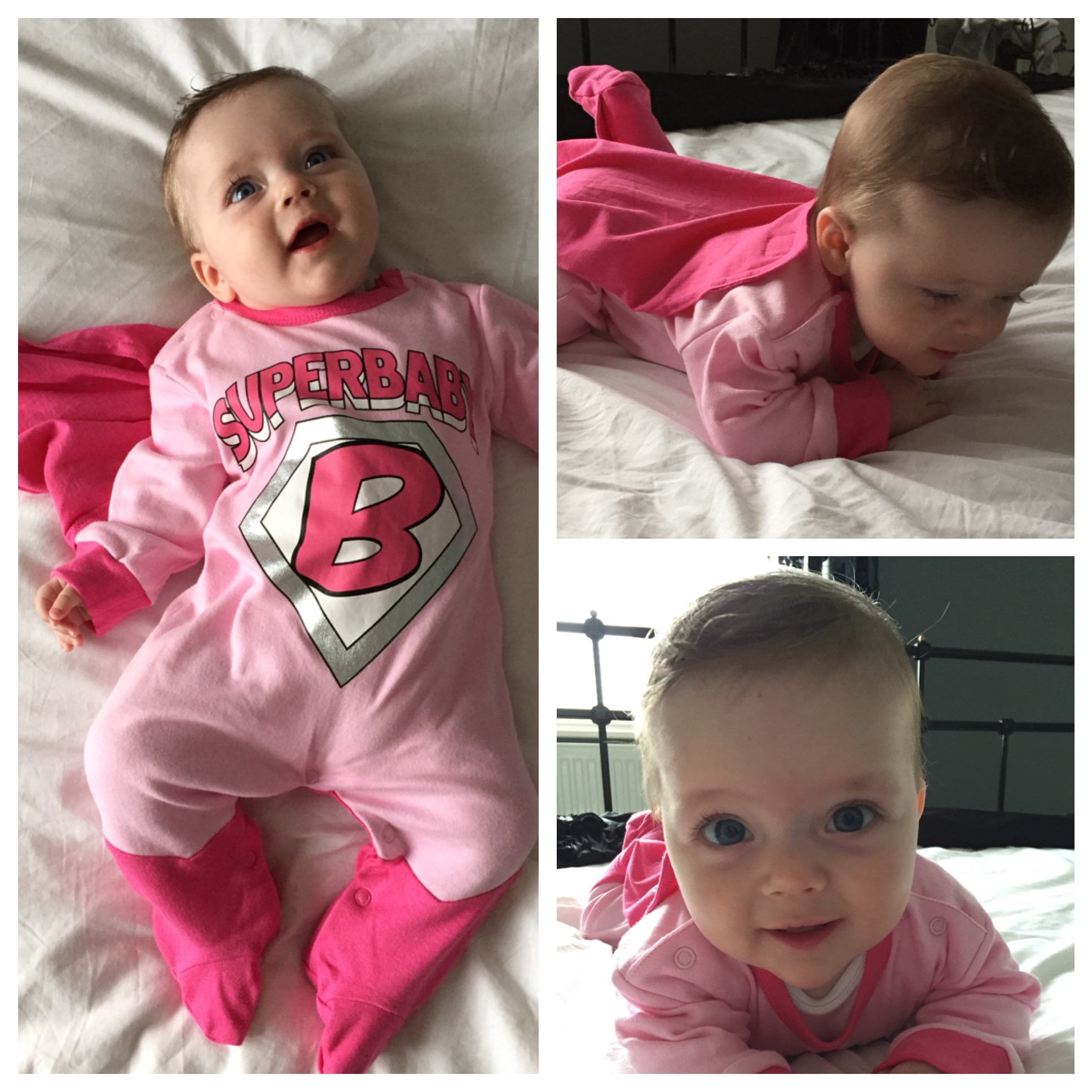
That is an e-mail I won’t forget in a while, because in just a couple of brief sentences a doctor over the other side of the world who has never met Freya or seen the details of her case, managed to sum up just how remarkable Freya is.  She has had to deal with more in her short time here than some of us will ever have to deal with in our lifetime.   She barely cries, she takes to every new experience like she’s been here and done it all before.  She is calm and content, and absolutely beautiful.  She is my little Peanut, and she is a Superbaby…

IMG_0326

Out of the mouths of babes

Sometimes I forget that Freya’s diagnosis didn’t just happen to her, and me.  It’s like I’m caught up in this kawabubble where my thoughts and feelings about what happened to her are all-consuming, and I have to remind myself that I am not the only person affected by Kawasaki Disease. It sent my whole world into an uncomfortable darkness; a darkness that enveloped not only me, but my husband and children and the wider family.

I think I did a pretty good job of protecting my children from what was happening to their baby sister.  They had already gone through a massive change in their environment when we brought Freya into the world, and suddenly Eliza (11) wasn’t the only girl and Finlay (6) wasn’t the baby anymore.  They handled the introduction of a fifth family member pretty well, and with just the right amount of balance.  Let’s face it, newborn babies can be pretty boring and when both kids realised that there was very little they could do to interact they soon got bored and went about their own business; Eliza up in her room listening to music and making make-over videos, and Finlay with his head stuck in Minecraft on my iPad.  They showed a little interest, but their mum was constantly feeding or changing the baby so there wasn’t much for them to do.  That said, it must have come as a huge shock to them when after just 7 weeks with a new baby sister in the home, she was taken from them, and with her went their mum.

When Freya became ill on Sunday 31st May 2015, we played it down and explained that because Freya was so young we weren’t able to give her any medicine, so we had to take her to the doctors to see what they could do about her temperature.  We said she had a cold, and in all honesty we thought that might be just what she had.  I don’t remember what time we were finally admitted to the children’s ward but I imagine the kids were in bed by the time their Dad got home so he was spared any explanations after a stressful and upsetting afternoon in A&E.  I’m not sure what was said to them the following morning, but Gavin had to leave them before they awoke as I had called him at around 6am to tell him he needed to come to the hospital.  Freya had taken a turn for the worst and had been rushed to the high dependency unit.  Luckily we have a great support network and it just so happened that my mum had come to stay with us for a visit so there was no need to wake the kids when my husband left.  We continued with the story that Freya had a bad cold, but that the medicine she needed had to be given to her at the doctors. I remember my daughter asking where Freya was going to sleep at the Doctors, so I guess then we told her that we really meant she was in the hospital.

On the Tuesday, Eliza was going on a school residential trip to Northumberland for 4 days, which in some ways was good as it relieved some of the pressure for us for a few days.  Finlay hadn’t asked any questions and was unlikely to, but Eliza is more astute and we couldn’t have kidded her for long.  I knew I had to present a brave face for her to be able to go off happily on her school trip and not worry about her little sister. We were not allowed contact with her while she was away, so again we were able to avoid any questions.  I remember she was quite upset on the Monday as she was worried about packing her bags without my help, and I had promised to see her off the next morning.  I nipped home with a heavy heart on the Monday evening to help her pack, and raced back to the hospital.  On the Tuesday morning, one of the family came over to sit with Freya in the HDU so that I could leave to be home with Eliza as she prepared for her trip, then my husband and I took her to school and waited to see her off on the coach. Every inch of me wanted to be back in the hospital with Freya. At that point her condition was pretty critical and I couldn’t shake the feeling that if something happened when I was away from her I would never forgive myself.  And so I went through the motions of being a caring mum, excitedly waving off my child on a school trip.  I remember staying as far away from the other parents as I could; I wasn’t strong enough to engage in conversation.  At that point no-one even knew that Freya was poorly.  People kept coming over to us and asking us how Freya was, how we were settling in with a new baby, were we getting any sleep; the usual newborn banter.  One person asked where she was and my husband replied that she was with his mum (not a lie), and they responded with “Don’t be getting too used to that!”  If only they had known, at that point the notion of getting used to a life without her seemed very probable.

I had to move into the crowd of parents once my daughter was on the coach so that she could see me and I could wave her off.  One mum gave me a little nudge and asked if I was ok.  I tried to shrug it off, but she pushed again.  She knew that I had suffered with post-natal depression with my first child and was worried that I might be struggling again.  And then the tears came, and I told her that Freya was in hospital being treated for suspected bacterial meningitis.  Another mum touched me on the shoulder and kindly said to turn around, as Eliza was looking out of the window, so I wiped my tears, painted on the biggest smile I could muster and waved and blew kisses like I should.  When Eliza returned from the trip days later she made fun of me; “And you said you weren’t going to miss me, you were the only mum that was crying, haha!”  I’ve never corrected her; I was happy for her to keep that illusion.

I didn’t see either of the children for the rest of that week.  Finlay didn’t ask any questions, other than the odd “When’s mum coming home?” or “Where’s the iPad?” but his behaviour at school took a bit of a nosedive.  Fin can be a challenge at the best of times, but it was the first week back at school after the holiday and he was clearly unsettled.  On the Sunday (Day 8) we felt it was time to let the kids come and visit their baby sister in the hospital.  By then the cannula in Freya’s head had been removed, which made her look a little less scary, and the Ward Sister had been doing everything she could to help us try to get Freya back to feeding normally, and off the IV fluids.   I had been home on the Saturday night and left my husband in the hospital; I needed a good night’s rest.  On the way over to the hospital I tried my best to prepare the kids for what they were about to see.  I asked Fin to tell me how he thought Freya might look, and he said she would look poorly, and pale and probably tired.  I described the room to them, and explained that every room was fully equipped for all eventualities, and not all of the equipment was there for Freya.  When the children arrived, Freya still had cannulae in her wrists, and a feeding tube in her nose, but we played it down, focussing Fin on how cool it must be not to have to bother to eat and just get food poured down a tube straight into your tummy. I don’t remember Finlay having much to say when he saw Freya.  He had spied the play area opposite our cubicle and was distracted by the Playstation.  I was glad for the distraction.  Eliza seemed more affected by the situation, and sat quietly with her grandparents on the sofa most of the time.  It was that morning that a consultant came to see us to advise of the transfer to Sheffield. He said we had been there long enough without a diagnosis and had it been his child he would not be satisfied.  Our efforts to play the situation down were scuppered when a nurse entered the room to tell us that an ambulance was on its way.  I remember seeing Eliza’s face full of panic and confusion.  Why were we going in an ambulance? Why were we moving to another hospital?  I reassured her that we weren’t allowed to drive Freya ourselves whilst she was an inpatient, and that we were moving because Sheffield had all the medicines there that Freya needed.  She seemed satisfied.  Looking back, I think I underestimated her.

We kept the visits from the children to a minimum over the 6 weeks we were in the hospital.  They visited less than a handful of times in total; once in Doncaster and a few times in Sheffield.  They didn’t come to Leeds.  Once my mother in law came over and sat with Freya for the afternoon whilst my husband and I took the kids to the museum across the road from Sheffield Children’s Hospital.  It was our attempt at a bit of normality, and it worked if only for a short while.  Whenever they visited, Eliza would become upset when it was time for her to go.  She’d ask if she could stay with us, but that wasn’t possible or appropriate.  It had been a pretty significant time for Eliza; she had recently had her SATS, it was her junior school graduation and she worried I wouldn’t be there (I was), and she would be starting a whole new chapter at Secondary School after the Summer Holidays.  This was a lot for her sensitive soul to deal with on top of all that.

All in all, I think we did a pretty good job of protecting the kids from the seriousness of the situation.  We didn’t feel that either of them needed to be frightened for their sister’s life.  Although Finlay didn’t say much to us about it, other than “Is she better now?” which we answered in the affirmative, I was told by one of his teachers that he had been quite excited one Friday at the thought of me coming home, saying “My mummy is coming home tomorrow because she wants to spend some time with me now.”  Funny how a 6-year old mind works; in his small view of the world his mummy had 3 children, but had chosen to spend her time with another and not him.  His behaviour settled down once we were back home, and things started to return to something close to ‘normal’.

It was a tough Summer holidays for both kids really.  With Freya’s immunity shot to pieces, we couldn’t do any of the things we might normally have done, or the things we had planned and promised to do.  There were times when Eliza would seem frustrated that we couldn’t go on holiday or have friends round like we might have done.  But she’s not a spoilt kid, so I know she didn’t mean any malice.  I had never asked Eliza how she felt about the situation; I guess I didn’t want to put her on the spot in case she hadn’t felt anything much at all.  I saw a glimpse of how this has affected her the day before she started her new school.  She came downstairs to say goodnight and I noticed a friendship bracelet on her wrist.  I told her she would need to remove it as the school had a strict policy on jewellery.  She couldn’t remove it, she said, it was a wishing bracelet.  A friend had bought it for her for her birthday a couple of weeks before.  You have to tie it on and make a wish, and only when it has unravelled will the wish come true.  We argued for a little while and she ran upstairs crying.  Then it hit me. I followed her up and said “So come on, tell me.  You’ve either wished for a puppy or it’s something to do with Freya.”  Tears rolled down her cheeks as she told me that she had wished for Freya to get better, and if she took the bracelet off her wish wouldn’t come true.  I said “Freya is better”, and she answered “No, I mean really better.” (by this time she was aware of the complications with Freya’s heart, but only to the extent of “the illness has made Freya’s heart a bit poorly”).  I held her in my arms and told her that no wish was going to make Freya better.  She was getting better every day, and would continue to get better because she was receiving the right medication, regular follow-up and had a family that loved her.  I said that if anything were to happen to Freya it would have nothing to do with that bracelet, and managed to pull it off over Eliza’s hand in tact.

On Friday last week, I sent an e-mail to our local press to ask them for their support in promoting the change.org petition.  A reporter called me that afternoon and interviewed me over the phone as they are interested in running a story about Freya.  During the conversation the reporter said, “You said you have other children?  How have they coped with all of this?” and I answered that they had been very level-headed about it and did not seem affected by it at all.  And then I realised that I couldn’t really say that for sure as I had never asked them.  Well, I don’t think I would ask Fin, but I wondered if I should ask Eliza.  So after the interview, I put the phone down and asked Eliza how she had felt when her sister was in the hospital.

“I knew something wasn’t right, I mean she was in there for ages and she had all those tubes and machines and things.  And you were there with her all the time.  She must have been really poorly.  And then I…I can’t say this to you…”  I urged her to go on.  “I thought only one of you would be coming home.”

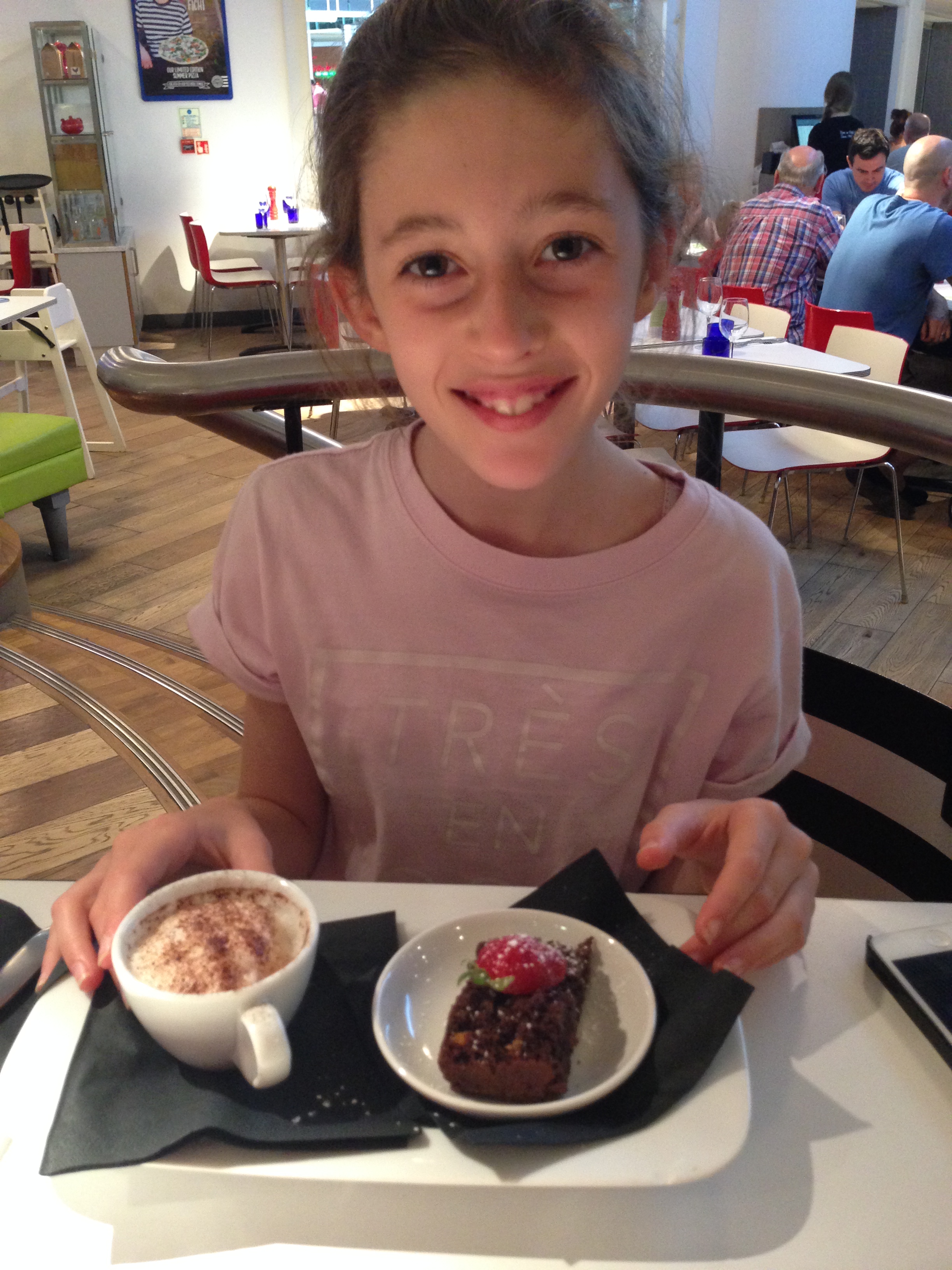
I don’t know if how I handled this was right or wrong.  Is there a right or wrong way to deal with something like this?  Or do you just do whatever feels right in your heart at the time?  I do not regret keeping the majority of Freya’s story from my children.  What I do regret is underestimating the impact that losing their mum and their baby sister for 6 weeks had on them, and not giving my daughter credit for her intuition and intelligence.  Had I known, I would have invested more time with her during mine and Freya’s ‘incarceration’.  We did have one special day – graduation dress shopping and lunch at a nearby shopping centre one Sunday.  And whilst practically every inch of me yearned to be back with my Peanut, this smile on this face was worth every second I was away from the hospital…

IMG_5479

What’s in a Petition…?

If Freya could talk, she would be saying a huge THANK YOU to the 39 people who signed the petition for me today (not to mention the 150 that had prior to today’s plea).  My e-mail has been pinging notifications at me all day, and each one has made me smile.  But, there are still less than 2,500 signatures in support of the petition, and that makes me sad.

To a lot of people, a petition is generally someone trying to stir up some kind of trouble.  I know I’ve always steered clear of them in the past, leaving them to the militant types that like to wear a sandwich board and march up and down the precinct yelling at passers-by about some political view or another.  The word rouses all kinds of images of do-gooders, activists and trouble-makers with extreme views.  But what does the word ‘petition’ actually mean?  Well, the dictionary definition is that a petition is “a formal written request, typically one signed by many people, appealing to authority in respect of a particular cause.”  And that is exactly what the Kawasaki Support Group UK’s petition is – it is an appeal to the NHS to raise the profile of Kawasaki Disease and inject some much-needed funding into research that will support the diagnosis, treatment and after-care of this terrible, yet little-known disease.

So, in case you are reading this and haven’t signed, or at least shared, the petition I thought I’d give you a few of my reasons for so energetically encouraging your support (otherwise known as boring you with endless posts with the petition link!).

First of all, I would like to clear up a question around the origin of the petition.  It isn’t mine, and it wasn’t my idea.  It was the brainchild of one of the founders of the Kawasaki Support Group UK who had a light-bulb moment one evening and thought it was time to try a new tactic to raise awareness and drive support.  The KSSG might sound like an elaborate and vast organisation, but it is not.  It was created by 3 mothers after their children suffered from Kawasaki Disease many years ago, when information was less readily available than it is today (and that’s saying something). I think it was even before the internet was born, so hats off to the founders for getting where they did.  It is a voluntary organisation dedicated to supporting and informing parents of sufferers (and indeed sufferers themselves) of this sinister disease.  Whilst I have led my own one woman research mission into this disease to make sure I was adequately advocating for Freya, I will not forget the support this group offered me in my darkest days.  This is the least I can do to pay that forward.

Why I am sad about the numbers of people supporting the petition is because I know how many supporters the KSSG have, and how many members their Facebook support pages have too.  And if every one of them were to sign, and share, and ask their friends to sign, there would be hundreds of thousands of signatures on that petition, instead of 2000.  Since Freya became ill, I have felt completely helpless and out of control.  The feeling that your role as protector has been snatched away from you, and the realisation that you cannot protect your child no matter how hard you try, has been emotionally debilitating.  But then this petition came along, and I suddenly felt a sense of purpose.  I felt like there was something tangible I could do that could help give Kawasaki Disease a voice.  It may be rare, but it is the world’s leading cause of acquired heart disease in children.  That has to count for something doesn’t it?

In case you are reading my blog for the first time, and have not been with me on my journey with Freya, let me tell you a few things about why it is imperative that we drive for a common protocol for handling Kawasaki Disease.

  1. There is no known cause.  There are suggestions that there is some genetic predisposition and a viral or environmental trigger, but research has been undertaken that suggests that the winds, stagnant water, carpet cleaners and even soy consumption could be factors that determine whether your child is unlucky enough to develop the symptoms of KD, none of which has reached a definitive conclusion.  You can have no warning that it is coming.
  2. There is no diagnostic test.  Without a cause (or ‘aetiology’ to use the correct term), the medical profession cannot develop a test.  As a result many cases are diagnosed too late to prevent coronary complications, or worse still cases go undiagnosed altogether and result in the worst possible outcome.  The lack of a diagnostic test, combined with a sneaky disease that likes to present itself as many other childhood illnesses do (meningitis, scarlet fever, for example) means that children suffer for days with soaring temperatures, septic shock, pain and discomfort, not to mention the daily blood samples that are taken, day or night, whilst the Doctors and Specialists try to ascertain what is wrong with them.  They’ll test for everything they can think of, and then test for the things they didn’t.  They will subject children (and babies as young as little Freya) to a series of medical procedures – lumbar punctures, MRI scans, echocardiogram, bone marrow aspiration (in Freya’s case), ultrasounds, x-rays, to name but a few – and still no answer.  The child will often receive a cocktail of broad spectrum antibiotics in the hope that whatever it is will be zapped by one or other of them.  They might even have a blood transfusion like Freya.  And that’s before a diagnosis, when the real heavy drugs are introduced.
  3. There is no standard UK or International protocol for the treatment of Kawasaki Disease.  Once diagnosed, it is pretty standard to administer a dose of IVIG (intravenous immunoglobulin).  It’s a blood product, made up of antibodies taken from over 1000 blood donors.  KD is a vasculitis – it causes inflammation in all of the blood vessels in the little child’s body, until it eventually reaches the coronary arteries (they’re the ones in your heart), causing varying degrees of damage.  That damage is responsible for the ongoing health issues suffered many years after diagnosis for some children.  For others, that damage is responsible for a life being taken far too soon.  After IVIG, it all becomes a bit more sketchy.  Some are left at that.  Some go on to have a further dose, others have even more.  Some receive steroid treatment.  Once it has been ascertained that there is heart involvement, most (if not all) children will be placed on blood thinners (like aspirin).  Where the coronary dilation is at its’ most severe, some are given anticoagulant therapy – but which one is used varies from county to county, and country to country.  Heparin? Warfarin? There are many different views.  And then you will find a specialist who has an opinion about the use of a ‘new’ drug that might not have been widely used in the treatment of KD.  Freya was one of those cases, receiving permission from NHS England for Infliximab to be given due to the severe presentation of the illness in her specific case.  Because of this inconsistency, parents are forced into their own routes of research, and the fear and panic that is born from all the “why didn’t my child get x”, “why did we only get x doses” and similar concerns, is all-consuming.  It makes you feel out of control, and you genuinely fear that your child could die because they may not be receiving the appropriate treatment.
  4. People just haven’t heard of Kawasaki Disease.  I mean, had you?  I know I hadn’t.  And because I hadn’t heard of it, when we received Freya’s diagnosis I was almost relieved. I mean, how bad could it be?  It wasn’t one of the ‘biggies’ like cancer, meningitis, leukaemia… And then a week later you are taken to a room by a Cardiologist who tells you that there is a risk that your baby girl’s coronary arteries could rupture and there is nothing they can do to prevent it, and nothing they could do to save her if it happened.  Don’t get me wrong, I don’t want to frighten people or cause widespread panic that Kawasaki Disease is out to get our children.  Let us not forget how rare it is – affecting around 8:100,000 children in the UK each year.  But, had I known about this disease and the symptoms; had I known that it should be on the medical radar if a child has had a fever, not controlled by antipyretic drugs, for 5 days or more, perhaps I would have asked the question, jogged a memory, sparked a new line of enquiry.  Had KD been on the radar in Freya’s case, maybe the doctors would have looked at that rash a little closer, not so easily dismissed those red, cracked lips as signs of dehydration, not ignored those swollen hands and feet.  When the diagnosis was finally reached (as a result of an echocardiogram showing significantly dilated arteries) it was like all the puzzle pieces suddenly fell into place.  Hindsight is indeed a wonderful thing.
  5. The future treatment and care of Kawasaki victims is unclear.  There is debate over how often a child who has suffered with Kawasaki Disease should be followed-up post-diagnosis.  What if there was no coronary involvement?  Should they be discharged and forgotten about, assuming nothing will change?  What if there was coronary involvement, but improvement or complete reversal has been seen? Do we celebrate their discharge and pray things remain that way?  And what should a long-term treatment plan look like? How regularly should a child be seen, and for how long? What are the success criteria for a full medical discharge? We have been told that Freya will be seen regularly until her coronary arteries have normalised.  Then she will continue to have annual cardiology check-ups with ECG, echo, MRI tests being undertaken, as well as exercise stress testing as she gets older (she can’t even sit up by herself at the moment, so no exertion just yet!).  And if by the age of 15 she has shown no concerning symptoms and the test results are normal, she will be completely discharged, only to be re-admitted should she develop any signs of coronary issues.
  6. The information available about the immunity of these children is confusing.  Kawasaki Disease is a syndrome that kicks off an auto-immune response in the patient’s body.  Basically instead of fighting off whatever virus might have entered the child’s body, the body turns on itself, attacking all the healthy cells.  The drugs that are given have an impact on the child’s immune system.  I won’t even try to explain why or how here because although I have carried out lots of research, I still can’t quite work this one out.  If I could, I guess there wouldn’t be a #6 on this list would there!  Freya was only 7 weeks old when she became ill, and as a result she missed all of her routine immunisations (at 8, 12 and 16 weeks).  The amount of conflicting information I have had in the last couple of months has meant that at 23 weeks old, my daughter remains unprotected from many illnesses and is relying purely on herd immunity – basically we are hoping all of your children have been immunised so she won’t come into contact with any nasties.  We’ve been told to give her the killed vaccines but not the live ones.  She can have the live ones 3 months after she finished her treatment.  Or can she?  Because in the US the advice is to wait 11 months after IVIG.  The blood transfusion Freya received will impact this also.  And then there’s chicken pox.  When my other two children were young, I would take them and rub them all over a kid with chicken pox to be sure they got it when they were young.  With Freya it is different.  There’s something about taking aspirin and contracting chicken pox that can lead to another rare illness called Reyes Syndrome.  It is a disease that affects the brain, and it can be fatal.  We’ve been told that we shouldn’t be concerned as Reyes is rare.  Hmm, pardon me for not being too comforted by the word ‘rare’ these days.  Kawasaki Disease is rare; it still attacked my kid.  Now we are being advised by the consultants to have Freya immunised against chicken pox.  Next month.  I’ve read that chicken pox vaccine should not be administered until 11 months after KD, and that it shouldn’t be administered whilst the recipient is taking aspirin.  Confused?  Join the club.

I’m guessing if you asked other parents, or members of the support group, or even the support group founders themselves, they could multiply this list threefold, more maybe, but I’ve rambled on enough.

I hope that this goes some way to explaining why the change.org petition is so important to me.  Amidst all of the fear, sadness, confusion, frustration and a whole plethora of emotions I could go on to list that go with your child being diagnosed with this devastating illness, there is this one chance to fight for all of the children that have been lost to this illness, and give current and future cases a chance at receiving the attention they deserve.  Parents should not have to spend hour after relentless hour trawling through the internet, reading medical journals, making contact with specialists all over the world just to try to understand their child’s illness and make sure they are being treated well enough to survive it. At times I felt like Freya was a ticking time-bomb and I was racing against time in a fight for her life.  Call that dramatic if you will, but there is no poetic license at play here.  At less than 5 months old, my daughter has already been through what most  of us won’t have to face in our entire lifetime, and I have learned more from this little girl than anyone else has ever succeeded in teaching me.

So please, make an allowance for my constant pleas to like and share Freya’s Story or to sign and share the petition.

“Never doubt that a small group of thoughtful, committed people can change the world. Indeed, it is the only thing that ever has.” ~Margaret Meade

FullSizeRender

You can follow Freya’s Story where I share this blog, as well as updates on her progress and life ‘after’ Kawasaki’s, by visiting http://www.facebook.com/freyasstory 😊

And if you would like to view the petition, sign and/or share, please click on the link below:

https://www.change.org/…/nhs-clinical-reference-group…

Change.org Petition to make a better future for Kawasaki Disease Survivors

“With your signature, we can ensure that every Kawasaki child is given the same chance at recovery the support and care they and their families so desperately need.”

Freya suffered for nearly 2 weeks before a diagnosis was reached, and it was too late to save her heart from the damage that Kawasaki Disease had done.

11990695_885606198200165_4269304241309190643_n

Please take a minute to participate.  Sign.  Share.  Simple.

 https://www.change.org/…/nhs-clinical-reference-group…

Day 100 – Genetic research and echo number 15

IMG_0090Today we went to Leeds for your follow-up appointment.  We went over on the train because it is so much easier than parking.  I’d end up getting myself lost or not being able to find a space and I could do without the anxiety, especially on a day like today.  Not only that, but the car park Daddy parked us in last time didn’t have a lift, so it was lucky he was with me as we had a flight of stairs to carry you up in your pram!  Thankfully the lift at Doncaster Rail Station was working today, and a kind man helped me get the pram onto the train.  We arrived around 1pm, and your appointment wasn’t until 2pm so I decided to go to a restaurant opposite the hospital for a spot of lunch.  I had hoped that it would make today feel more like a normal mother-daughter day out, but with the hospital looming in the distance behind us that didn’t quite work out as planned.  Still, I had a nice light lunch and a cheeky little glass of Prosecco.  I couldn’t help but worry that the Prosecco could be a bad omen; celebrating too early?

I was so pre-occupied when we left that I walked out into the road at the crossing, and an angry man in a van beeped his horn at us.  Ok, so I should have been paying more attention, but he saw us so there was no harm done, eh?! Surprisingly I managed to get you to the hospital in one piece and we headed up to the Cardiology Outpatients department.  We know the drill now, so I told them your name and went and sat in the children’s waiting room.  We weren’t waiting long before they came to weigh and measure you; today you weigh 6.07kg (around 13lbs I think) and you are 63cm long.  After that I took you down the corridor for an ECG.  You are pretty used to those now, but this time it was a bit more challenging for the nurse as you were wriggling all over the place.  In the end it took 3 of us to get the result, with me holding you on one side, one nurse on the other, and another pressing the buttons on the machine!  That was all clear as usual; there has never been any concern over your heart function.

IMG_0091 IMG_0092

A little while longer in the waiting room and your Cardiology Consultant called us into her room.  There was a girl in there on work experience.  I love it when there are students in the room as I get to learn all sorts when the medical staff explain things that they might not have done if the student wasn’t there.  You were pretty good for your echo, although you did keep trying to take over by grabbing the probe, and you kept sticking your foot up the Doctor’s sleeve and jogging her! That’s not very helpful Peanut – we need her to get those measurements spot on!

We weren’t seen by your usual cardiologist last time, so I was anxious to see what your doctor thought.  She apologised for not being there last time, but I explained that I understood because I knew that one of her colleagues had died in a tragic accident that day and it most certainly couldn’t be helped.  She did say that she had seen the results from your last appointment and noted that there had been further improvement which she said was great.  At the last echo, we were told that your right coronary artery (RCA) had normalised to around 2mm (normal for a baby is approximately 1-2mm), and that your left coronary artery (LCA) was dilated to around 3mm.  It had been around 4mm at the echo prior to that so that was great news.  Today your doctor got slightly different measurements (or she was just more specific with the numbers), so your RCA measured 2.6mm and your LCA measured 3.3mm.  I wasn’t concerned about the slight difference in numbers, as we are dealing in fractions of a mm so it is negligible, plus could be attributed to slightly different positioning for measurement.

Once the echo was complete, the Doctor asked how long it has been since you became poorly.  I told her you became ill on the 31st May 2015 and was diagnosed with atypical Kawasaki Disease on the 12th June 2015.  She seemed pleased with the progress you have made in such a short space of time, and is happy to give it a bit longer before your next follow-up.  The next appointment will be in 2 months; thus far they have seen you once a month.  We had a lengthy conversation about risks and concerns, one of which was my confusion over whether or not you had an aneurysm or just (just, ha!) dilation.  In the reports I have received some refer to an aneurysm and others don’t.  We were told some time ago not to be too concerned with the name, as the risks are the same no matter what you call it.  Today the doctor explained that you didn’t have a typical fusiform aneurysm (what they describe as a ‘string of pearls’), but that your arteries were dilated all the way along (as far as they can see on an echo anyway).  She showed me your LCA on the screen and highlighted where the artery becomes normal so I could see the dilated section really clearly.  Apparently that is how your arteries were when the Kawasaki’s took its hold, except they were significantly dilated.  It’s like your LCA was one big aneurysm.  Whilst that was a reason for huge concern earlier on your journey, the fact that they have improved significantly is fantastic.  And as they are regressing, they are doing so in quite a uniform way which is further reducing the risks of anything nasty happening.  I asked the doctor outright if she felt there was any immediate cause for concern, and she said she was no longer concerned and that your arteries were healing well.  Today was the 100th Day of your journey, and this was your 15th echo.  It’s strange how this has become so normal to us now.  Are you really a little miracle, sweetheart?  Your recovery is beyond anything any of us were led to expect.

I then talked to the Doctor about your future and expressed my concern that if you healed quickly they could discharge you too early.  There is a change.org petition underway to enable the NHS to undertake some long-term studies because of a fear that KD victims may be discharged prematurely causing later issues to go undetected.  The doctor said that the longest study that has been undertaken is in Japan, where the results from the study cohort showed that not one of the girls went on to suffer further damage or issues.  It is well publicised that this condition seems to be harder on boys’ hearts.  She said that once they are happy that your heart has repaired itself and there are no signs of stenosis (where the arteries continue to repair too far and close up) or pain, that you will move to annual cardiology follow-up.  At those appointments you will have an ECG and echocardiogram.  The only real way to establish the full extent of any damage to the coronaries is through an angiogram, but she explained that this is tricky in babies as the arteries can be ‘sticky’ and when the tube is inserted the arteries can spasm and stick to the tube.  CT scans can also be carried out, but they involve radiation which is always best to be avoided if possible.  She said as a result they are tending more to cardiac MRI as a means of exploration, so that may well be on the agenda going forward.  When you get to about 7-8 years old, they will start doing exercise testing too, so that can ascertain any affect on your fitness as a result of the disease.  And if by the age of 15 you have shown no signs of continuing complications, you will be discharged, on the proviso that we act immediately upon any signs of potential issues; angina or breathlessness for example.

I ought to be celebrating the results, but I just feel a bit numb really.  I think it is a combination of things.  All the puzzle pieces have started to fall into place as we get more and more informed about your illness, and Kawasaki Disease in general.  Now I understand the looks on the doctors faces when we were sent to the cardiac unit in Leeds.  Now I understand why your cardiologist felt she needed to take me aside and explain the risks associated with the extent of the damage to your heart.  And as much as we need to put the past behind us, I don’t yet feel able to put it all in a box.  I just can’t seem to comprehend what you went through, and how close we came to a very different outcome.  I can also see how very lucky we were that the disease took hold of you so aggressively in that 2nd week.  The clear echo on the first Monday in Sheffield resulted in the doctors ruling Kawasaki Disease out.  Had you not shown us that rash, the Immunology Consultant may never have asked for an opinion from Rheumatology.  Had the Rheumatology Consultant not decided to be cautious and request another echo, you would never have received the IVIG to stop the dilation in its tracks.  As it was you needed a second dose of IVIG and a dose of Infliximab, a drug that is not yet part of the UK protocol for use in treatment of KD.  In some ways, perverse as it may sound, we were lucky you were so incredibly sick.  Had you started to recover with the cocktail of antibiotics they threw at you in that first week, we might have been sent home and your heart would have sustained damage that we couldn’t see or prevent.  Words cannot express how grateful I am to the medical staff who moved so quickly to treat the condition as soon as they had the diagnosis, and the aggressive approach they took to stopping Kawasaki Disease in its tracks.

IMG_0094

So now it is time to start to get back on track to a ‘normal’ life.  We still have to clear up the confusion over whether to immunise or not, and the doctors now want you to have the chicken pox vaccine to reduce the risk of developing Reyes’ Syndrome.  We are still in the middle of the aspirin battle, and your Cardiologist is writing a “strongly worded letter” to your GP to make it clear just how dangerous it would be for you not to have your medication.  Once those things have been cleared up I think we really can start to look forward.  But this is going to be part of our lives for a long time, and I for one will never forget what this disease did to you.  And what it has done to me.  So it is time to start thinking about paying it forward.

This morning we posted the genetic research pack back to Imperial College London, so we will be part of their research study to try to understand the genetic factors that might influence why some children get Kawasaki Disease, but others don’t.  Or why some children suffer coronary complications when others manage to escape that ‘gift’.  Your Rheumatology Consultant wants to present your case to a medical conference, to raise awareness of this disease in the neonatal population, as well as pushing the case for using Infliximab as part of the standard treatment of the disease.  I will never forget one of the consultants saying how much they had learned about Kawasaki Disease from you; you’ve been sent here for a reason little one.

And the next step?  I’ve emailed the professor who is leading the research study to tell him that I am keen to support his efforts wherever I can.  I’ve said that I understand my fundraising contributions will be just a drop in the ocean of the many  thousands of pounds that this research needs, but he has graciously accepted any offer of help and is putting me in contact with a charitable organisation that can help.  He has also said that his international links have donors who will match whatever we raise.  Right now I need to focus on getting over some of the hurdles we are facing, and invest some time in doing some of the things together that can help us to heal from this experience.  But I have my thinking cap on, and will hopefully be able to share with you some ideas that I have to make sure that your story doesn’t only have a happy ending for you, but helps the doctors to find a happy ending for Kawasaki Disease.

Freya’s Story (26)

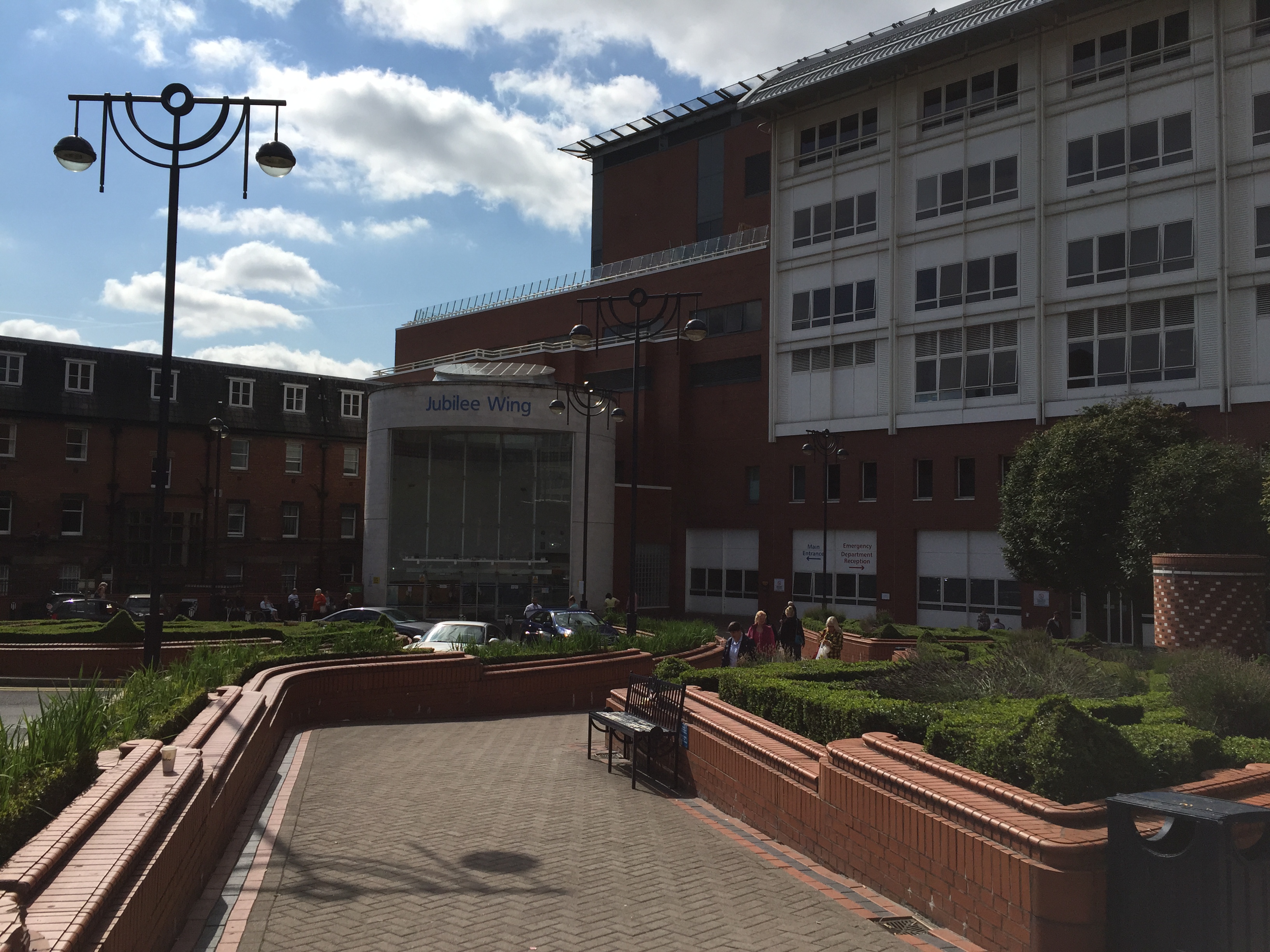
Today mummy had a meltdown that she didn’t see coming sweetheart.  It happened in the place where it all began; the place where you were born, and the place where you were nearly taken away.  I hadn’t expected how a visit to our local hospital would make me feel.

You see we’ve been having a few challenges  getting you the medication that you need.  You now only take 2 medicines; aspirin to thin your blood, and lansoprasole to protect you tummy from the aspirin.  The lansoprasole has a strong relationship with the aspirin dose, so if the aspirin goes up, so the lansoprasole is increased to make sure your tummy receives enough protection.  Sounds simple doesn’t it.  Well, it would be if it weren’t for a number of reasons.  Firstly, the aspirin dose (which is currently 5mg per kilo) is prescribed dependant on your weight.  At the last weigh in you were just coming up to 6kg (5.62kg to be precise), so the consultant increased your aspirin dose to 30mg.  Simple.  Ha! Except that aspirin (well, the cheap aspirin that the NHS supplies) comes in 75mg tablets.  Hmm, tricky. So we have to dissolve a 75mg tablet in 5mls of water and then give you 2mls of the solution.  The lansoprasole comes in a 15mg tablet which we have to dissolve in 5mls of water and then give you 1.3mls (precisely!)  Lansoprasole is intended to be placed on the tongue to dissolve, but clearly at your age you’re going to find that a bit tricky, so I have to dissolve it.  And it doesn’t dissolve very well.  Not at all.  So who knows if the right amount is dispersed in the water or whether you are actually getting 1.3mls of the medicine?!  To be honest I am more concerned about the aspirin, and being a dispersible tablet that one usually works pretty well.  Once I’d worked out how to get the air bubbles out of the tubes (syringes doesn’t seem like the right word – no needle?) I felt pretty confident that you were getting what you needed.

We are given a 28-day supply of your medication, which in usual circumstances would be prescribed by your GP.  Except our GP is refusing to prescribe aspirin because you are so young, despite it being vital and authorised by a cardiology consultant.  The problem we have is that aspirin isn’t licensed for use in children, so medical professionals (that aren’t used to cardiac issues requiring this treatment) get a little edgy about prescribing it.  And our doctors surgery had an incident where a baby was  given the wrong dose of aspirin for a cardiac issue as a result of poor communication between the hospital specialists and the GP, so they’ve made a decision that they will not prescribe without crystal clear guidelines from Leeds.  Add into the mix a baby who gains weight exponentially, and slack administration in Leeds, and you’ve got a recipe for disaster where no-one can keep up with the right dose, and our GP has closed that door for now.

This becomes frustrating when we run out before your next cardiology appointment is due, and there is always a window of about a week where I spend hours on the phone back and forth to your GP and the Cardiac Nurses trying to work out how I get you the medication you need it before it runs out.  At the moment you are being seen in Leeds once a month, which is good but even then there is usually more than a 28-day gap between appointments so we’ve found ourselves back in a situation where your medication has run out, but you are not back in Leeds until the 7th September.  A few phone calls though, and one of the Cardiac Nurses managed to organise for the paediatrician you were originally under in Doncaster to prescribe the medication (yay!) so today we had only to take a trip into town, rather than a 40 minute drive to Leeds.

When I set off with you and Fin in the car I had no idea that this trip would end as it did.  I was completely calm, matter of fact, a mum in a car on her way to pick up a prescription.  I had to go to the Children’s Observation Unit in the Women & Children’s Hospital to collect the script and then take it to the hospital pharmacy to collect the medication.  As I pulled up to the car park I did get a sense that this is where it all began, and I looked up to the top floor of the hospital and recollected those wonderful moments when I gave birth to you, my beautiful baby girl, and set free all the fears I had during the pregnancy that something bad was going to happen to you.  I took a deep breath and made my way into the hospital, called the lift and made my way with you and Fin up to the 4th floor.  The Children’s Ward, where you spent the first 8 days of your illness, was to our left.  There was a sign on the door saying it was closed.  Not permanently I guessed; sometimes when the wards were short-staffed they pooled the resources into one ward rather than keeping both open.  We turned right and approached the door to the Observation Unit, the unit where we took you after we had been seen in A&E.  I had taken just a few steps before a feeling of panic overcame me, and began to cry unexpectedly.  But I had Fin with me so I needed to be strong and brave and not let him, or you, see me sad.  So I shook it off and pressed the buzzer, but I couldn’t hold it back and walked into the Unit with tears streaming down my cheeks.  A nurse approached, she looked concerned, but I tried to collect myself and told her that I was there to pick up a prescription for you.  She asked me what the prescription was for, and for the first time since this whole ordeal began I could not for the life of me remember the name of your medication!  I remembered the aspirin, but no matter how hard I tried to summon up lansoprasole in my mind, it would not come.  I felt under pressure from the nurses watching the crazy woman (me) in the reception area, crying and looking like she was going out of her mind.  They said it didn’t matter and found the prescription for me.  I left the ward, and once out on the landing area I fell apart in heavy sobs.

I don’t think I’ve experienced a panic attack before, but I would say that was what I had right there on that landing.  I was gasping for air in between the sobs and I felt like it was never going to end.  Finlay looked up and said “why are you upset mummy?”, which pulled me from whatever it was that I was in and I took a few deep breaths before shaking myself off and heading towards the lift.  Although I was able to hold myself together better, I couldn’t stop the tears from flowing.  Seems to be the case these days – I can go days without shedding a tear, but when I do allow them to fall there’s no stopping them.  It’s worse when I am on my own and I am left with my thoughts trying to process the hell that we have been through together.  I must have looked a mess by the time we got to the pharmacy, and I really could have done without the rigmarole that followed as the pharmacist questioned your medication, the dose, the way in which it is administered.  We definitely need to get a more robust plan in place for your medication, especially when the cardiology appointments start to become wider apart.

Your Annie Nic says that I should go and see my doctor; that it isn’t right that I should have such bad days or that I find it hard to be alone and I might need some help to come to terms with it all.  But I think I am doing ok.  As well as can be expected anyway.  It’s kind of like post-traumatic stress isn’t it?  And it’s bound to come out now that things are settling and there is time for me to think about me.  I don’t know.  Right now I feel so confused about it all.  I feel like I’m doing ok, and then I’m transported back in time to those days where you were not my little Freya, when you looked so lost and confused and I couldn’t make you feel better.  I wonder how long I will be haunted by the memory of those weeks we spent in hospital.  If there will ever be a time when I look at you and realise that I’ve forgotten about anything but how wonderful you are.  I hope so Peanut, I really do,  because I don’t want to waste our time together agonising over what might have been.  The worst did not happen.  You fought back, and your little face shone again, and it continues to shine brighter every single day.  That light is the fuel I need to keep me going.  I’ve said before, this world is a much brighter place because you are in it.  I love you, I always will.